Get Full Government Meeting Transcripts, Videos, & Alerts Forever!
Get email alerts on the State Budget Military topic
No spam. Unsubscribe anytime.
House Finance Subcommittee reviews DMVA FY2026 budget; seeks funds for organized militia outreach and counterdrug support
Summary
The House Finance Subcommittee heard a brief FY2026 budget overview from the Department of Military and Veterans Affairs that focuses on expanding Alaska’s organized militia outreach and adding interagency authority to support counterdrug state active duty assignments.
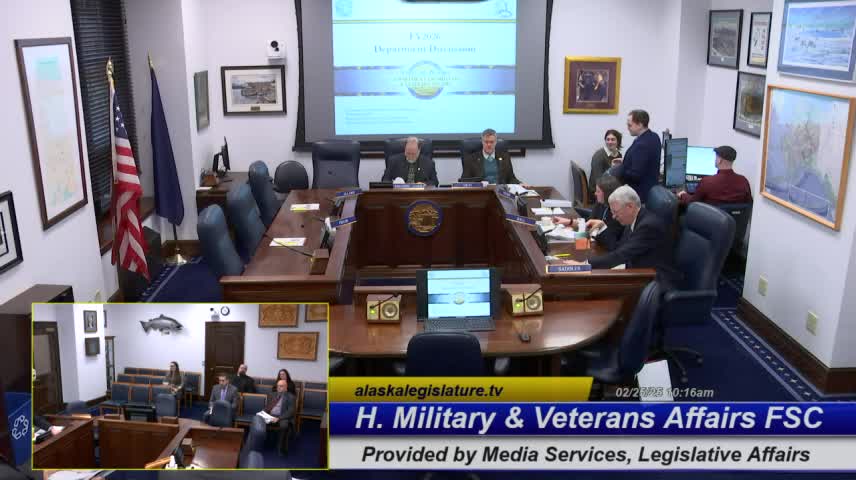
Representative Eisheid, acting chair of the House Finance Subcommittee for the Department of Military and Veterans Affairs, opened a Feb. 25, 2025, meeting at the State Capitol to continue a brief review of the department’s FY2026 governor’s budget request and invited department officials to answer follow-up questions.
The Department of Military and Veterans Affairs presented three principal budget requests for FY2026: (1) expansion of operations for the Alaska organized militia to support outreach, training and response capabilities; (2) programmatic adjustments in Homeland Security and Emergency Management reflecting movement of federal grant activity into capital accounts; and (3) authority for $200,000 in interagency receipts to fund state active duty assignments for the National Guard’s counterdrug mission when other state agencies request support.
The department’s administrative services director, Bob Earnesty, told the subcommittee, “We’d like to consider ourselves small but mighty,” while summarizing that the department’s share of the governor’s unrestricted general fund (UGF) is roughly 0.4 percent. Earnesty outlined budget-line shifts that include an $800,000 decrease in federal receipt authority, a $500,000 increase in interagency receipts and a $300,000 increase in capital interagency receipts tied to grant programs moving into capital budgets.
Deputy Commissioner Craig Christensen explained the organized militia request is intended to enable “additional state active duty payments, recruitment efforts, training, travel, supplies, and other associated costs.” Members asked about prior appropriations and operational examples. Earnesty said no additional funding had been appropriated for the organized militia in the prior year, and that in FY2023 the department received about $400,000, the majority from general funds.
Representative Gray pressed for examples of responses that would not rise to a state disaster declaration; Deputy Commissioner Christensen said such missions could include localized flood response—sandbagging, debris removal—and other assistance that would use state active duty authority without a formal disaster declaration. On the counterdrug request, Christensen said the National Guard’s counterdrug program “is totally federally funded” in its baseline structure, and that roughly 18 soldiers and airmen are assigned to that mission. He said the $200,000 interagency-receipt authority would allow the adjutant general to place members on state active duty to assist other Alaska state agencies when those agencies request support.
Committee members did not take formal votes during the session. Representative Eisheid thanked the presenters and adjourned the meeting after roughly 10 minutes of department questioning and answers.
Why it matters: The requests would expand the state’s ability to activate National Guard members on state active duty for non-declared incidents and to respond to other agencies’ needs, while budget shifts reflect how federal grants for emergency management have been moved into capital accounts. Any appropriation or change in authority would require action later in the Legislature’s budget process.