Get Full Government Meeting Transcripts, Videos, & Alerts Forever!
Get email alerts on the Insurance Fund topic
No spam. Unsubscribe anytime.
DAS warns state insurance fund balance shrinking; actuaries see $10M monthly run rate
Summary
Department of Administrative Services risk managers told the Ways and Means Subcommittee that the state's insurance fund has declined in recent years, that actuarial estimates and large litigation have driven liabilities up, and that the governor's proposed assessment would increase agency charges to begin rebuilding reserves.
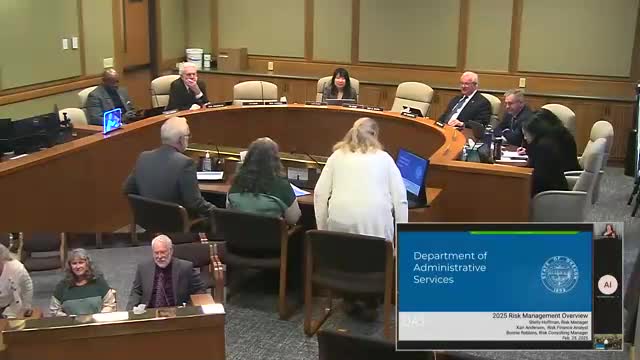
The Joint Committee on Ways and Means Subcommittee on General Government heard Feb. 25 from the Department of Administrative Services’ risk management team that the state insurance fund’s balance has declined, driven by a run of large liability claims and rising defense and medical costs.
Shelley Hoffman, risk program manager at the Department of Administrative Services, introduced the department’s overview of self-insurance and commercial insurance layers that cover property, liability and workers’ compensation for state agencies. Carl Anderson, DAS finance analyst, told the committee the fund had about $90 million in assets at the start of the year and that DAS is currently running a net outflow of roughly $10 million per month on normal operations.
“That run rate downward is about $10,000,000 per month,” Anderson said, describing ongoing monthly payments for defense costs, settlements and premiums. Anderson and other DAS staff attributed the fund’s deterioration to a combination of insufficient income from agency assessments and several very large claims dating from roughly 2014–2020 that together have driven substantial liabilities.
DAS said the governor’s request for the next biennium would increase the assessment to agencies by about $303 million—roughly $120 million higher than the assessment applied for the 2023–25 biennium—intended to begin rebuilding reserves. Representative Pam Reschke (committee member) noted an amendment she attached to a bill would instead request a one-time $120 million general-fund infusion to the insurance fund; she said that, if the bill proceeds, the subcommittee would review whether that approach is appropriate.
Committee members asked why liability costs are increasing. DAS staff listed multiple factors: more complex and costly litigation requiring outside counsel, annual increases in tort caps under the Oregon Tort Claims Act, a rising share of federal civil-rights claims (which are uncapped), increasing workers’ compensation medical costs and the effect of presumptive PTSD laws on public-safety employees’ claims. Bonnie Robbins, risk consulting unit manager, said DAS is engaging directly with high-exposure agencies—including the Department of Corrections, Oregon State Police, Department of Transportation, Department of Human Services and the Oregon Health Authority—to identify mitigation measures and return-to-work or safety strategies.
Anderson summarized the actuarial view: assets vs. liabilities have diverged in recent biennia and actuarial estimates—based on a large historical claims database—project higher future liabilities unless income or claim trends change. He and Hoffman said DAS purchases commercial excess property coverage (a layered program that provides coverage up to $425 million) and works with an international broker (Willis Towers Watson) and multiple carriers to place coverage; DAS also uses SAFE Corporation for statutorily required workers’ compensation purchasing.
DAS staff said the commercial property program insures nearly $11 billion in building and contents values; the department currently self-insures $1.5 million per loss for most property claims (and $4 million for earthquake and flood) before the commercial layers attach. Anderson noted a handful of very large cases have uniquely driven recent losses: four long-running cases spanning 2014–2020 account for approximately $120 million in losses, and one case against the Oregon Health Authority has one remaining $4 million payment scheduled in September.
DAS outlined mitigation steps including targeted consulting to large-exposure agencies, claims-management efforts, seeking better pricing in the commercial market and internal steps to manage frequency and severity of claims. The department said recovery will take time and will depend on the governor’s proposed assessment, claims experience and any legislative action to provide additional one-time funding. The committee took no formal votes during the hearing.