Get Full Government Meeting Transcripts, Videos, & Alerts Forever!
Get email alerts on the Victim Services topic
No spam. Unsubscribe anytime.
Alaska DPS outlines new Integrated Victim Assistance Division, seeks DNA lab funding in FY26
Summary
Department of Public Safety officials briefed the House Finance Subcommittee on a new Integrated Victim Assistance Division created last year, described funding pressures on victim services and grants, introduced a victim navigator program, and requested FY26 increments for DNA testing equipment and reagents at the state crime lab.
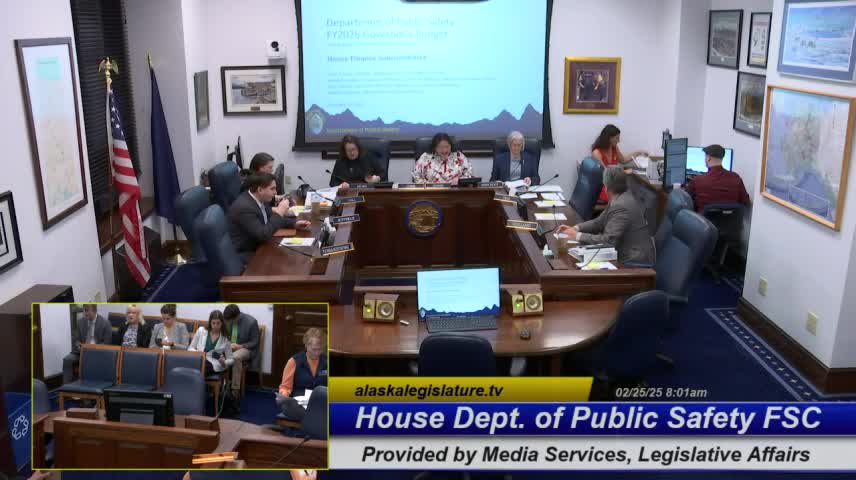
The Department of Public Safety told the House Finance Subcommittee on Feb. 5, 2025, that it has consolidated victim services into a new Integrated Victim Assistance Division and is seeking targeted FY26 funding for DNA testing equipment and reagents.
Department administrative services director Diana Thornton told the committee the division combines the Council on Domestic Violence and Sexual Assault, the Violent Crimes Compensation Board, the state crime lab and other units to “strengthen our victim services, enhancing the rights of victims' rights, and improving access to survivors of crimes and their loved ones.”
The change matters because state officials told lawmakers federal grant funding is unstable, inflation is increasing service costs, and Alaska’s dispersed, high-cost service environment makes maintaining current services difficult without new or reallocated funds. Department and council officials asked lawmakers to consider the FY26 increments for the crime lab and to note continuing pressure on grants that fund shelters, crisis response and prevention.
Susie Frenzel, director of the Integrated Victim Assistance Division, described a new victim navigator program embedded with state troopers. “We currently have 7 navigators and 1 program coordinator,” Frenzel said. She told the committee that in the last six months the navigators have assisted in 96 cases and made 53 victim-witness contacts. Frenzel said the navigators “do help assist victims and witnesses through the criminal justice process during the investigation stage.”
Marybeth Gagnon, executive director of the Council on Domestic Violence and Sexual Assault (CDVSA), summarized the council’s operations and grant portfolio. CDVSA staffs 11 full-time employees, funds 35 agencies through 77 subawards, and distributed about $22 million in grants in FY24. Gagnon said roughly 84% of that grant funding goes to victim services, 7% to prevention, and 2% to perpetrator rehabilitation programs.
Gagnon and other department witnesses told the committee that federal formula grants that fund shelters and crisis services — including the Victims of Crime Act (VOCA) and the Family Violence Prevention Services Act — fluctuate and do not account for Alaska’s higher service costs. The council has also used temporary federal relief grants, including some American Rescue Plan Act funds and an earmark described as a burn grant from U.S. Sen. Lisa Murkowski, that expire after FY26.
Victoria Shanklin, executive director of the Violent Crimes Compensation Board (VCCB), said the board processes roughly 1,000 compensation applications a year and has substantially reduced application-processing times by changing policies and procedures. Shanklin said the average paid award is about $2,600 and that the statutory maximum award is $40,000, though reaching the maximum is rare. She told the committee VCCB is 100% funded by fines, fees and restitution from convicted offenders and that funding levels can vary with annual allocations tied to the Permanent Fund Dividend and the restorative justice account.
David Canaris, chief of the state crime lab, told lawmakers the lab currently has 49 authorized positions, of which “all but six are currently filled.” He described lab quality controls and said calendar-year 2024 average turnaround for sexual-assault kit (rape kit) DNA testing was 133 days; the lab’s goal is to reduce average turnaround to about 90 days. Thornton told the committee the governor’s FY26 budget includes two increments for the crime lab: $347,000 for DNA testing equipment and about $124,000 for DNA reagent, which the department said is no longer eligible for prior federal funding.
Committee members asked repeatedly for more data on trends and geographic distribution of domestic violence and sexual assault. Multiple representatives requested follow-up with the division’s data; Diana Thornton and Marybeth Gagnon agreed to provide additional statistics and reporting to the committee after the hearing.
The committee heard that challenges include decreases and instability in federal grants, recruitment and retention of staff at CDVSA, higher cost of services, and the expected expiration of relief-funded projects at the end of FY26. Officials described ongoing work on a statewide needs assessment with tribal coalitions and the Alaska Network on Domestic Violence and Sexual Assault to better track where tribal and federal set-aside funds are being used.
No formal votes were taken during the presentation; staff committed to follow up with requested data and staffing counts for certain line items after the meeting. Chair Jimmy adjourned the hearing at 9:03 a.m.