Get Full Government Meeting Transcripts, Videos, & Alerts Forever!
Get email alerts on the Statewide Transportation Improvement Program topic
No spam. Unsubscribe anytime.
DOT opens STIP Amendment 2 for public comment, warns federal reviews and inflation are slowing delivery
Summary
The Alaska Department of Transportation and Public Facilities (DOT&PF) released Amendment 2 to its Statewide Transportation Improvement Program for public comment through March 20 and told the Senate Finance Committee that federal reviews, program complexities and inflation are complicating project delivery and the summer construction pipeline.
The Alaska Department of Transportation and Public Facilities on Feb. 25 released Amendment 2 to its Statewide Transportation Improvement Program, opening the document for public comment through March 20 and saying the update includes fund‑type eligibility changes, cost and year adjustments and improved online comparison tools.
The update matters because the STIP programs roughly $6.9 billion over four years and governs which federally funded projects the state can obligate; DOT told the Senate Finance Committee that federal reviews, advance‑construction balances and higher material and labor costs are constraining how much work the department can put on the ground this summer.
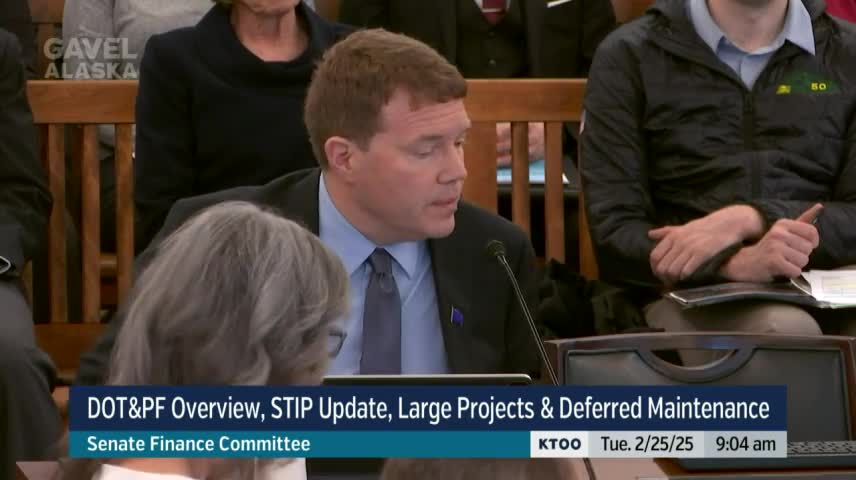
Catherine Keith, deputy commissioner for DOT&PF, told the committee Amendment 2 is posted on an upgraded Esri‑based platform that lets users compare Amendment 1 to Amendment 2 and shows changes to scope and funding with red and green arrows. "This amendment incorporates changes to formatting of our fiscal constraint tables," Keith said, adding that the public comment period runs through March 20.
Commissioner Ryan Anderson briefed senators on the status of prior federal planning findings and said department staff traveled to Washington, D.C., to meet with Federal Highway Administration and Federal Transit Administration officials to resolve outstanding items. Anderson said those meetings produced at least one direct outcome: a project the FHWA had rejected was approved after the issue was elevated to headquarters.
DOT officials told the committee staff resources for the STIP are now distributed across multiple divisions—fiscal management, project delivery and a data/modernization office—rather than being owned by a single staffer, and that broader federal requirements have increased the document's scope and complexity.
On delivery, DOT said its routine annual formula funds run about $850 million and Federal Transit Administration formula funds about $85 million; the STIP totals about $6.9 billion, including roughly $3.6 billion for construction and about $396 million for preconstruction activities. The department programs discretionary grants as well; Deputy Commissioner Keith said approximately $1.05 billion in discretionary grants is reflected in the four‑year program.
Advanced construction (AC) obligations—where the state effectively uses future years' authorization to start work now—are an active part of DOT's toolbox. Anderson said the state's AC balance in work is approximately $400 million today, down from a prior peak in the $550–600 million range. "We could put more work on the street by increasing our AC balance over what is currently programmed," Anderson said, and noted the department has been working to manage that balance.
Committee members pressed DOT for a confidence estimate on the agency's tentative advertising schedule. DOT said about $15 million was currently advertised, more than $120 million of projects are bid and pending award, and that staff estimate over $200 million of work could be advertised between now and May if approvals and procurement proceed as planned. Officials said they will provide a more detailed, project‑level confidence ranking to the committee.
DOT also highlighted programmatic items it does not expect to resolve in this amendment—such as how the department programs parent/child projects across multiple years—and said those will be addressed in the rolling 2025–2028 STIP.
How this could affect Alaskans: senators repeatedly emphasized the need to get work on the street before the 2025 construction season. Contractors and municipal partners, DOT said, have urged the agency to prioritize simpler paving and preventative maintenance projects that can be delivered quickly. Federal review timelines, fund‑type limitations and supply‑chain constraints—especially for rural projects—remain bottlenecks.
DOT invited legislators and the public to review the STIP amendment online and submit comments during the public comment window. The department also agreed to provide the committee with a project‑by‑project confidence ranking and more detailed advertising schedule information.
Ending: The committee offered to work with DOT on solutions that could accelerate project delivery and asked the department to follow up with the requested confidence ranking and clarifications about outstanding federal findings.