Get Full Government Meeting Transcripts, Videos, & Alerts Forever!
Get email alerts on the Public Defense topic
No spam. Unsubscribe anytime.
Oregon courts warn unrepresented-defendant surge is slowing criminal case processing
Summary
State court officials told the Public Safety Subcommittee that rising criminal filings and a growing number of defendants without counsel have reduced clearance rates and delayed case dispositions, stressing judges, staff and victims.
State court leaders told the Oregon Legislative Public Safety Subcommittee on Feb. 25 that a surge in criminal filings and a sustained public‑defense shortage have driven down clearance rates and lengthened time to disposition across case types.
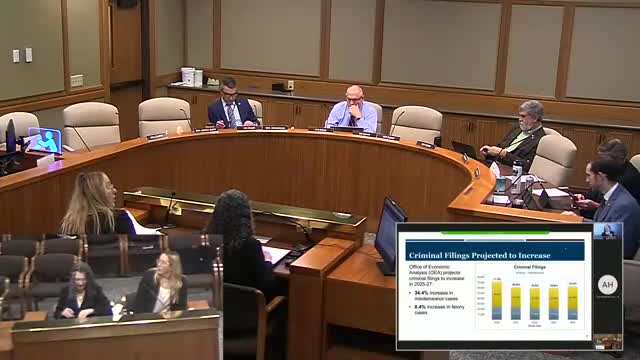
Nancy Kozine, State Court Administrator, and Chief Justice Megan Flynn said the Office of Economic Analysis projects a 34.4% increase in misdemeanor filings and an 8.4% increase in felony filings in the coming biennium, and that new criminal statutes will add workload to the system. "House Bill 4,002 adds a substantial workload to the Judicial System," Kozine said, referring to 2024 changes that recriminalized possession of controlled substances and added conditional discharge and record‑redaction duties.
The department reported that clearance rates slipped in 2024: felony clearance remained about 97% but misdemeanor clearance fell to roughly 90% against a 98% goal. Time‑to‑disposition targets likewise missed their marks: the goal of resolving 98% of felony cases within 365 days is currently at about 85%; the 98% goal for misdemeanors within 180 days is at about 79%.
Kozine and Flynn said those shortfalls are driven in part by the "unrepresented crisis," where defendants wait longer for appointment of counsel and courts spend significant staff time managing backlog. Flynn noted that court staff must track unrepresented cases and prioritize appointment forms, and that delays have human impacts: "Defendants are in pretrial release status for a longer period of time which impacts their ability to travel and can impact their ability to get a job and move forward with their lives. Victims are in a holding pattern." (Megan Flynn, Chief Justice of the Oregon Supreme Court).
Court staff maintain an "unrepresented dashboard" to track cases and work with jails, the Office of Public Defense (OPDC) and other partners. The department said as of Feb. 1 the unrepresented count was "a little over 4,800 cases," a month‑over‑month increase of about 4.5%, and that the January monthly rise had been roughly 11%.
On appointment of counsel, the department described the statutory application/contribution program administered with OPDC. Staff verify applications using a release of information, and judges can impose application fees or post‑case contributions. The department said about 97% of submitted applications that are processed are granted and roughly 3% are denied; statewide verification of applications occurs in about 40% of cases (Washington County reported near‑universal verification at 99%).
Legislators and court officials discussed multiple responses: improving online application access (including trials of jail iPad use), jurisdiction‑level crisis plans following Senate Bill 337 stakeholder work, and local innovations to speed caseflow. Representative Chotzin and others pressed for data showing how much the unrepresented status alone affects KPMs; Kozine said the effect is twofold and not fully separable from staff time diverted to managing the crisis.
Ending
Court leaders asked the subcommittee to consider the workload implications for HB 5012, the Judicial Department budget, and to support investments that would reduce delays tied to the unrepresented caseload and related staffing and technology needs.