Get Full Government Meeting Transcripts, Videos, & Alerts Forever!
Get email alerts on the State Highway Fund topic
No spam. Unsubscribe anytime.
ODOT says $1 billion federal‑revenue overestimate; outlines cuts, STIP changes and reforms
Summary
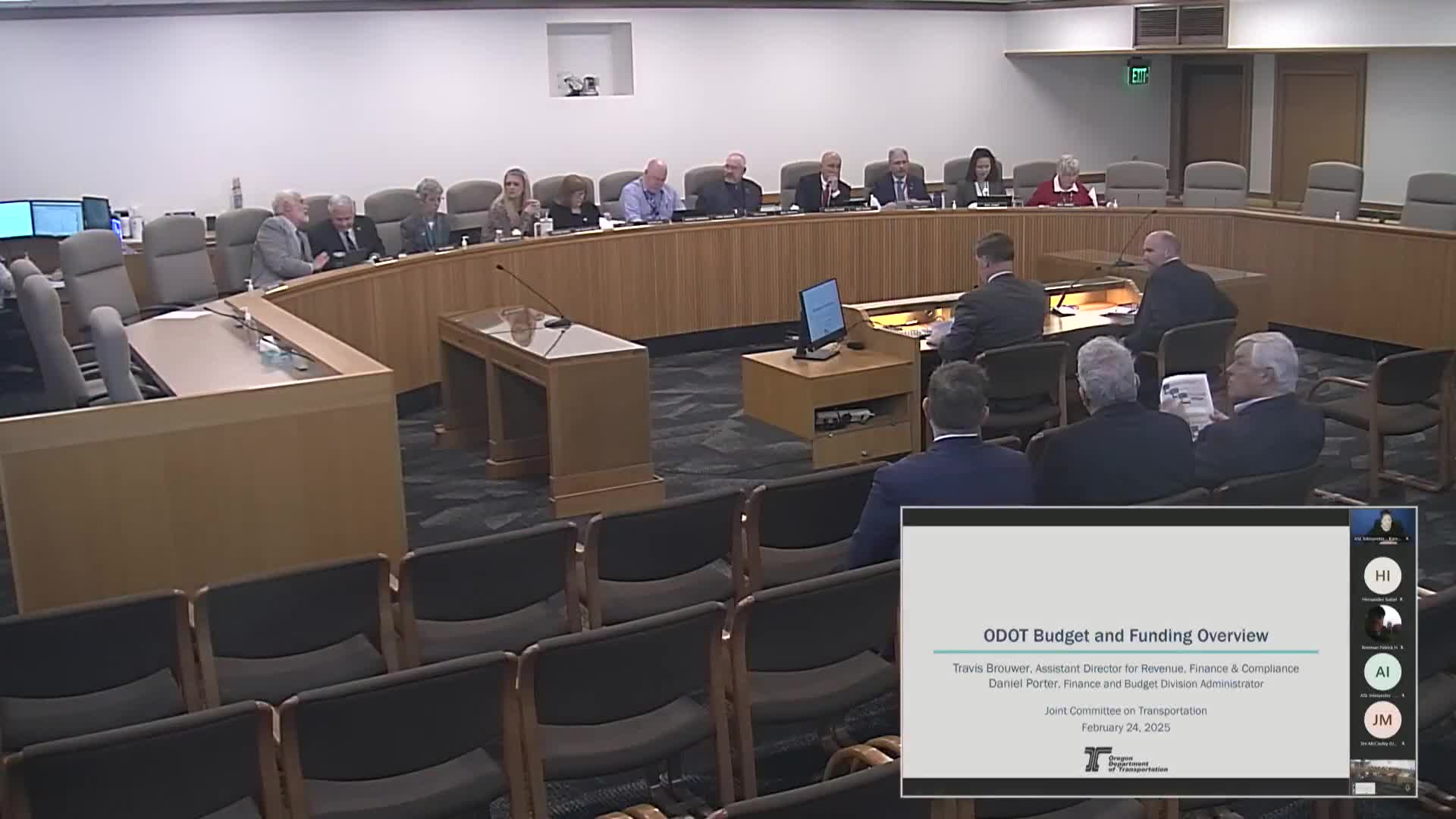
The Oregon Department of Transportation told the Joint Committee on Transportation on Feb. 24 that it discovered an overestimate of roughly $1 billion in federal reimbursements reflected in project delivery and local government budgets for the 2023–25 biennium.
The Oregon Department of Transportation told the Joint Committee on Transportation on Feb. 24 that it discovered an overestimate of roughly $1 billion in federal reimbursements reflected in project delivery and local government budgets for the 2023–25 biennium.
Travis Brower, ODOT Assistant Director for Revenue, Finance and Compliance, described the error as a product of how the department’s long‑used cash‑flow model translated a heavily front‑loaded Statewide Transportation Improvement Program (STIP) and projects using the federal advanced‑construction tool into near‑term federal‑reimbursement assumptions. “I think the most important conversation tonight is really about the budget error that we discovered and the agency's work to address this,” Brower told the committee.
Daniel Porter, ODOT’s Finance and Budget Division Administrator, framed the underlying technical issue: ODOT programs some projects using advanced construction — a federal tool that lets the agency put projects into construction before annual federal allocations are available and later convert costs to be federally reimbursed. The department’s cash‑flow model converted many of those advanced‑construction items into immediate federal reimbursements for the 2023–25 budget rather than projecting those reimbursements to later biennia. Daniel Porter summarized the broader funding picture: “This is a very complicated picture of how the transportation funding packages, have come together, over the last 25 years.”
How the error arose and steps taken
ODOT said the overestimate became apparent late in 2023 and was analyzed across divisions over several months. Because the STIP for 2024–27 was front‑loaded with a concentration of projects in the first two years, the cash‑flow model yielded unusually high projected federal reimbursements in 2023–25. That mistake, compounded by the model’s handling of projects designated as advanced construction (including some HB 2017‑funded projects that might later convert to federal funding), drove the $1 billion discrepancy, ODOT said.
The department and the Oregon Transportation Commission (OTC) responded by rebalancing the STIP in May 2024 to push some work into later years and by imposing internal spending limits. ODOT has also stopped relying on the cash‑flow model for preparing the 2025–27 budget and instead used historic, actual federal revenues for near‑term budgeting; it is tracking HB 2017 funds in separate accounts and plans to hire a capital investment manager to coordinate project selection and delivery across programs.
Budget impacts and service‑level reductions
ODOT officials said the agency has cut operations and maintenance to stay within the State Highway Fund. Since 2019 the agency has taken progressively larger reductions; for the 2023–25 biennium the net impact was roughly $171 million after the legislature provided a $39 million general‑fund backfill. The department reported roughly $29 million in net reductions specifically to maintenance in 2023–25 (a reduction it described as about 5 percent for maintenance) and about a 14 percent reduction in shared services such as IT and finance.
Travis Brower testified that the cuts have translated into vacant positions and reduced field work: about 119 permanent maintenance positions and roughly 40 seasonal positions were vacant, he said, and ODOT has reduced chip‑seal work, deferred fleet replacements, curtailed litter and camp cleanup (except in Portland metro where additional funds were provided), and reduced some transfers to state parks that had served as rest‑area partners.
The DMV and staffing pressures
ODOT said DMV experienced a smaller proportional cut but is operating with many vacancies, causing planned and unplanned field office closures and longer customer wait times. Officials said starting wages for some DMV field positions had lagged local private‑sector pay and that the recent collective bargaining agreement (COLA and step increases) added substantially to the agency’s cost base. Committee members asked for follow‑up data on turnover, comparative wages and how much of the biennial cost increase was attributable to collective bargaining.
Debt service, bonding and longer‑term context
Porter and Brower reviewed how multiple state transportation funding packages (OTA 1–3, JTA, HB 2017) layered dedicated revenue and bonding commitments over base fuels tax revenues. Brower and Porter told the committee that ODOT’s debt service is a substantial share of the agency budget (officials estimated roughly in the 20 percent range) and that maturities for older bond series create periods where debt service falls in the 2030s, opening capacity for future bonding if market conditions are favorable. ODOT said it will pursue refinancing opportunities when market conditions warrant.
Accountability and audit
Director Chris Strickler and OTC members discussed accountability steps. ODOT empaneled a strategic review panel in spring 2024; the department’s internal audit services group delivered an audit to the Oregon Transportation Commission in January 2025. Commission member Lee Beyer and Commissioner Jeff Baker said the commission is treating accountability and institutional reform as ongoing priorities. Baker summarized the commission’s view: the causes include process gaps, aging technology and personnel capacity; the commission said it will hold the department to the audit’s recommendations and track improvements.
Federal funding outlook
ODOT officials told the committee they do not currently expect an immediate interruption to federal formula reimbursements tied to ongoing federal programs but cautioned about the Infrastructure Investment and Jobs Act (IIJA, federal transportation reauthorization) sunset. Officials said the IIJA reauthorization poses a material risk if Congress does not act, because the Federal Highway Trust Fund faces a projected shortfall at the national level in coming years.
Follow‑up, transparency and next steps
Committee members asked for a list of projects delayed or reprioritized in the STIP, reporting of outstanding principal and interest on state transportation bonds, a retrospective HCaTS analysis based on actual expenditures rather than forward projections, and details on property disposition revenue and the sale of surplus ODOT land. ODOT agreed to provide follow‑up materials and quarterly reports to the OTC and the legislature.
What the department asked the committee to note: ODOT officials emphasized that while the model error was serious, current expenditure trends are running below the erroneous budget baseline; ODOT projected it would remain within State Highway Fund limits and avoid a cash shortfall for the biennium with the STIP changes and spending controls in place.