Get Full Government Meeting Transcripts, Videos, & Alerts Forever!
Get email alerts on the Domestic Violence Law topic
No spam. Unsubscribe anytime.
Bill aims to stop merger of strangulation and related offenses in domestic-violence cases after appeals ruling
Summary
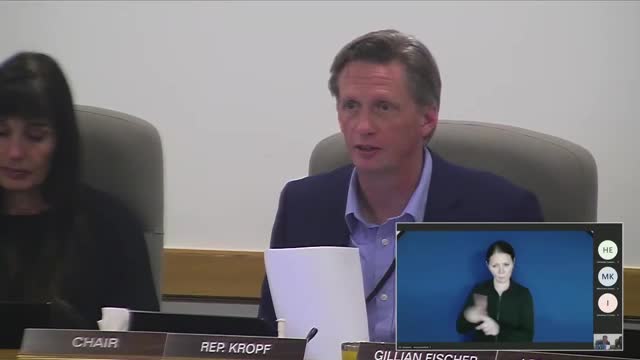
The House Judiciary Committee heard testimony on House Bill 2975, a measure to clarify that the domestic-violence designation is a classification, not an element that causes separate assault or strangulation charges to merge for sentencing.
The House Judiciary Committee heard testimony on House Bill 2975, a measure to reverse recent appellate court guidance that prosecutors said forces courts to merge separate offenses in domestic-violence incidents.
Representative Vanessa Hartman, sponsor, said the bill is intended to ensure "the distinct harms of strangulation and fourth degree assault in domestic violence cases are recognized and punished appropriately." Hartman cited a Court of Appeals decision in State v. Miles (2024) and said that decision led courts to treat the domestic-violence designation as subsuming separately charged misdemeanors and felonies when they occur against the same victim in the same incident.
Jeffrey Nitschke, a deputy district attorney in Clackamas County, testified for the Oregon District Attorneys Association and said the Miles ruling has had an immediate and harmful effect on survivors' ability to have separate harms recognized in charging and sentencing: "It helps things like informing release decisions for judges. It helps in obtaining restraining orders and FAPA orders. It helps in making sure that there are appropriate accountable, sentences and enhancements if there is repeat domestic violence offenses." He said many domestic-violence incidents commonly include multiple offenses such as strangulation, menacing and assault.
Maylee Browning of the Oregon Criminal Defense Lawyers Association thanked the chair for convening a stakeholder work group and said parties were working to refine narrow language; she warned that the draft as written may raise issues about lesser-included offenses and asked for careful technical review.
Committee members questioned how courts would determine which offense subsumes others; prosecutors said Miles created uncertainty that can lead to inconsistent outcomes depending on whether the victim relationship is domestic. The committee closed the public hearing without voting and directed stakeholders to continue technical negotiations aimed at restoring the pre-Miles practice while avoiding unintended consequences.
No formal committee action was taken at the hearing.