Get Full Government Meeting Transcripts, Videos, & Alerts Forever!
Get email alerts on the Housing And Homelessness topic
No spam. Unsubscribe anytime.
State officials, governor outline sustainable shelter program in House Bill 3644; committee opens public hearing and introduces separate committee bill
Summary
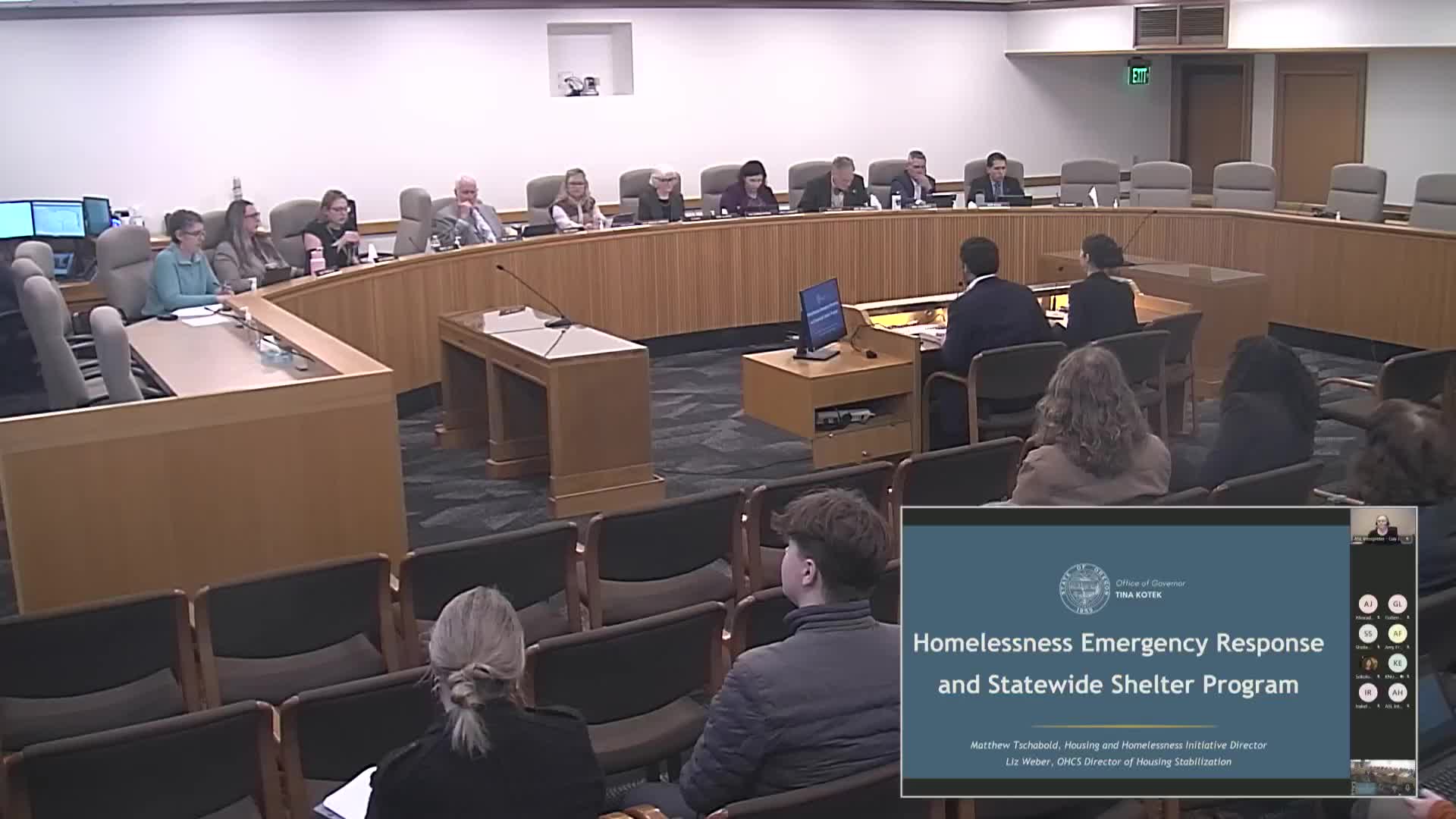
Governor Tina Kotek and Oregon Housing and Community Services staff told the House Committee on Housing and Homelessness on Feb. 24 that House Bill 3644 would create an outcomes‑based, regionalized statewide shelter program and requested funding to sustain existing shelter operations.
State officials and the governor told the House Committee on Housing and Homelessness on Feb. 24 that House Bill 3644 would create an outcomes‑based, regionalized statewide shelter program to maintain and align emergency shelter capacity, rehousing services and prevention efforts.
Governor Tina Kotek and officials from Oregon Housing and Community Services (OHCS) said the bill grows out of an emergency response established after rising unsheltered homelessness. “Shelter is not the goal. Rehousing is the goal,” the governor said, describing the bill as a way to systematize recent, largely one‑time investments and set consistent expectations, reporting and regional planning requirements.
OHCS officials Matthew Schawbold of the governor’s office and Liz Weber, director of the Housing Stabilization Division at Oregon Housing and Community Services, described the executive‑order work that scaled temporary shelter capacity, street outreach and rehousing funds. They said the governor’s budget seeks approximately $217.9 million to maintain existing shelter operations funded with one‑time dollars in the current biennium; that figure is part of a larger approximately $700 million package the governor proposed for shelter services, rehousing and prevention.
Schawbold and Weber summarized outcomes tied to the emergency response: they said the state will fund more than 4,800 shelter beds, rehouse over 3,300 Oregonians and prevent roughly 24,000 households from entering homelessness by the end of the biennium if the recommended budget is approved. These figures were presented as program targets and projected outcomes for the governor’s budget.
The sustainable shelter work group — a multi‑stakeholder group convened by the governor and the committee — recommended a regional approach that allows communities to self‑identify planning geographies and a regional coordination entity. Subgroups focused on “how we fund,” “what we fund,” and “data and technical assistance.” The work group emphasized flexibility for local needs, equity, accountability for outcomes, and two‑year regional plans with annual reporting.
Work group members who testified included Tammy Baney (Central Oregon), Jimmy Jones (Mid‑Willamette Valley Community Action Agency), Cindy Timmons (Umatilla County commissioner) and Rick Russell (Redmond pastor and vehicular shelter operator). Testimony from regions emphasized that models differ: rural areas need transportation and capital flexibility; some communities rely heavily on vehicular sheltering or safe parking programs; others scaled motel or navigation‑center approaches.
Several committee members asked technical questions. Officials said data sources include the federal point‑in‑time count and state tracking of outcomes tied to the executive orders; OHCS said it intends to set administrative rules and funding agreements to implement the statutory framework. OHCS also signaled an upcoming amendment to clarify eligible shelter types so the statute does not unintentionally limit funding to only 24/7 facilities.
The committee opened and then adjourned the public hearing on House Bill 3644 with plans to reopen it Wednesday for additional testimony. At the end of the day the committee introduced a separate committee measure, LC 4199 (a construction‑defects bill affecting planned communities and condominiums). Representative Iverson moved to introduce LC 4199; the committee recorded a roll call and the motion passed (10 yes, 0 no, 1 excused). The roll‑call votes are listed below.
Ending: HB 3644 sets a statutory framework for a statewide, outcomes‑oriented shelter program centered on regional planning, accountability and alignment with rehousing and prevention services; lawmakers will continue public testimony and technical review as they consider the governor’s budget request.