Get Full Government Meeting Transcripts, Videos, & Alerts Forever!
Get email alerts on the Education topic
No spam. Unsubscribe anytime.
Subcommittee hears presentation on House Bill 5018, funding for Board of Licensed Social Workers
Summary
The Education Subcommittee of the Joint Ways and Means Committee opened a public hearing Feb. 24 on House Bill 5018, the budget request for the Oregon Board of Licensed Social Workers.
The Education Subcommittee of the Joint Ways and Means Committee opened a public hearing Feb. 24 on House Bill 5018, the budget request for the Oregon Board of Licensed Social Workers. Agency representatives described a governor-recommended one-time general fund investment of $625,000 to begin replacing an outdated licensing system and asked to extend a limited-duration office specialist position while proposing a 20% fee increase for the 2025–27 biennium.
“ The governor's budget for the Oregon Board of Licensed Social Workers supports their current service level and addresses the emerging issues by extending a limited duration office specialist and providing funding to begin a licensing system replacement project,” said Hari Belopandian of the Department of Administrative Services Chief Financial Office during the agency budget presentation.
The board’s executive director, Ray Miller, told the subcommittee the board’s mission “is to protect the citizens of Oregon through licensing and regulation of social workers.” Miller described staffing and workload: the board has nine positions totaling about 8.5 full-time equivalent employees and serves roughly 9,000 licensees. He said the board requests a one-time $625,000 general-fund allocation to procure a new licensing platform and expects to cover ongoing licensing-system costs from other funds (licensing fees) once the system is implemented.
Miller and licensing manager Kimberly Coleman described operational impacts they attribute to recent process changes and the limited-duration office specialist hired after the 2024 legislative session. The presenters said complaint-resolution metrics and application-processing times improved after staffing and process changes: the share of public complaints resolved within six months rose from about 15% in 2023 to about 34% in 2024, and monthly average application-processing times declined after the June 2024 hire that added application-processing capacity.
The presenters described the current licensing platform (Thentia) as lacking data-capture features needed to report key performance measures and said a new system would enable timely reporting of customer-service metrics. The board anticipates the new system could be implemented by January 2026 and indicated it will coordinate with the state’s mental health regulatory agency to share some initial costs.
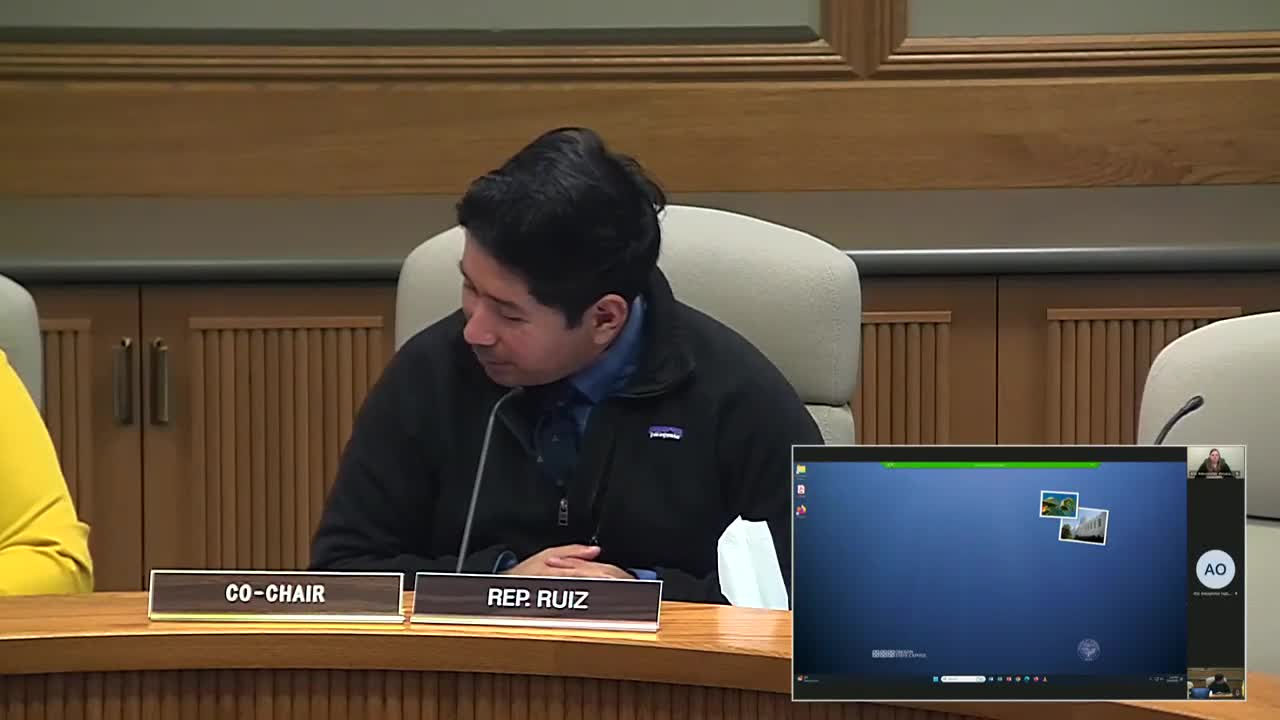
Committee members questioned data availability, fee impacts and program permanence. Co-chair Senator Sollman and Co-chair Representative Ruiz led the hearing; Representatives McLean and Wright and Senator Weber pressed for more up-to-date customer-service and complaint-category data. Miller said the board can provide additional metrics from internal reference documents and that most ongoing costs would be expected to be supported by licensing fees. The board proposed a 20% fee increase in 2025–27 and said the last fee increase occurred in 2017. Miller said the limited-duration position authorized in 2024 materially improved performance and that the board is seeking to extend—not make permanent—that position for the 2025–27 biennium.
The subcommittee did not take a vote during the hearing. After questions, the co-chairs closed the public hearing on HB 5018. The board representatives said they would follow up with additional performance metrics and with details about procurement and timelines for the licensing replacement project.
Looking ahead, the subcommittee noted the planned schedule: the committee will consider additional education agencies in subsequent hearings, including the Teacher Standards and Practices Commission.