Get Full Government Meeting Transcripts, Videos, & Alerts Forever!
Get email alerts on the Food Safety topic
No spam. Unsubscribe anytime.
Cowlitz County health staff review 2024 inspections, emphasize food-safety basics
Summary
Health and Human Services presented 2024 program numbers including more than 600 regulated food establishments, 645 inspections in 2024, restored online access to inspection reports and an explanation of common foodborne pathogens and inspection procedures.
COWLITZ COUNTY — County Health and Human Services staff on behalf of the Cowlitz County Board of Health presented a quarterly update that summarized 2024 activity across vital records, environmental health and food establishment inspections.
Gina (Health and Human Services) told the board the department processed more than 8,800 birth and death certificates and issued a total of 645 food establishment inspections in 2024. She said the county currently licenses over 600 food establishments and typically handles 200–300 temporary permits a year.
“Inspection reports are available online,” Gina said, explaining that the county’s inspection database is back online after a prior data-system failure and can be searched by restaurant name.
The nut graf: the presentation underlined why routine inspections and timely reporting matter. Dr. Kroeger, the county health officer, reviewed common foodborne pathogens, their usual incubation times and the challenges public health investigators face linking illnesses to specific meals.
Dr. Kroeger said the illnesses the county tracks are largely gastrointestinal and often require detective work to connect cases. “Most of these — weare going to talk about — are gastrointestinal symptoms, right? So vomiting, diarrhea, sometimes fever,” he said, noting some pathogens (for example, E. coli O157:H7) can cause severe outcomes in vulnerable groups.
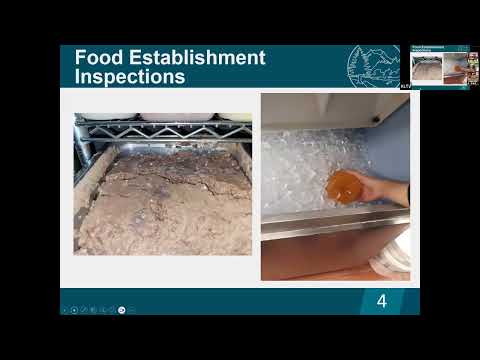
What the staff reported and why it matters - Inspection frequency and staffing: Inspectors visit food establishments between one and four times per year depending on risk and inspection history; the county uses a point-based system that distinguishes lower-risk “blue” violations from higher-risk “red” violations. Gina said the department was fully staffed with four inspectors at the time of the meeting but had operated with only two for most of 2024, which skewed last year’s inspection counts. - Typical enforcement steps: staff seek immediate correction in the field where possible, schedule follow-up inspections for unresolved issues and convene management-level office conferences if problems persist; closure is rare and treated as a last resort. - Examples from inspections: staff showed noncompliant findings they occasionally encounter, including a deceased rodent in storage, mold growth on prepared food and a bottle stored in an ice machine; they emphasized those are isolated and that most inspected facilities are compliant and clean. - Delivery and complaint response: the department has no direct oversight of what happens to prepared food after it leaves a permitted facility; foodborne-illness investigations are launched after consumer complaints or when laboratory reports identify a notifiable condition. - Shared (group B) water systems and wells: staff described group B systems as shared wells with three to 14 connections; the Department of Ecology oversees well construction, while the county verifies potable water availability and enforces required testing for group B systems. Gina said arsenic is rarely found at concerning levels in the county’s inspected group B systems.
Board members asked about inspector training, and Gina said inspectors complete an intensive training process with state-provided materials, observed inspections and continuing education when the food code changes. The county also provides guidance on rabies investigation protocol: county nurses initially assess exposure reports and the health department can submit animal specimens to the public health lab for testing.
The presentation closed with a practical note: restaurant inspection reports are searchable on the county website so residents can review the most recent inspection results.
Ending: The Board of Health received the quarterly report with no formal action taken on the report itself; members asked follow-up questions about staffing, delivery-related complaints, and water testing requirements. The board moved on to other agenda items after the presentation.