Get Full Government Meeting Transcripts, Videos, & Alerts Forever!
Get email alerts on the School Finance topic
No spam. Unsubscribe anytime.
LBB outlines $89.3 billion TEA recommendation, flags property-tax, enrollment drivers for school funding
Summary
Legislative Budget Board staff presented an $89.3 billion all‑funds recommendation for the Texas Education Agency covering the Foundation School Program and other TEA programs, highlighting district property value growth, student weight changes and contingency funding for property‑tax relief as the largest cost drivers.
The Legislative Budget Board on Wednesday recommended $89.3 billion in all funds for the Texas Education Agency for the 2026–27 biennium, including about $71.8 billion for the Foundation School Program, and outlined major cost drivers that will shape conference committee negotiations.
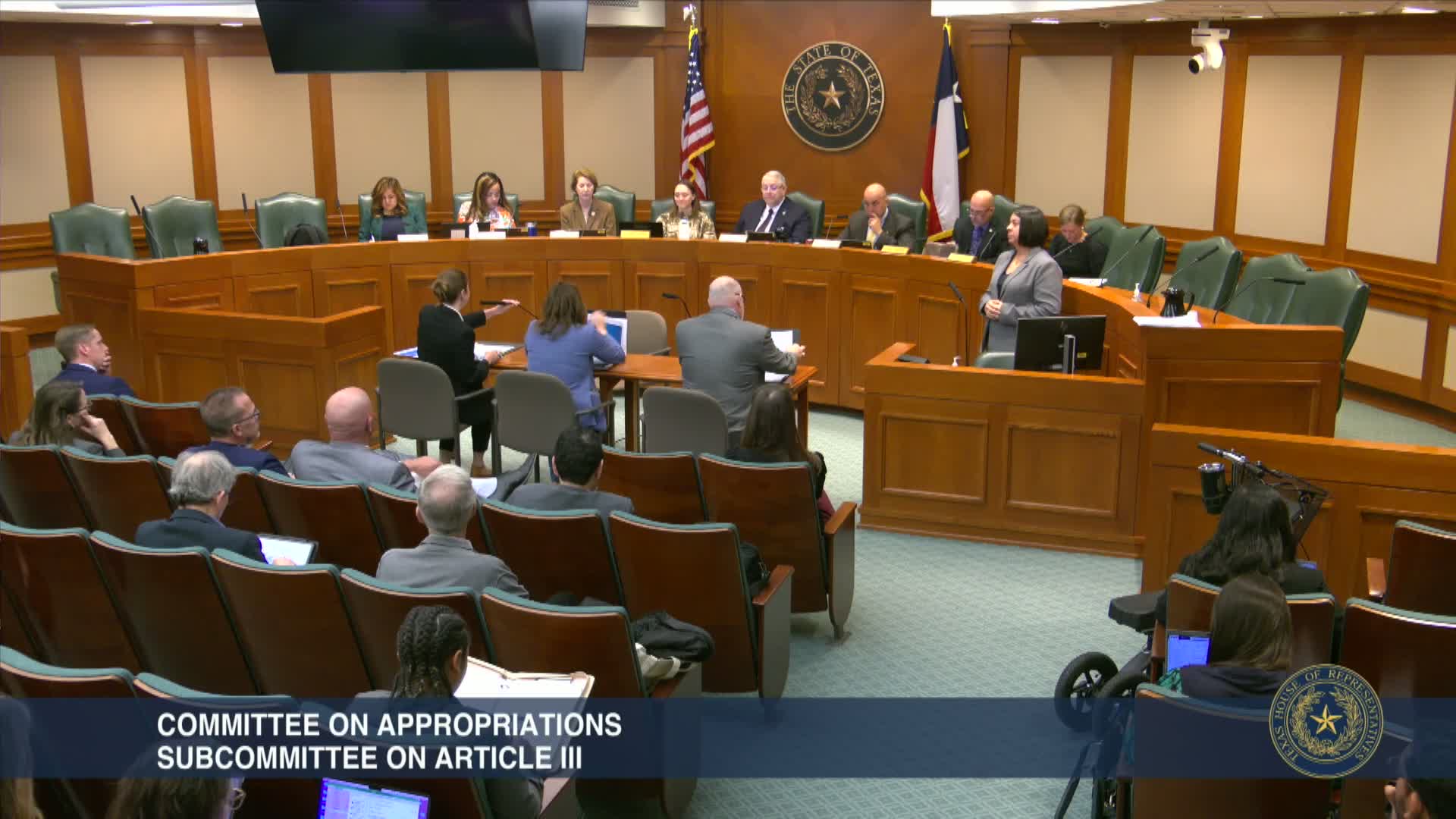
The LBB’s Maggie Yepsen, presenting the agency rollout to the House Appropriations subcommittee on Article III, told members that the recommended GR cost for TEA rises largely because of projected increases in weighted students and changes in district property values, and includes contingency appropriations for property tax relief and program expansion.
Why it matters: TEA’s budget makes up the bulk of state K–12 funding and contains multiple levers—basic allotment, teacher incentive allotment, facilities aid and tax‑compression payments—that affect local school budgets, teachers’ pay and district tax rates. How the Legislature balances direct state aid versus property‑tax relief will determine whether districts net more flexible operating dollars or see pressure to raise local rates.
The LBB recommendation shows an 16.8 percent increase in all‑funds TEA spending from the adjusted 2024–25 base. “Recommendations include $89,300,000,000.0 for all of TEA in all funds,” Yepsen said in the presentation transcript, summarizing the introduced figures.
Major drivers and tradeoffs - Weighted students and special populations: The LBB said projected growth in certain student populations will increase weighted average daily attendance funding demand and the teacher incentive allotment participation. The LBB identified a projected increase tied to weighted student growth as one of the largest new costs. - District property values: Higher projected property values reduce the state’s share of the Foundation School Program under current law, but the LBB emphasized that hospital district tax compression (referred to during the briefing as HP3) will increase state compression costs, creating offsetting pressures on the budget. - Golden‑penny yield: The presentation retains prior‑biennium basic allotment levels but projects increases to the “golden penny” yield (the yield guaranteed for certain tier‑2 pennies) because of district property growth; the LBB quantified modest increases attributable to that mechanic. - Contingencies and transfers: Recommendations include multi‑billion dollar contingency amounts for property tax relief and program priorities (the LBB listed $8.75 billion in contingency funding for a mix of property tax relief, public education funding increases and school safety); the LBB also described a larger GR transfer to the PTRF in the context of state tax relief mechanics.
Program‑level items - Foundation School Program: The LBB broke the FSP into maintenance-and-operations and facilities components and highlighted expected shifts in average daily attendance (ADA) and weighted ADA (WADA), noting slight projected ADA declines but rising WADA in some cohorts. - Teacher Incentive Allotment: The recommendation contains funding increases tied to TEA’s projections of higher district participation; LBB noted $750 million included for TIA increases. - Facilities and hold‑harmless: The LBB recommended $2.5 billion for facilities payments in 2026–27 and identified $3.3 billion for multiple hold‑harmless provisions in the FSP.
Next steps: The comptroller and TEA will supply updated ADA and property‑value projections in March, the LBB said; the committee and conferees will use those updates to finalize conference budgets.
Members pressed LBB and TEA during the hearing about details of charter school guarantees, the interplay between local tax effort and state yield guarantees, and which programmatic changes require new appropriations. TEA Commissioner Mike Morath, who also briefed the subcommittee, said the introduced House bill “fully funds the Foundation School Program under current law” but repeated that implementation details and conference adjustments depend on the March projections that the LBB will incorporate.
Ending: The LBB and TEA told the subcommittee they are available to provide updated revenue and ADA figures in March; the subcommittee will consider those updates as it converts introduced numbers into final Article III recommendations for conference committee work.