Get Full Government Meeting Transcripts, Videos, & Alerts Forever!
Porter County officials review local income tax options to address budget pressures
Summary
County leaders and a Baker Tilly consultant reviewed local income tax categories, caps and likely revenue impacts in a workshop, focusing on options to relieve property-tax pressure and fund public safety, EMS and jail projects amid legislative uncertainty.
Porter County officials and outside consultant Jason Semler of Baker Tilly met in a workshop to review local income tax options available to the county and how each would affect revenue sharing, property-tax relief and county services.
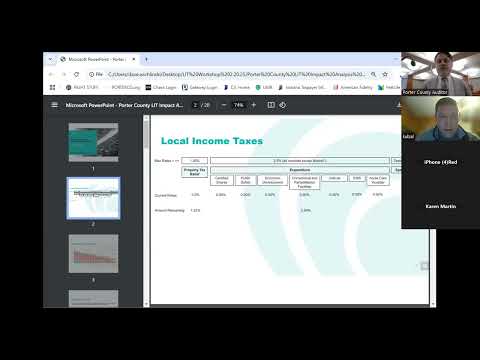
The discussion focused on how Indiana law currently structures local income taxes (LITs), what caps are in place and which LIT buckets would give Porter County direct revenue versus revenue that must be shared with cities and towns. Semler summarized the basic rule: “local income tax … is really a tax on the adjusted gross income for individuals who live in the county.” He said that detail is important because revenue follows residency, not workplace.
Why it matters: Porter County is operating with what officials described as constrained revenues while demand for public-safety and other services is rising. The workshop outlined how different LIT choices would either shift funding away from property taxes (property-tax relief credits) or generate new county-controlled revenue for operations and capital projects (several expenditure-rate buckets). County staff said the information will inform any decision about asking voters or the fiscal body to adopt new LIT rates.
Major options reviewed
- Property-tax relief: A LIT option capped at 1.25% that functions as a credit against property taxes rather than producing net new revenue for local governments. Semler said this option typically shifts the funding source for services from property tax to income tax rather than increasing total dollars available.
- Expenditure-rate buckets (combined cap 2.5%): Semler described the common expenditure-rate categories and noted that counties may adopt any…
Already have an account? Log in
Subscribe to keep reading
Unlock the rest of this article — and every article on Citizen Portal.
- Unlimited articles
- AI-powered breakdowns of topics, speakers, decisions, and budgets
- Instant alerts when your location has a new meeting
- Follow topics and more locations
- 1,000 AI Insights / month, plus AI Chat