Get Full Government Meeting Transcripts, Videos, & Alerts Forever!
Get email alerts on the Local Income Tax topic
No spam. Unsubscribe anytime.
Porter County officials review local income tax options to address budget pressures
Summary
County leaders and a Baker Tilly consultant reviewed local income tax categories, caps and likely revenue impacts in a workshop, focusing on options to relieve property-tax pressure and fund public safety, EMS and jail projects amid legislative uncertainty.
Porter County officials and outside consultant Jason Semler of Baker Tilly met in a workshop to review local income tax options available to the county and how each would affect revenue sharing, property-tax relief and county services.
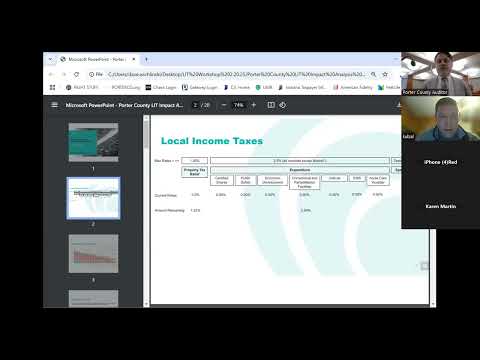
The discussion focused on how Indiana law currently structures local income taxes (LITs), what caps are in place and which LIT buckets would give Porter County direct revenue versus revenue that must be shared with cities and towns. Semler summarized the basic rule: “local income tax … is really a tax on the adjusted gross income for individuals who live in the county.” He said that detail is important because revenue follows residency, not workplace.
Why it matters: Porter County is operating with what officials described as constrained revenues while demand for public-safety and other services is rising. The workshop outlined how different LIT choices would either shift funding away from property taxes (property-tax relief credits) or generate new county-controlled revenue for operations and capital projects (several expenditure-rate buckets). County staff said the information will inform any decision about asking voters or the fiscal body to adopt new LIT rates.
Major options reviewed
- Property-tax relief: A LIT option capped at 1.25% that functions as a credit against property taxes rather than producing net new revenue for local governments. Semler said this option typically shifts the funding source for services from property tax to income tax rather than increasing total dollars available.
- Expenditure-rate buckets (combined cap 2.5%): Semler described the common expenditure-rate categories and noted that counties may adopt any combination of these up to a combined 2.5% cap. Porter County currently has what was described as an economic-development LIT at 0.5%, but because of a county-specific statute that rate is allocated differently: roughly the first 0.25% is distributed among the county and overlapping units, about $3.5 million of the next 0.25% is earmarked for the Regional Development Authority (RDA), and the remainder of that second 0.25% flows as additional homestead credits. Semler said that, in Porter County’s case, the second 0.25% produces roughly $18 million in total revenue, with about $3.5 million directed to the RDA and the remainder to additional homestead credits.
- Public-safety LIT: A county that adopts a public-safety LIT shares revenue with cities and towns (but not townships, unless arranged by contract). Semler described an option to set aside a PSAP (public-safety answering point) carve-out so the county retains 100% of that portion for 9‑1‑1 dispatch and related costs. Officials discussed using a public-safety LIT to fund dispatch, police, fire and related operating costs but noted that townships normally do not receive distributions unless the county sets up contracts.
- Correctional/rehabilitation (jail) rate: This special expenditure rate is limited to a maximum of 0.2% (part of the 2.5% ceiling) and, if adopted by the county fiscal body, is distributed to the county before other rates so the county retains 100%. Semler said many counties have used this rate to fund jail construction and operations, and that counties commonly budget enough to cover operating costs in addition to debt service. The rate can remain in place for the life of the bonds (examples cited of 22–25 years) and can be readopted afterward.
- EMS rate: Also a county-only option with a 0.2% cap and a 25-year limit; Semler said more counties have adopted EMS LITs recently to cover rising ambulance and EMS contract costs. The county can change rates once per year.
- Additional restricted rates: Semler described a narrower “additional” LIT that can be used for limited judicial staffing (court reporters, bailiffs, court administrators) and noted statutory limits that prevent funding more than 50% of certain budgets from that source. He also described a rarely used hospital-assistance option that few counties have adopted.
Revenue examples and timing
- Increment size and examples: The smallest increase is 0.1 percentage point. Semler’s example schedules showed that a 0.1% LIT would generate roughly $7.2 million in Porter County under current assumptions; a 0.5% increase was illustrated as roughly $250 a year for a filer with $50,000 of adjusted gross income and $500 a year for $100,000 AGI (these figures reflect income-tax dollars, not direct changes to property bills).
- Effective dates: Semler explained schedule deadlines. If the county adopts an ordinance by Aug. 31 of a given year, the payroll withholding change can start Oct. 1 and the county would begin receiving revenue in January of the following year; later adoption pushes revenue to the next calendar year.
Key constraints and choices
- Revenue sharing: Several LIT buckets are shared with overlapping units (cities, towns, schools, townships) by statute; others (for example, correctional and EMS lids) are kept by the county. Townships generally do not receive public-safety LIT distributions unless the county establishes a contract that ties a portion of the county revenue to township-provided services.
- Volatility vs. stability: Semler and county staff cautioned that income-tax revenue can be more volatile than property tax during economic downturns, though income-tax bonds are marketable and some counties pair income tax revenue with property-tax pledges to improve bondability.
- Porter County special statute: Porter County’s economic-development LIT is governed by special language adopted previously; changing how those funds flow (for example, redirecting the portion now going to homestead credits) would require legislative action by the state. Officials noted such a statutory change would have to be pursued in the next legislative drafting cycle to take effect in subsequent years.
Legislative uncertainty and next steps
Officials repeatedly noted uncertainty about pending state legislation (discussed as “SB 1” and related proposals) that may alter property-tax caps, growth quotients and circuit-breaker reimbursements; Semler repeatedly cautioned that state law could change in the coming months and that the presentation reflected current law. County leaders and staff said they intend to continue analyses, model scenarios for the 2026 budget year, consult with legislators about any needed statutory change specific to Porter County, and present options publicly before taking formal action.
No formal action was taken at the workshop. County staff and members indicated the next steps will include more detailed modeling of how particular LIT choices would affect annual operations, bond payments, and property-tax levies as well as outreach to overlapping units and state representatives.