Get Full Government Meeting Transcripts, Videos, & Alerts Forever!
Get email alerts on the Short Term Rentals topic
No spam. Unsubscribe anytime.
Senate committee hears bill to classify short‑term rentals as residential use
Summary
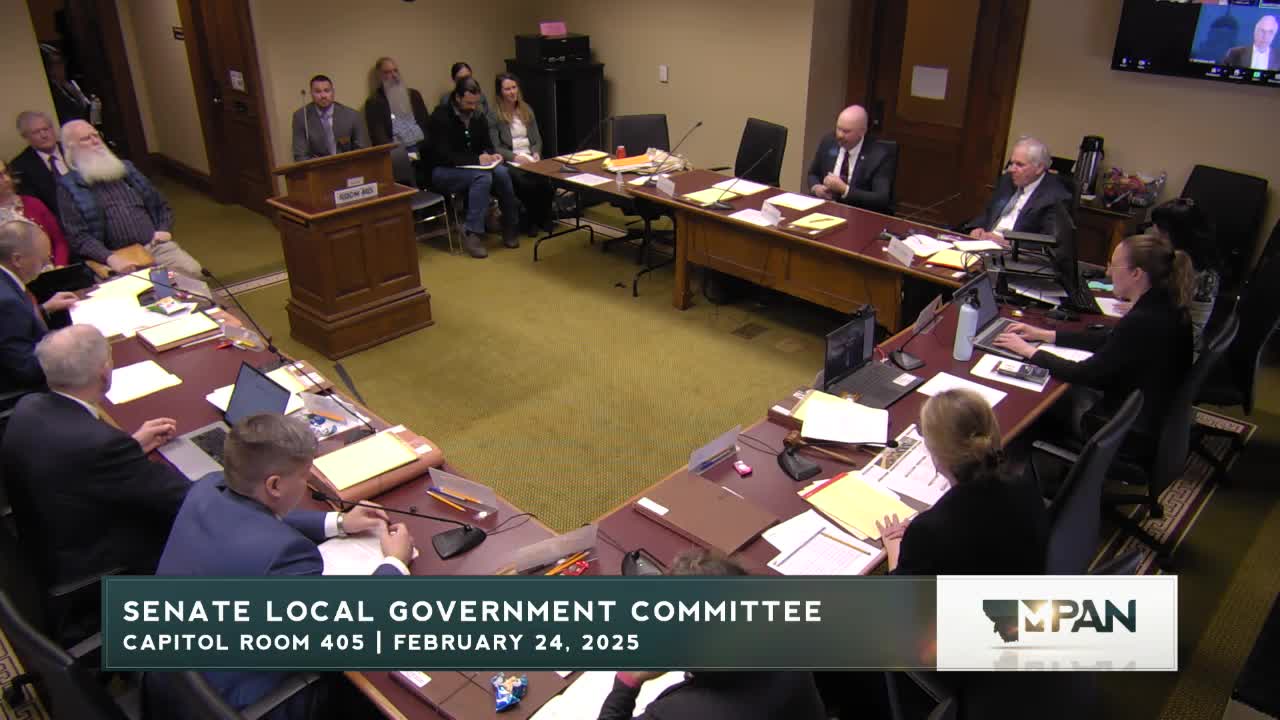
Senator Greg Hertz, who represents Senate District 7 from Polson, opened a hearing before the Senate Local Government Committee to introduce Senate Bill 336, legislation that would define short‑term rentals (STRs) as a residential use and limit how local governments and homeowners associations may prohibit them.
Senator Greg Hertz, who represents Senate District 7 from Polson, opened a hearing before the Senate Local Government Committee to introduce Senate Bill 336, legislation that would define short‑term rentals (STRs) as a residential use and limit how local governments and homeowners associations may prohibit them.
The bill, Hertz said, would make short‑term rentals “residential property and is not commercial or business,” and would require any jurisdiction or covenant that proposes a blanket ban on STRs to show specific public‑safety or infrastructure reasons in a formal analysis. The proposal also contains a grandfathering clause to protect STRs already in operation on the bill’s effective date and an exception allowing a property owner to rent out all or part of their primary residence or an adjoining property.
The measure drew extensive proponent testimony from homeowners, rental operators and industry representatives who said the bill would protect long‑standing property uses, preserve retirement income for older Montanans, and maintain lodging capacity in rural tourism communities. Stephanie Baucus, an attorney from Billings, told the committee that state licensing records show “nearly 5,000 owners that have tourist home licenses” and that more than 60% are Montana residents. Daniel Cox, representing the Montana Association of Realtors, said the bill would resolve uncertainty left by recent court decisions.
Opponents included the Montana Lodging and Hospitality Association and local government and planning groups. Melissa Shannon of the Montana Lodging and Hospitality Association said STR listings are increasingly professionally managed and that “this bill would give one segment of what is presently the commercial lodging industry … an advantage” and risk reducing housing stock. Kelly Lynch, executive director of the Montana League of Cities and Towns, said the bill’s language on accessory dwelling units (ADUs) and the shorter residency test (183 days) could limit local regulation and complicate enforcement.
Several witnesses raised housing‑supply and public‑safety concerns. Jake Brown of Shelter Whitefish said STR growth can reduce the long‑term rental supply, and Richard Hildner, a Whitefish resident and member of Flathead Families for Responsible Growth, warned the measure could undercut fire‑safety inspections and local tools used to regulate lodging. That issue was discussed with Eric Copeland of the Department of Labor and Industry; Copeland said jurisdictions certified to the state building code have differing inspection regimes and that the bill would not automatically subject single‑family residences to additional state inspections.
Key provisions discussed in the hearing included: - A statutory definition of short‑term rental as a unit or part of a dwelling offered for a fee for 30 days or less; the bill extends the definition to single‑family homes, multifamily units, condominiums, cooperatives and owner‑occupied residences. - A rule that, unless expressly prohibited in an entire zoning district or jurisdiction, short‑term rentals are permissible where residential uses are allowed; a ban must be accompanied by a written analysis showing consistency with growth policy and reasons tied to public health, safety, transportation, water/sewer, schools or parks. - An exception that a property owner’s primary residence (defined in the bill as occupancy at least 183 days per year) may be rented short term even where general prohibitions apply, and a grandfather clause for STRs existing on the bill’s effective date.
Proponents said the definition and grandfathering would prevent conflicting court rulings and protect property owners who rely on STR income to afford housing costs. Opponents urged the committee to preserve local zoning authority, keep more stringent local health‑and‑safety or permitting requirements, and address investor‑owned, professionally managed STRs separately. Several witnesses suggested technical amendments to clarify notice and analysis requirements for jurisdictions that adopt bans.
The committee did not take final action on SB 336 during the hearing. Sponsor Hertz said he would work with opponents on possible amendments to clarify the analysis and the interplay with local ADU rules.
The hearing record includes numerous written and oral statements from Montana homeowners and rental operators describing local impacts; committee members pressed for clarity on the bill’s effect on municipal permitting, ADUs, insurance and state licensing requirements for tourist homes.
What’s next: SB 336 will remain eligible for amendment and further committee action. Several committee members asked staff and proponents to draft clarifying language on the analysis required for bans, residency thresholds and how the grandfather clause would operate after permit expirations or property sales.
Quotes (selected): “Short‑term rentals are residential property and is not commercial or business,” Senator Greg Hertz said when introducing the bill.
“We pulled data from DPHHS and there are nearly 5,000 owners that have tourist home licenses. And over 60% of those are Montanans,” attorney Stephanie Baucus told the committee.
“This bill would give one segment of … the commercial lodging industry an advantage over the remainder of Montana’s lodging industry,” Melissa Shannon of the Montana Lodging and Hospitality Association said in opposition.
Ending: Committee members signaled willingness to work with the sponsor on targeted amendments. No committee vote occurred at the hearing; proponents, opponents and informational witnesses were asked to provide suggested drafting changes ahead of any future executive action.