Get Full Government Meeting Transcripts, Videos, & Alerts Forever!
Get email alerts on the Drought Voluntary Conservation topic
No spam. Unsubscribe anytime.
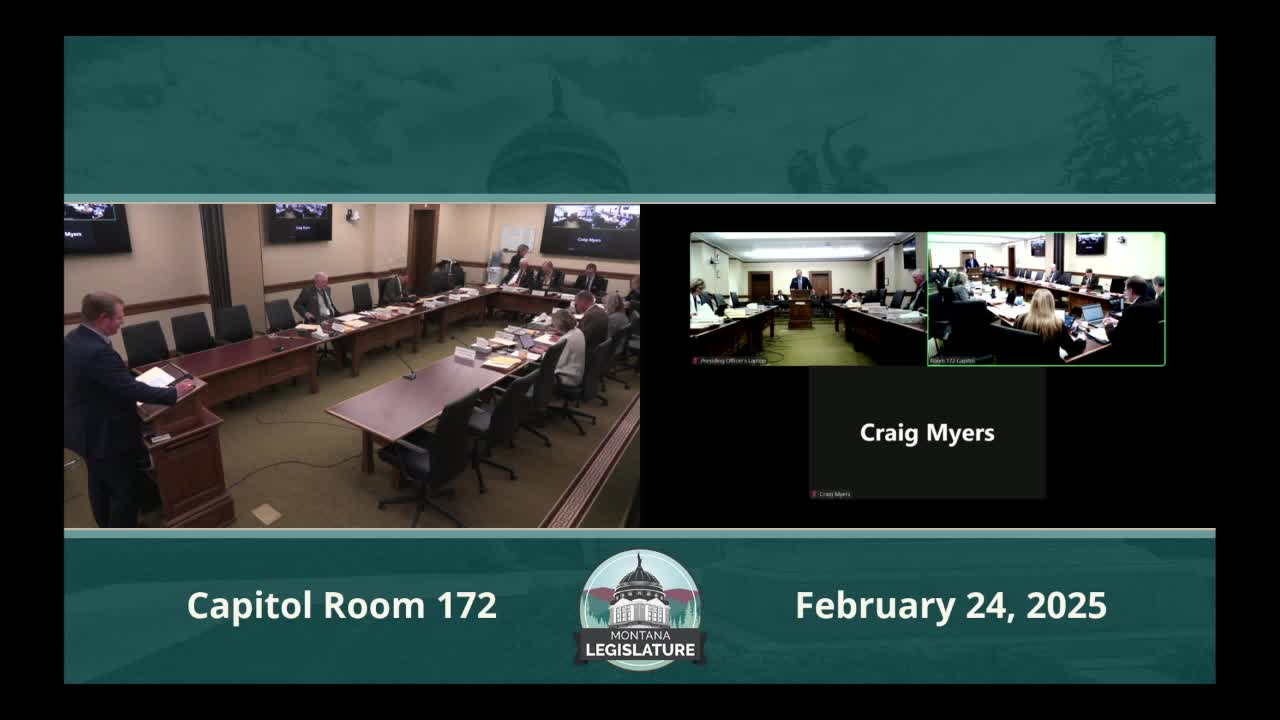
Committee hears HB 580 to protect voluntary water‑use reductions during droughts
Summary
Representative Josh Seckinger introduced HB 580 to clarify that water‑rights holders who voluntarily reduce use as part of a drought management plan should not be treated as having abandoned their rights; proponents from Trout Unlimited, water users and stockgrowers supported the bill and DNRC staff offered technical context.
Representative Josh Seckinger, sponsor of House Bill 580, told the House Natural Resources Committee the bill would clarify that during an official drought designation water‑rights holders who voluntarily curtail use as part of an approved drought plan would not have that nonuse considered evidence of abandonment. "We will be switching that or to an and," Seckinger said in the hearing, describing a forthcoming amendment tying a drought designation to the existence of a drought plan.
The bill responds to what proponents described as a practical barrier to collaborative drought planning: irrigators and other appropriators fear that a documented voluntary reduction could be used in an abandonment challenge. Clayton Elliott of Trout Unlimited explained the legal concern and cited the applicable statutory framework, saying, "The use or non use of the appropriation right does not by itself represent an intent of the appropriator to abandon the right." He described successful local drought plans, including work in the Big Hole watershed and Jefferson area, where irrigators and anglers negotiated shared‑sacrifice approaches.
Why it matters: testimony framed HB 580 as a relatively narrow, commonsense fix to encourage local, voluntary drought management. Mike Murphy of the Montana Water Resources Association and Rayleigh Honeycutt of the Montana Stockgrowers Association testified in support, saying the clarification would allow communities to implement drought plans and share temporary reductions without risking loss of water rights.
DNRC technical context: Cori Hawk, DNRC Water Planning bureau chief, explained the practical drought‑designation process and said the governor’s Drought and Water Supply Advisory Committee uses multiple metrics (snowpack, streamflow, soil moisture and local impacts) and meets weekly to recommend county‑by‑county designations. Committee members asked about how designations account for surface versus groundwater; witnesses said the monitoring process uses a “convergence of evidence” across gauges, precipitation and soil moisture indicators (including Montana Mesonet data).
The bill’s amendment under consideration would require both a drought designation and a written drought plan (with a stated metric) before voluntary reductions get the statutory protection. Proponents said the change was requested and vetted by stakeholders during recent DNRC‑led public meetings and would protect cooperative measures developed locally.
No formal committee vote was recorded during this hearing. Representative Seckinger closed by urging a "do pass" recommendation to the full House, but the committee did not act on the bill during this session. The hearing record includes technical detail likely to inform any amendment language and DNRC follow‑up.