Get Full Government Meeting Transcripts, Videos, & Alerts Forever!
Get email alerts on the School Administration topic
No spam. Unsubscribe anytime.
Bill would offer QEP boost to counties that form broad multi-district sharing agreements
Summary
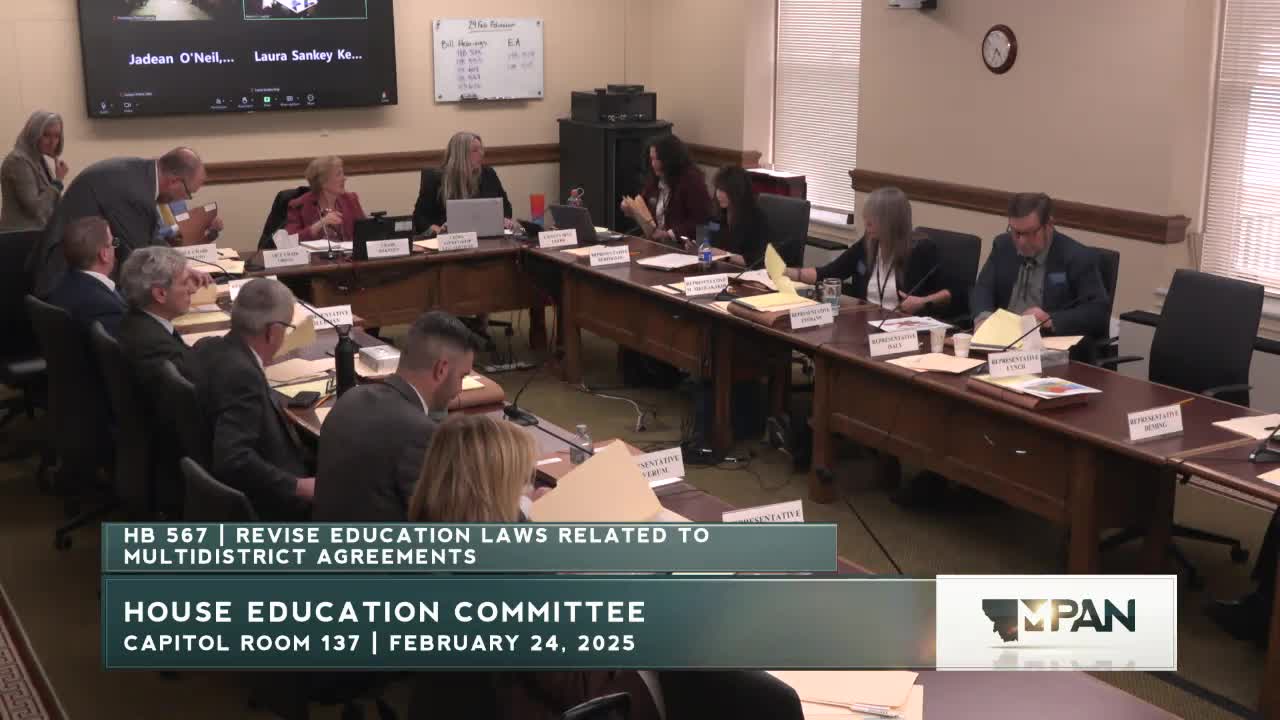
House Bill 567 encourages countywide multi-district cooperation by offering a potential 50% increase in the Quality Educator Payment for districts that enter comprehensive resource-sharing agreements; proponents said the bill incentivizes voluntary collaboration and avoids forced consolidation.
House Bill 567, introduced by Representative Brad Barker, encourages resource sharing among school districts and offers an incentive: districts that enter countywide multi-district agreements covering a broad set of functions could become eligible for a 50% increase in the Quality Educator Payment (QEP) for participating districts.
Representative Barker said the bill promotes voluntary collaboration (transportation, shared staff, curriculum consortia, joint operations) and is not a mandate. The bill builds on existing statutory authority that permits districts to cooperate (2 or more districts can operate jointly), but HB 567 extends the concept to countywide agreements and links that cooperation to the QEP incentive.
Lance Melton of the Montana School Boards Association spoke in support and explained the bill’s intent to encourage efficiency and avoid forced consolidation by providing statutory permission and financial incentive for districts to cooperate. Melton said a countywide approach that examines multiple functions would allow districts to smooth budgeting and address fluctuations in enrollment without mandating closures.
The bill’s draft language includes contractual allocation language and cites a contribution mechanism tied to a district’s general fund direct state aid; sponsors discussed a 44.7% figure used historically as a reference point for contribution calculations. The sponsor and proponents said the full statewide cost of the incentive, if every district participated, would be larger, but they expect an incremental adoption and noted the fiscal note was pending.
No opponents testified in the hearing record; committee members asked about cross-county participation, how contributions would be calculated for districts of widely differing sizes, and whether this duplicates existing cooperative structures. Proponents said cross-county agreements are possible and the core idea is voluntary collaboration to recruit and retain teachers and use facilities more efficiently. Committee staff later noted a fiscal note was being requested.