Get Full Government Meeting Transcripts, Videos, & Alerts Forever!
Get email alerts on the Renewable Resource Grants topic
No spam. Unsubscribe anytime.
Renewable-resources funding discussion turns to Missoula library green roof; subcommittee recommended removal, sponsor seeks reconsideration
Summary
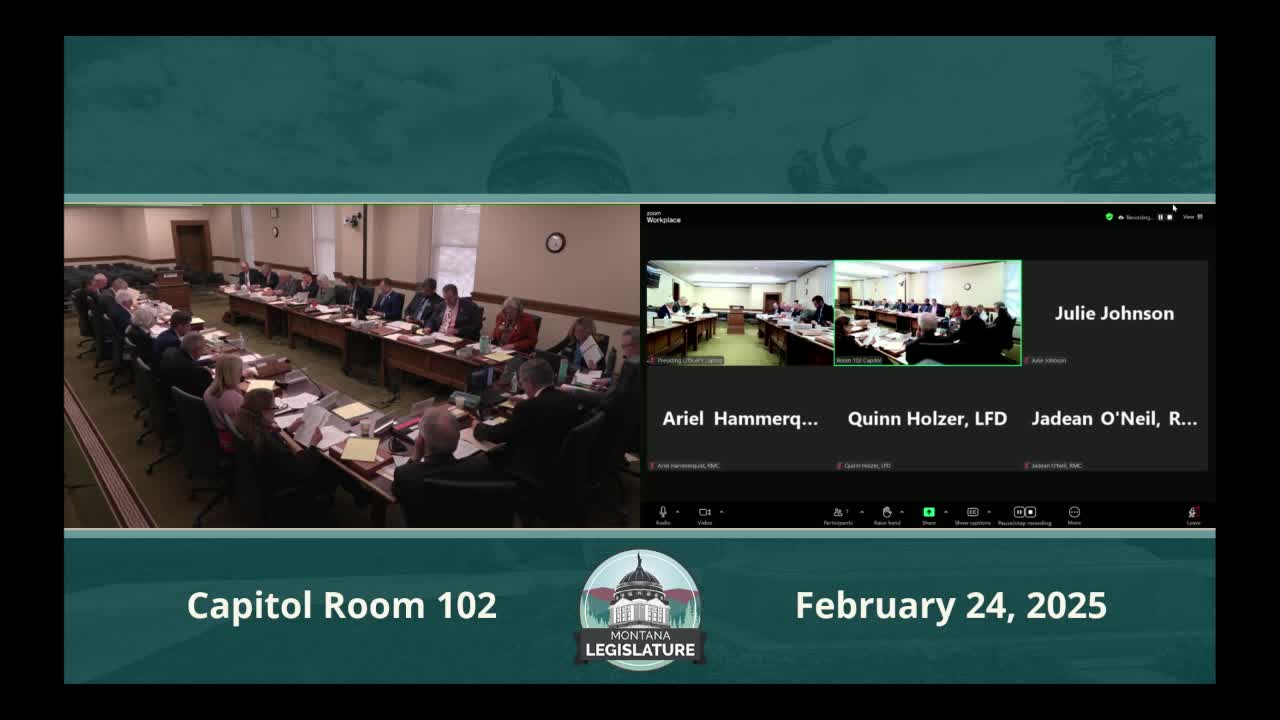
During executive action on House Bill 6, committee members debated whether a Missoula Public Library living roof should remain on the renewable-resources funding list; the subcommittee had removed the project and an amendment to restore it failed on a roll-call vote.
House Bill 6 (renewable resource grants) was before the House Appropriations Committee in executive session with an amendment that reflected the subcommittee’s recommended project list and deletions. Representative Fitzpatrick moved the principal amendment (subcommittee changes) and explained the subcommittee had deleted two projects lacking local match or judged inconsistent with program priorities, and had required capital reserve accounts for certain irrigation repair grants.
A central point of debate was whether the Missoula Public Library’s proposed living (green) roof qualified under the renewable-resource program. Subcommittee members said the project was atypical among mostly water and wastewater projects and that engineering and cost questions (the roof and building are relatively recent, and the bid costs were high compared to conventional roofing) weighed against funding it. Representative Matthews and others urged reconsideration, highlighting green-roof benefits for stormwater control, longevity and local economic benefits from a local contractor. Representative Keogh offered an amendment to restore the Missoula project. The motion to restore the library roof failed on a roll-call vote (15 yes, 8 no) in the transcript.
The committee ultimately adopted the subcommittee’s amendment package and passed House Bill 6 as once amended by voice vote; the transcript records that the final passage moved forward. Sponsor remarks and subcommittee discussion emphasized prioritizing projects with local match and capital-reserve planning and noted the committee hoped additional state funds might become available in the near term to fund projects not included on the prioritized list.
Why it matters: The discussion shows how project-fit, cost reasonableness, local match and program priorities shape allocations for renewable-resource grants; it also highlights tensions between project innovation (green infrastructure) and program norms focused on water/wastewater infrastructure.