Get Full Government Meeting Transcripts, Videos, & Alerts Forever!
Get email alerts on the State Budget Decisions topic
No spam. Unsubscribe anytime.
Appropriations subcommittee reassigns WIOA funding, approves lottery audit language and advances cannabis staffing contingency
Summary
The Appropriations Subcommittee A moved multiple decision packages across agencies, corrected the placement of a WIOA adult basic education package, adopted language directing a 2027 performance audit of the Montana Lottery procurement, and debated contingency funding for cannabis compliance tied to the moratorium.
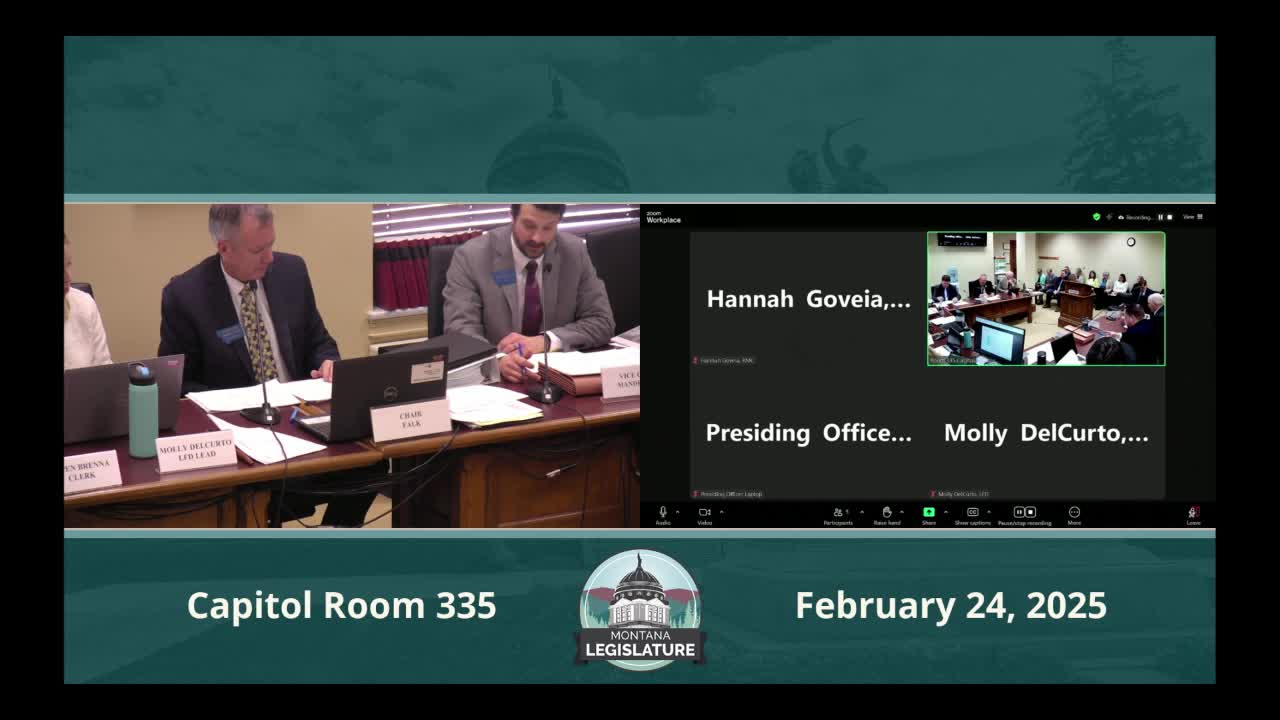
HELENA — The Montana Legislature’s Appropriations Subcommittee A on the morning session voted to correct the program placement of a Workforce Innovation and Opportunity Act adult basic education decision package, adopted language that directs a 2027 legislative performance audit of the Montana Lottery contract procurement process, and advanced several Department of Revenue and administrative budget items while debating contingency language for cannabis compliance staffing tied to the industry moratorium.
The most immediate action was a motion to reconsider and re-place DP 10‑44, WIOA Adult Basic Education, after committee members concluded the item had been placed in the wrong program on the original vote sheet. Vice Chair Mandeville moved the reconsideration and the committee later approved the DP within the Department of Labor and Industry’s workforce services division by voice vote.
The subcommittee also adopted budget language on page 16 that directs the Legislative Audit Division to perform a performance audit in the 2027 biennium of the Montana Lottery contract procurement process. Jason Harlow of the Governor’s Budget Office told the committee the audit is expected to be performed within existing legislative audit resources and that no additional funding was requested for that work.
Committee members spent appreciable time clarifying statutory transfers into the Capital Development Fund and the major maintenance formula. Senator Flowers pressed staff for the statutory basis and amounts; Jason Harlow and other budget staff explained that the capital development transfer follows statute (cited in committee discussion as “17‑7‑208”) and that the calculation yields roughly $33.5 million per year as the 1% transfer of certified general fund revenue discussed earlier in the session. Committee members asked staff to provide the full statutory calculations and copies of the supporting analysis for follow up.
On Department of Revenue items, members debated how many compliance positions to fund in the Cannabis Control Division if the industry moratorium expires. Committee members described a compromise that reduced requested positions for surprise inspections while leaving room to restore staffing if the moratorium is lifted. Committee staff noted existing language that conditions certain DPs on whether the moratorium is extended or canceled; Senator Flowers and others asked staff to prepare clearer contingency language for the next day’s meeting. The committee later approved DP 4‑02, a cannabis control contract increase, by voice vote.
The committee approved funding for a decennial school funding study required by statute, moving DP 21‑08 (school funding study) forward. It also passed DP 21‑06 to fund Legislative Days after a roll call vote: six ayes and two nays. The roll call for DP 21‑06 recorded Vice Chair Mandeville — yes; Senator Tzitzek — no; Representative Walsh — yes; Senator Harvey — yes; Representative Muscovich — yes; Senator Flowers — yes; Senator Lammers — yes; Chair Falk — no.
On the legislative branch budget, the committee moved DP 20‑06 (Mitchell Building rent) and DP 20‑05 (a transfer related to security detail). Angie Carter explained that the security cost is a transfer to pay Montana Highway Patrol costs for the building’s security desk and described the motion as “the legislative branch paying our part.” Committee members asked whether odd‑year needs (when the Legislature is in session) would be higher and asked Carter to follow up with General Services Division staff about operational impacts if the transfer were not approved.
Several other decision packages were moved across departments by voice votes with little or no extended discussion; committee members signaled they would return to some items the following day with additional information. Committee members repeatedly asked staff to circulate calculations and statutory citations for the capital development and major maintenance transfers and to prepare conditional language tying cannabis compliance staffing to moratorium outcomes.
The subcommittee adjourned with agreements to reconvene the next morning to resolve outstanding language clarifications and contingency wording.