Get Full Government Meeting Transcripts, Videos, & Alerts Forever!
Get email alerts on the Behavioral Health Budget And Caseloads topic
No spam. Unsubscribe anytime.
Committee advances behavioral-health decision packages, adopts LFD caseload updates; mixed votes on provider rate boosts
Summary
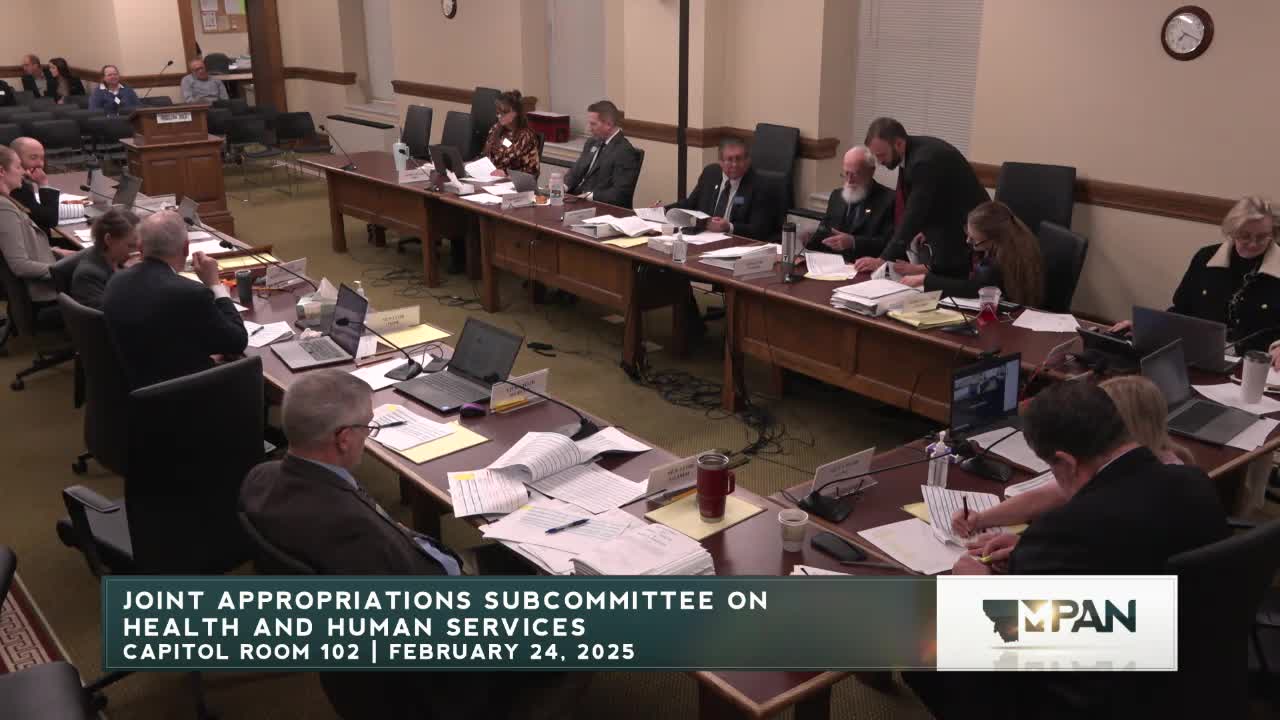
Helena — The Legislative Appropriations Subcommittee on Health and Human Services spent Feb. 20, 2025, debating BISFIG behavioral-health decision packages and Medicaid caseload updates, adopting a mix of restricted biennial and one-time appropriations and accepting LFD caseload adjustments after divided votes.
Helena — The Legislative Appropriations Subcommittee on Health and Human Services spent the morning and afternoon of Feb. 20, 2025, debating a large stack of BISFIG (behavioral health reform) decision packages, related Medicaid caseload updates and several legislative requests. The panel approved a mix of restricted biennial and one-time (OTO) appropriations, adopted LFD caseload adjustments for Medicaid lines and split on provider rate increases.
The committee began with BISFIG recommendations and updated decision packages (DPs) tied to certified community behavioral health clinics (CCBHCs) and other behavioral health items. Lawmakers amended and approved a CCBHC-related DP with coordinating bill language attached, adopting it with one recorded nay. Members debated whether to make several BISFIG items OTO (one-time-only) to allow a pause for evaluation before placing items in the base.
The panel accepted the LFD February caseload updates for Medicaid in multiple divisions (including Health Resources and Behavioral Health & Developmental Disabilities), incorporating the executive February updates and LFD adjustments into the committee’s caseload funding baseline.
Votes were mixed on supplemental provider-rate increases: several omnibus 3% proposals for provider categories were rejected, while other targeted BISFIG DPs (including care-transitions and select children’s residential rate redesign) carried after roll-call or voice votes. Committee members repeatedly emphasized the difference between discussion items (conceptual or study recommendations) and formal appropriations and asked for reporting language and clearer coordination when funding new statewide initiatives.
Key outcomes at a glance
- Certified Community Behavioral Health Clinics (DP 10732): Committee adopted a substitute motion that added coordinating language tying OTO funding to passage of implementing legislation; recorded one nay (Vice Chair Lentz). Outcome: approved (substitute motion passed).
- Care Transitions Program (BISFIG recommendation; DP 10,718): Passed on roll call 5–4 after debate about timing of expenditures and whether the rollout needed to be slower. Outcome: approved (5–4).
- School-based behavioral health startup (DP 10728, BISFIG recommendation 18): Committee approved a substitute motion reducing the request (cut in half) after discussion; outcome: approved (substitute motion passed).
- In-state youth residential rate redesign (DP 10,799 / BizFig rec. 17): Approved (voice vote; record showed one nay).
- Behavioral health and DD workforce incentives (DP 10729): Committee approved a substitute motion to make this one-time-only funding; members asked to add reporting requirements. Outcome: approved (motion carried).
- Mental-health community crisis beds (legislator DP 10456): The committee approved a one-time-only appropriation of $2.5 million over the biennium (split between fiscal years) after a substitute motion to make it OTO and reduce the biennial total. Outcome: approved (5–4 roll-call recorded as passed).
- Medicaid caseload funding (multiple DPs across divisions): The panel adopted the executive February updates and the LFD caseload adjustments in Health Resources and Behavioral Health & DD divisions (committee votes adopted the LFD February baseline for those divisions). Outcome: LFD caseload updates adopted for the named divisions.
- Selected provider-rate omnibus increases (multiple DPs proposing 3% across categories): Several omnibus increases were offered but many of the broad 3% across-the-board proposals for providers were not approved by the committee. Outcome: most omnibus 3% provider increases were rejected; some targeted rate redesign DPs (e.g., in-state youth residential redesign) passed.
Process notes and committee direction
Lawmakers repeatedly asked for clearer reporting requirements on OTO investments and asked staff to draft follow-up and reporting language to be included in companion legislation. Several members pressed for measures that limit the committee’s exposure if legislative policy (for example, an implementing bill for CCBHCs) does not pass. The committee accepted several OTO designations to allow pilots or time-limited rollouts rather than automatic base additions.
Agency staff (department analysts) were asked repeatedly to clarify funding sources (state special revenue, federal match, BISFIG funds), the timing of federal match (FMAP) impacts, the share of general fund in each package and the implementation timeline for multi-year items. Committee members requested that the department and LFD continue refining caseload calculations and bring any consequential supplemental needs forward with reporting timelines and evaluation metrics.
What’s next
The committee approved a number of BISFIG DPs and the LFD caseload updates and asked staff to prepare companion bill language for reporting and OTO restrictions. Members signaled willingness to revisit items that were held or cut if more detailed implementation or cost data becomes available. The subcommittee is expected to move remaining reconciliations into final bill language and companion amendments in subsequent meetings.
(Exact motions, roll-call results, and recorded yea/nay counts are listed below in the actions section to reflect the committee record.)