Get Full Government Meeting Transcripts, Videos, & Alerts Forever!
Get email alerts on the Extradition topic
No spam. Unsubscribe anytime.
Committee hears bill to modernize Montana's extradition law
Summary
The House Judiciary Committee heard testimony on House Bill 535, a governor-request bill that updates Montana's Uniform Criminal Extradition Act to clarify warrant types, require judicial bail setting in fugitive matters and modernize language first adopted in 1947.
At a House Judiciary Committee hearing, lawmakers opened discussion on House Bill 535, a governor-request bill to update Montana's Uniform Criminal Extradition Act (Title 46, Chapter 30) to clarify terminology and procedures used by law enforcement and courts.
The bill matters because the statute was adopted in 1947 and, proponents said, contains imprecise language that has caused confusion for sheriffs, prosecutors and judges. Supporters told the committee the changes will clarify which types of warrants apply in particular situations, ensure fugitives cannot post bail before appearing before a judge in extradition matters, and streamline the governor's ability to meet constitutional duties under inter-state extradition requirements.
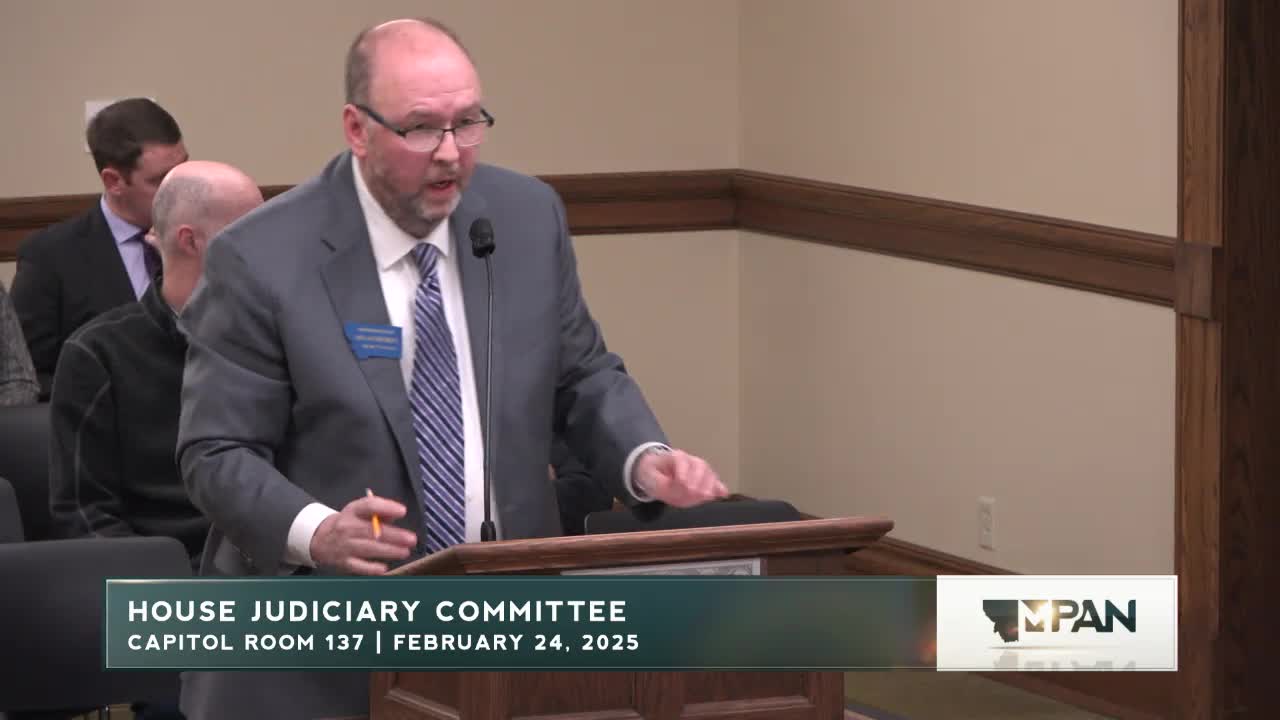
Representative (sponsor of HB 535) opened the hearing by saying, "This bill's purpose is to clarify terms that have created confusion for those on the ground and helping the governor execute his constitutional duty." Anita Milanovich, general counsel to the governor and the office's extradition lead, told the committee the governor's office worked with numerous stakeholders while drafting the bill and described recurring problems under the existing act. "The various sections of the act don't always specify which warrant they are addressing, the effect of which is gaps in the process that are undermining the governor's compliance with US constitutional directives," Milanovich said.
Milanovich and other proponents explained three recurring issues the bill addresses: unclear references to differing warrant types (a governor's warrant of requisition, a governor's warrant of arrest and rendition, and judicial warrants), inconsistent court treatment of waivers of extradition, and instances in which fugitives have been able to post bail before appearing in court in their fugitive status. "This bill clarifies that issue," Milanovich said regarding waivers. The bill also clarifies that bail must be set by a judge before a fugitive may post bond in extradition matters.
Stakeholders who testified in support included representatives of the governor's office, the Montana Association of Clerks of District Court, the Montana Sheriffs and Peace Officers Association and the Montana County Attorneys Association. Jesse Luther of the Montana Association of Clerks of District Court said the cleanup language is helpful for clerks; Nanette Gilbertson, representing both the sheriffs association and county attorneys association, said the bill "cleans up the language" and will require additional training for on-the-ground personnel.
Committee members asked no substantive questions during the recorded portion of the hearing. The committee closed testimony on HB 535 without recording a committee vote at the hearing.
The hearing record shows proponents said the bill is primarily a technical and clarifying update intended to make existing procedures clearer for law enforcement, prosecutors and judges; no opponents testified during the recorded hearing.