Get Full Government Meeting Transcripts, Videos, & Alerts Forever!
Get email alerts on the Health Care Chiropractic topic
No spam. Unsubscribe anytime.
Montana committee hears divided testimony on bill to let chiropractors prescribe limited drugs and expand Medicaid coverage
Summary
Representative Greg Oblander opened the committee hearing on House Bill 500, saying the bill would create a prescriptive‑authority endorsement for chiropractors and extend Medicaid coverage for chiropractic services to adults.
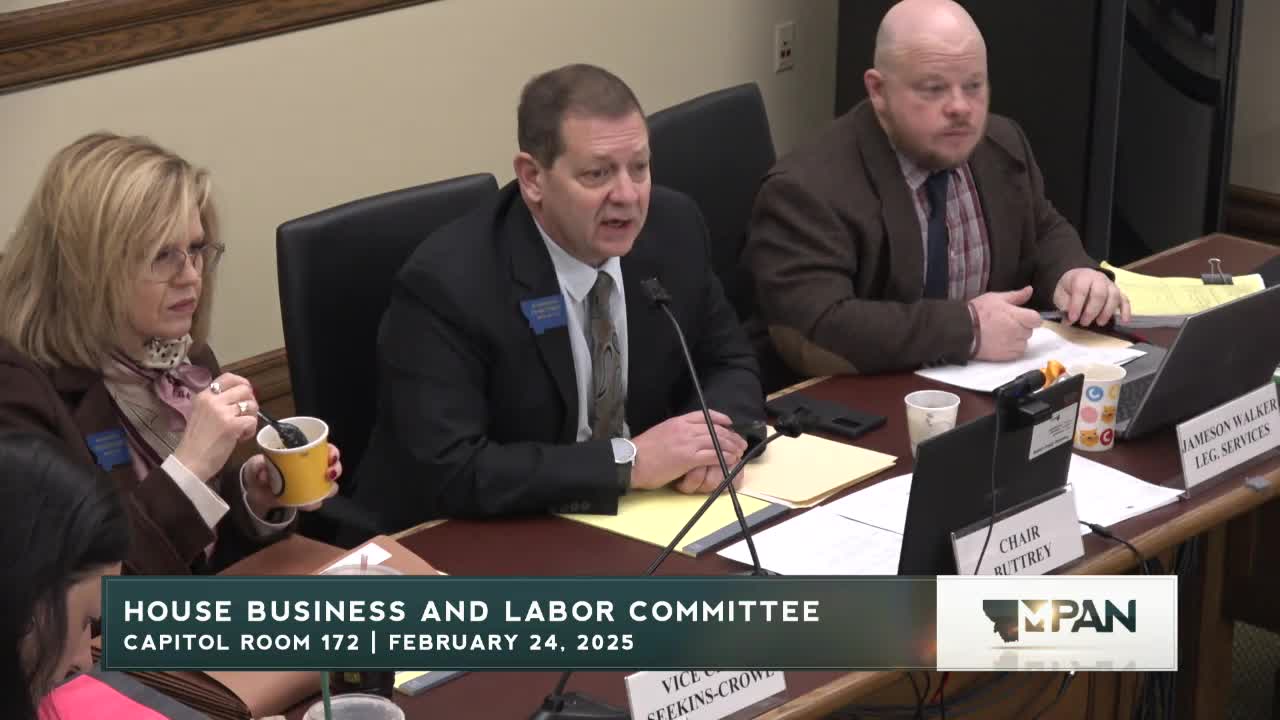
Representative Greg Oblander opened the House Business and Labor Committee hearing on House Bill 500, describing the proposal as a “chiropractic license endorsement for prescriptive authority” and a change to Medicaid coverage. “This is totally 100% optional,” Oblander said, describing the prescriptive endorsement as an add‑on license and stressing that chiropractors would not be required to prescribe drugs.
Proponents — mostly chiropractors practicing across Montana — said the bill would let properly trained chiropractors treat acute musculoskeletal conditions faster in rural communities and keep patients out of emergency departments. Dr. Sheridan Jones, president of the Montana Chiropractic Association, said patients sometimes arrive in such pain that “the modalities I am currently able to offer failed in providing relief” and that a short course of muscle relaxants or anti‑inflammatories can allow hands‑on care to proceed. Several practitioners described the bill as limited to non‑opioid medicines, noting the sponsors intend to restrict authority to drugs in schedules IV and V and to a named formulary (muscle relaxants, COX‑2 inhibitors and nonsteroidal anti‑inflammatory drugs among them).
Opponents included practicing chiropractors and physicians. Dr. Jack Berg, a Montana chiropractor, urged rejection of the prescribing portion and reminded the committee that “chiropractic was founded in 1895 in this country as a drug‑free form of health care.” Representatives of the Montana Medical Association and multiple family physicians told lawmakers they opposed the prescribing language as written, arguing chiropractic education does not provide the same pharmacology training as medical or pharmacy programs and expressing concern about drug–drug interactions and patient safety. Dr. Cara Harrop, a family physician, cited cases she has treated of serious adverse outcomes when medications were added to complex regimens.
Committee members pressed sponsors and witnesses on details the bill leaves to the Montana Board of Chiropractors: the content and length of qualifying education, whether the board would include physicians or pharmacists on any advisory panels, and how prescribers would confirm patient medication histories before issuing new drugs. Representative Oblander said the sponsor expects the board to adopt implementation rules and that a prescriptive endorsement likely would not be available before 2026. He also said the formulary would exclude schedules I–III and focus only on schedule IV and V drugs. Department of Labor and Industry staff and the Department of Public Health and Human Services (Medicaid) appeared as informational witnesses and said they could answer implementation questions (Medicaid would file a state plan amendment if coverage is expanded).
The hearing included testimony on the bill’s separate Medicaid change to extend chiropractic coverage beyond age 21. Several chiropractors said Montana’s current Medicaid coverage cutoff at age 21 prevents many adults on Medicaid from accessing conservative spinal care. Proponents asked that adults be covered so low‑cost conservative care could be used instead of costly emergency care.
No committee vote was recorded during the hearing. The record shows a small, clerical amendment was handed out at the start of the hearing and proponents expect the Board of Chiropractors to write implementing rules if the bill advances.