Get Full Government Meeting Transcripts, Videos, & Alerts Forever!
Get email alerts on the Remote Attendance Policy topic
No spam. Unsubscribe anytime.
Little Rock board debates ending virtual attendance; strikes health-determination clause and tables ordinance
Summary
Directors debated an ordinance that would limit remote attendance, removed language requiring the board to vote on a colleague’s health, and voted to table the item for a rewritten version at the March 4 meeting.
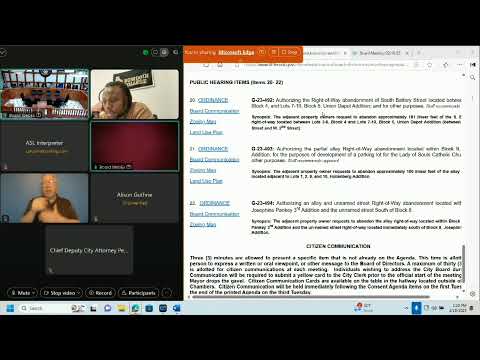
The Little Rock City Board of Directors debated and temporarily deferred action on an ordinance (item No. 18) that would limit elected members’ ability to attend meetings remotely, striking a provision that would have required the board to vote on whether a colleague was sufficiently ill to participate virtually.
The ordinance’s sponsor, Director Joan Peck, told the board she believes members should attend in person outside emergency periods and brought forward language that would limit the remote option. Director Antoine Phillips argued the proposed text was objectionable because it would put the board in the position of voting to determine a colleague’s medical condition and said he would abstain rather than make such a determination. Director Phillips also said the remote option is an accessibility tool that lets members perform duties when travel or other circumstances prevent in-person attendance.
City Attorney Tom (last name not specified in the record) confirmed the draft included language the board found problematic. Councilors voted to strike the language requiring the board to determine whether a member was “sick enough” to attend remotely; the presiding mayor announced, “Ayes have it.” The board then voted to table the ordinance and direct the city attorney to prepare a cleaner version; the item will be taken up again at the board’s March 4 meeting. Director Peck stated she would defer the third reading to that meeting.
Public comment underscored the accessibility implications of restricting remote attendance. Allison Guthrie, calling herself a Little Rock resident and graduate student, said she has a dynamic disability (Ehlers-Danlos syndrome) and that virtual access had allowed her participation in civic life. "Virtual attendance is accessibility. It is attendance, and it is inclusion," Guthrie said.
Several directors said they prefer in-person deliberation. Director Lance Hines said remote participation has harmed discourse in some local bodies and cited past occasions when the board handled remote attendance inconsistently. Director Virgil Miller asked that the problematic health-determination language be removed; several members agreed and the city attorney was asked to prepare revised text.
The board also noted an emergency clause had been proposed on the ordinance; the mayor and city attorney said city staff would need to rework the substitute language and the timing of any emergency provision. Director Peck made the motion to table and the board approved it.
The tabling preserves the status quo for remote attendance until the board considers a revised ordinance. The record does not show a final vote on permanent limits; the board’s next scheduled meeting to revisit the item is March 4, 2025.
Ending
The board removed the clause that would have required directors to vote on another member’s medical fitness for remote attendance and deferred the ordinance so city attorneys can present revised language at the March 4 meeting. Public commenters urged the board to consider accessibility impacts before finalizing restrictions.