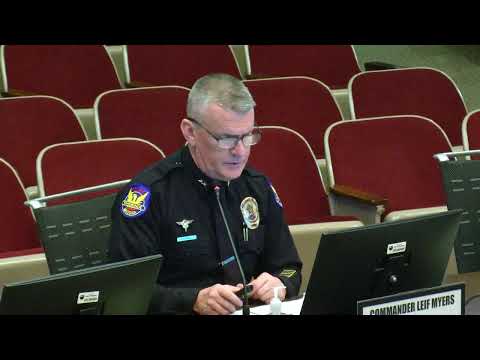
Phoenix city prosecutor outlines charging standards, domestic-violence data and reasons for dismissals
Get AI-powered insights, summaries, and transcripts
SubscribeSummary
City Prosecutor Jim Simpanis told the subcommittee that prosecutorial charging is governed by legal standards and resource limits; he provided case counts and disposition rates for domestic-violence cases and described reasons prosecutors dismiss or further cases.
City Prosecutor Jim Simpanis briefed the Public Safety and Justice Subcommittee on Feb. 5 on the prosecutor’s office jurisdiction, mission and case-handling practices, including detailed statistics on domestic-violence charges and common reasons for declines or dismissals.
The prosecutor’s office handles misdemeanor crimes that occur inside Phoenix city limits; felonies are referred to the Maricopa County Attorney’s Office. “A prosecutor has an obligation to seek justice, not merely a conviction,” Simpanis told the subcommittee, citing state case law and professional ethics.
Why it matters: Council members and members of the public have questioned whether arrests lead to prosecution and whether dismissed cases allow repeat offending. The prosecutor’s presentation explained legal standards, prosecutorial discretion and how evidence and witness availability affect charging decisions.
What the prosecutor said and provided Simpanis explained the office’s charging framework and how differing legal standards apply: police arrests are made on probable cause; prosecutors must decide whether there is a reasonable likelihood of conviction and whether prosecution is in the interest of justice. He said approximately 20% of cases are submitted for a pre-charge review by prosecutors and the remainder are filed directly by police as tickets and reviewed afterward.
Simpanis provided aggregate numbers for recent fiscal years: about 28,700 cases (FY2023–2024) were either submitted for charging review or filed in court; he said roughly 21% of those were domestic-violence-related cases. In domestic-violence matters, Simpanis said assaults made up the largest category (about 54%), followed by criminal-damage and interference with judicial proceedings or violation of protection orders.
On dispositions, Simpanis said roughly 27% of domestic-violence cases were dismissed for reasons that can include legal or factual insufficiency, and another roughly 11% were dismissed at the time of trial — often because an essential witness, typically the alleged victim, did not appear. He emphasized that his office does not automatically dismiss domestic-violence cases when victims later say they no longer want charges pursued.
Common reasons for declines or dismissals Simpanis told the committee that prosecutors decline or dismiss charges for multiple reasons, including: insufficient admissible evidence, receipt of exculpatory material, discovery of felony-level elements that should be referred to the county attorney, unavailable essential witnesses, or plea negotiations that resolve matters to other charges. He said the office also dismisses or further-investigates cases when the police ticket lacks necessary factual details; the office will often ask detectives for additional material rather than simply dismissing.
On felonies and interagency coordination Simpanis explained that when an arrest appears to involve felony conduct, the matter is usually sent to the Maricopa County Attorney for review, and the defendant may be released while county prosecutors determine whether to file felony charges. He described reasons for that handoff, including avoiding a double-jeopardy problem that could prevent felony prosecution later if the defendant pleaded to a misdemeanor.
Prosecutor’s remarks and examples Simpanis summarized the office’s mission as “to provide effective and efficient justice for all,” language he used repeatedly in the presentation. He gave a recent case study in which a chronically unhoused, addicted defendant with multiple trespass citations entered community court, completed program requirements, reunited with family and had all local charges dismissed as a result of the diversion outcome.
Questions from council members Vice Mayor O’Brien and Councilman Waring asked for more granular breakdowns — for example, the number of declined submittals that were later forwarded to the county attorney, and counts of prosecutions or plea outcomes tied to enforcement periods. Simpanis said the office can produce additional detail and noted that the office’s case-management system is being improved to capture more granular reasons for declines and dismissals.
Ending note Simpanis asked for ongoing collaboration with police, described prosecutors as partners who must preserve legal independence, and promised follow-up data on declined cases, county referrals and DV disposition detail requested by council members.