Phoenix officials report mixed results from expanded light rail security; Nineteenth Avenue remains a concern
Get AI-powered insights, summaries, and transcripts
SubscribeSummary
Phoenix Police and Valley Metro briefed the Public Safety and Justice Subcommittee on Feb. 5 on a layered security strategy for light rail. Officials cited declines in some incident categories after enhanced enforcement and staffing, but several council members and residents said Nineteenth Avenue corridor problems persist.
Phoenix Police Department transit commanders and Valley Metro officials told the Public Safety and Justice Subcommittee on Feb. 5, 2025, that stepped-up enforcement, new customer-experience staff and planned contract changes have reduced some incidents on the light rail system but have not erased persistent problems on the Nineteenth Avenue corridor.
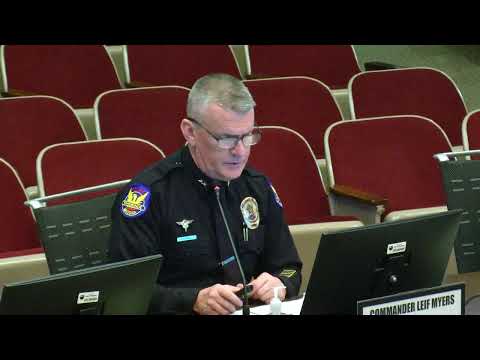
The subcommittee heard data and operational details from Commander Leif Myers of the Phoenix Police transit unit and Adrian Reese, Valley Metro director of safety and security. Commander Myers said the transit unit maintains four enforcement squads (two first shift, two second shift), with 13 detectives and 24 police assistants assigned and four sworn vacancies. “We did over 1,400 criminal investigative reports…we made over 1,700 arrests, and we submitted over 4,500 criminal charges for prosecution,” Myers said.
Why it matters: Light rail is a major, city-funded transit system that averaged about 10.2 million boardings in 2024; public safety concerns affect ridership, neighborhood quality of life and budgetary choices. Council members pressed officials for corridor-level detail and community outreach after presentations showing reduced passenger assaults in some periods but hotspots remaining along Nineteenth Avenue.
Officials’ account of changes and results Valley Metro said its security and customer-experience strategy combines contract security (Allied Universal), customer experience coordinators (CECs) and partnerships with police. Reese said vacancies among contract security workers dropped after a July 2024 board-approved wage increase; Valley Metro reported a 3.82% ridership increase for 2024 compared with 2023 and systemwide improvements in some incident rates. Reese said systemwide there were 86 reported incidents in 2024 (a rate Valley Metro calculated as 1.46 incidents per 100,000 boardings) and noted a roughly 20% decrease in passenger assaults when comparing January–June and July–December 2024 for parts of the system.
Phoenix Police described the transit unit’s activity and enforcement metrics. Myers said an “enhanced light rail security plan” implemented Sept. 2023 to Sept. 2024 boarded trains for fare or code compliance enforcement and that during that program the department “touched over 900 trains…over 3,400 passengers present,” recovered about 860 fares, issued more than 2,000 trespass warnings, issued roughly 3,200 citations and made over 800 arrests during that period. He also described K-9 explosive detection teams, downtown event staffing and community engagement with neighborhood groups.
Council and community reaction Several council members and the subcommittee pressed for more context and corridor-level numbers. Councilman Waring questioned how the enforcement-period counts (for example, the 34,581 passengers referenced in a fare-enforcement snapshot) relate to total annual ridership (about 10.2 million in 2024), and urged Valley Metro and police to publish clearer denominators and time ranges. Vice Mayor O’Brien and others asked for counts of prosecutions, the number of people formally trespassed from the system, and whether trespass warnings resulted in effective removals; Commander Myers said warnings are logged and that return after a warning would normally lead to a citation.
Councilwoman Guardado and others highlighted persistent safety concerns along Nineteenth Avenue from Dunlap to Camelback. Officials described targeted measures on that corridor: Valley Metro said it has a fixed security post at Nineteenth and Dunlap during operating hours, hourly patrols tied to community input, and more concentrated zone coverage between Nineteenth & Camelback and Metro Center. Police said multiple precincts coordinate patrols and community action officers to address the corridor’s problems.
Operational and contract changes planned Valley Metro said it is moving some maintenance (pressure washing) in-house to allow more frequent cleaning in problem areas, expects a consultant report on Crime Prevention Through Environmental Design (CPTED) improvements this spring, and is advancing procurement for a new fare inspection and security services contract with a primary/secondary award structure that would allow quicker replacement of a contractor that fails to meet obligations. Reese said the new contract scope will emphasize contractor accountability, staffing maximization, more experienced supervisory personnel, expanded field training, mental crisis/de-escalation training, and data analysis tied to deployment changes.
Quotes from the meeting “We want to improve the perception of security with the additional presence and investment by all staff and contractors,” Adrian Reese said, noting the layered approach that pairs Valley Metro staff, contract security and police units.
‘This is not a fare enforcement. This is code compliance,’ Marcus Coleman, light rail administrator, told the subcommittee when council members questioned whether operations were only about fare collection.
Looking ahead Council members asked for corridor-specific follow-ups and for Valley Metro and police to provide clearer time-span definitions for enforcement snapshots and a breakdown of citations, trespass warnings and prosecutions. Valley Metro and police said they will return with additional data and that they plan to expand security staffing ahead of the South Central extension.
Ending note Valley Metro and the Phoenix Police transit unit described measurable operational steps and some reductions in incidents, but council members and public commenters said problems persist in specific corridors and pressed officials for clearer, corridor-level reporting and faster community engagement.