Get Full Government Meeting Transcripts, Videos, & Alerts Forever!
Get email alerts on the Water Quality Certification topic
No spam. Unsubscribe anytime.
Hundreds of residents, environmental groups urge MassDEP to deny or tighten draft 401 certification for FirstLight’s Northfield Mountain project
Summary
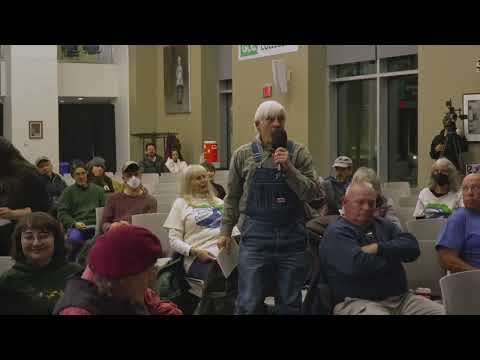
The Massachusetts Department of Environmental Protection on Feb. 19 held a hybrid public hearing at Greenfield Community College on its draft Section 401 water quality certification for FirstLight’s Northfield Mountain pumped‑storage project. Dozens of residents, municipal officials, conservation groups, tribal representatives and state lawmakers urged DEP to deny the draft certificate or impose much stronger conditions to protect aquatic life, riverbanks and cultural resources.
The Massachusetts Department of Environmental Protection on Feb. 19 held a hybrid public hearing at Greenfield Community College on its draft Section 401 water quality certification for FirstLight’s Northfield Mountain pumped‑storage project. Dozens of residents, municipal officials, conservation groups, tribal representatives and state lawmakers urged DEP to deny the draft certificate or impose much stronger conditions to protect aquatic life, riverbanks and cultural resources.
Many speakers told DEP staff that the plant’s routine reverse‑flow operations and turbine mortality harm fish, invertebrates and river habitat and that the draft certification does not show the projects will bring impaired reaches of the Connecticut River into compliance with Massachusetts surface water quality standards. "If you grant the certificate for 50 years, they will continue to harm the river," said Dennis Carr, a member of the Covington planning board.
The objections covered several recurring themes: turbine mortality and the narrow measurement of "water quality," the adequacy and timing of required fish‑passage and barrier‑net installations, bank erosion tied to frequent reservoir drawdowns, lack of meaningful public oversight of monitoring plans, and exclusion of Indigenous knowledge from the 401 process. "You're defining water quality too narrowly if you leave out river life," said John Thompson of the Connecticut River Defenders.
Why it matters: The 401 certification is a state decision under the Clean Water Act that can approve, deny or condition a federal hydropower license. Commenters said the certificate will determine whether the Connecticut River above and below Turners Falls Dam remains listed as impaired or steps toward attainment. Senator Joseph Comerford (D‑Hampshire, Franklin and Worcester) told DEP officials that a recent state law expanding the definition of eligible "clean energy" to include pumped hydro could increase future use of the plant and should be reflected in any modeling of project operations before the certificate is finalized.
Public concerns and requested changes
- Fish mortality and species protection: Multiple speakers described turbine mortality of fish eggs, larvae and adult fish and cited recent eDNA evidence indicating short‑nosed sturgeon upstream of Turners Falls Dam. Andrew Fisk, Northeast regional director for American Rivers, said the draft treats some invertebrates more conservatively than federally or state endangered fish and specifically criticized the certificate’s implementation schedule for fish passage and barrier nets. Fisk said DEP "is authorizing 25 days of violation of water quality standards" for the Turners Falls impoundment under the draft and called that timeframe insufficient.
- Barrier net and fish‑passage timing: Commenters noted MassDEP reduced a proposed timeline for installing a barrier net at Northfield Mountain from seven years to five years; many speakers urged a much shorter schedule — two to three years at most — and asked that designs explicitly account for short‑nosed sturgeon and other protected species. Senator Comerford asked DEP to require the barrier net to meet the needs of short‑nosed sturgeon "in addition to all other fish species."
- Bank erosion and monitoring: Municipal and regional officials, including Kimberly Noak McPhee of the Franklin Regional Council of Governments, urged that DEP require stronger bank‑erosion monitoring, modern quality assurance project plans (QAPPs), and a permanent role for local stewards such as the Connecticut River Stream Bank Erosion Committee and the Connecticut River Conservancy in plan development and review. Speakers said the canal drawdown committee should not be disbanded after three years and that public access to plans and reports is essential.
- Indigenous and cultural resources: Joseph Gravlin of the Nolumbeeka Project (Nipmuc coalition) and other speakers said Indigenous voices have been excluded from the 401 process and urged DEP to follow federal historic‑preservation requirements and to include Indigenous knowledge in certificate conditions.
- Transparency and enforcement: Several commenters said FirstLight has not been transparent about how often it operates in pumping mode, questioned whether the company should self‑monitor, and asked what enforcement steps DEP would take if required protections fail. Don Ogden and others called for sampling of outfalls and the reservoir for pathogens or toxins following turbine grinding of aquatic life.
- Broader policy context: Speakers argued the plant’s pumped‑storage operations can increase net fossil‑fuel consumption and emissions and questioned whether licensing the project is a valid climate solution. Some urged DEP to press FERC (Federal Energy Regulatory Commission) on relicensing decisions or to support broader relicensing and decommissioning discussions across multiple projects on the Connecticut River.
What DEP said and next steps
MassDEP staff opened the hearing, explained the process as a public‑comment opportunity on the draft 401 certification and said DEP would not engage in a Q&A during the session. Staff identified themselves on the record, including Tim Jones, Acting Director of MassDEP’s Division of Wetlands and Waterways; John Bieling, Deputy Commissioner for Policy and Planning; and Elizabeth Stefanik, wetlands analyst in the wetlands division’s major projects and policy unit.
The hearing record remains open for written comments until Feb. 24 at 5 p.m.; MassDEP said it will post written comments and the hearing recording on its website and provided instructions for electronic and mailed submissions. The hearing itself did not produce a decision; DEP will consider written and oral comments before finalizing, modifying or denying the draft 401 certification.
Community voices and next filings
Representatives of environmental organizations — including American Rivers, the Connecticut River Conservancy and the Connecticut River Defenders — municipal officials, tribal representatives, state Senator Joe Comerford and numerous local residents indicated they will submit written comments and technical evidence. Several speakers said they would pursue legal or administrative remedies if DEP issued a certificate they consider insufficient to meet water quality, endangered‑species, or cultural‑resource obligations.
The MassDEP comment deadline and instructions posted at the hearing: written comments accepted until Feb. 24 at 5 p.m.; email dep.hydro@mass.gov with subject line "First Light 401 WQC" or mail comments to Elizabeth Stefanik, Attention First Light 401 WQC, MassDEP BWR, 100 Cambridge St., Suite 900, Boston, MA 02114.
Ending note: The hearing underscored a sustained, multi‑stakeholder challenge to the proposed long‑term certification. Commenters asked MassDEP to apply more stringent, shorter timelines for fish passage and monitoring, to expand public oversight on erosion and dredging plans, and to explicitly protect listed species and Indigenous cultural resources before approving a long‑term 401 certification.