Get Full Government Meeting Transcripts, Videos, & Alerts Forever!
Get email alerts on the Capital Improvement Plan topic
No spam. Unsubscribe anytime.
Prescott Valley outlines five‑year capital improvement framework and funding toolbox
Summary
Town staff presented a capital improvement program framework and a five‑year financial plan that prioritizes water quality, drainage, streets and public facilities and lists funding options including pay‑as‑you‑go, grants, impact fees and debt instruments.
Selena Morris, town staff, told the Prescott Valley Town Council that the town has updated the capital improvement program (CIP) framework and is preparing a five‑year financial plan to accompany the fiscal year 2026–2030 capital list.
Morris said the town is distinguishing the capital improvement plan (the long‑term list of projects) from a capital improvement financial plan that models resources across five years so the town can move beyond funding only a single year at a time. “Right now between the capital request items for infrastructure and IT, we have close to 300 requests,” Morris said.
The presentation laid out a governance and project lifecycle model — planning and design, procurement, construction and closeout — and described evaluation criteria staff use to prioritize projects. Morris said the town’s existing policy, Fiscal Planning and Management (405), plus council priorities and community survey results guide evaluation. “We heard water quality, storm water and drainage, facilities and town‑owned building improvements, streets and transportation,” she said.
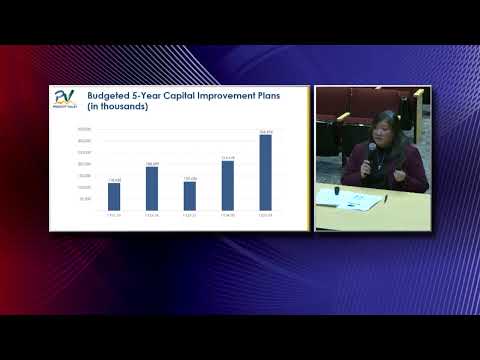
Why it matters: Morris told the council the plan will feed the annual budget. The town takes the first year of the five‑year CIP and the financial plan and places those projects into the current fiscal budget; for fiscal 2025, Morris said that first‑year total was $82,000,000. She also told the council that a prior five‑year plan reached $326,000,000, and that individual projects in the current first year range from under $100,000 to more than $20,000,000.
Staff highlighted several projects already in the first year of the plan, citing the Quail Wood PFAS project, a YMCA recreation facility and Glassford Hill Road. Morris said fiscal 2027 includes a large utilities and public works building request. She emphasized that each project is re‑evaluated annually through the same justification and risk assessment so priorities can change with new information.
Morris reviewed funding options the town considers: pay‑as‑you‑go (savings/fund balance), one‑time revenues (for example construction‑related sales tax), capital grants at state or federal levels (which can include requirements such as Davis‑Bacon wage rules), development impact fees tied to an infrastructure improvement plan, developer contributions under development agreements, debt tools (general obligation bonds, revenue obligations, revenue bonds and loans), and public‑private partnerships. She said staff is preparing material for a proposed citizen advisory committee that would review whether a revenue obligation paid with excise taxes (for example a portion of transaction privilege tax) would be appropriate.
Council members asked how staff matches available funds to the list of requests; Morris replied the five‑year financial plan will show resources matched to requests when the council reviews the final FY26–30 plan. On whether the town’s needs exceed available funds, Morris said she would bring back that matching analysis with the plan.
Morris and Director Reuter described the town’s approach to programmatic projects (year‑over‑year replacements such as signal system upgrades) versus one‑time large projects (for example Glassford Hill Road). Reuter (Director Reuter) described the design, permitting, easement acquisition and inspection steps the town completes before bidding construction, and said the town typically will not bid until easements and utility relocations are resolved to avoid contractor standby time and increased costs.
The presentation emphasized cost escalation risk from national and Phoenix‑area construction cost indices and noted recent softening in some material prices. Morris said the presentation and the full CIP material will return to council as part of the upcoming budget process for council approval.
The council did not take formal action during the presentation; staff said specific budget and project approvals will be presented later in May when the annual budget and the FY26–30 CIP are returned for council action.
The town provided the presentation and staff said they will post it online for public reference.