Get Full Government Meeting Transcripts, Videos, & Alerts Forever!
Get email alerts on the Public Works Water Sewer Airport topic
No spam. Unsubscribe anytime.
Wasilla public works warns of recurring glaciation, advances water interconnect planning
Summary
Public works outlined emergency response spending for winter glaciation, updates on sewer discharge permitting and airport master planning, and presented mapping and funding details for a Wasilla–Palmer water interconnect and water‑system upgrades.
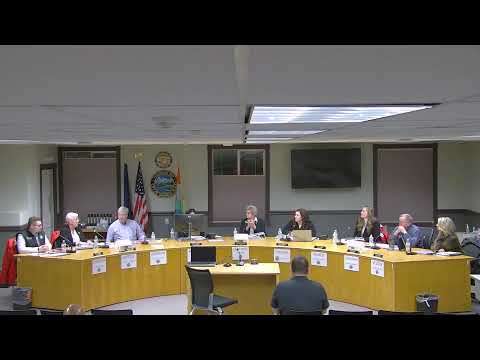
The Wasilla public works director told the City Council on Feb. 17 that recent warm spells have caused standing water and renewed glaciation in parts of the city, prompting targeted emergency work and the use of outside steam‑thaw contractors.
The remarks came during the council’s regular meeting, when Eric, Public Works Director, described two days of pumping at the Lake Wasilla Library after rain on thawed ground overwhelmed dry wells, several glaciation incidents on Sunday Circle that required steam thawing and excavation, and contingency spending to protect residences from freeze‑thaw damage.
The public works report matters because it identifies recurring infrastructure stressors — warmer winter rain events and persistent groundwater migration — that are driving unplanned operational costs and will affect capital planning for drainage, roads and utilities.
Public works updates and immediate response Eric, Public Works Director, said crews had to pump water away from the Lake Wasilla Library for two days and used a portable pump to move stormwater into the nearest storm drain. He described downtown storm‑pump station operations that briefly routed excess stormwater into Lake Lucille when ponds filled and pumps were turned off to manage outfalls.
“We pumped that down,” Eric said of the library flooding, and later described digging and steam‑thaw contracts used to free frozen vehicles and protect at least four homes at risk of glaciation. He said the city has spent “tens of thousands of dollars” this winter to keep properties from suffering freeze damage and that some contractors’ equipment has been unreliable, forcing the city to keep several firms on call.
Council members asked whether the city owns steam‑thaw equipment; Eric replied that an older unit was decommissioned for safety about a decade ago and the city currently relies on contractors, with a reciprocal agreement in development with the borough.
Sewer permit, sludge handling and utilities work Eric summarized work on the city’s sewer discharge permit and the layout of the sewer treatment plant, including sludge digesters and percolation beds that do not dry effectively in winter. He said the city is seeking federal and state approval to discharge treated water into wetlands as part of permit revisions and that staff will hold a neighborhood meeting to discuss required easements.
Airport master plan and community outreach Public works announced an airport master‑planning public meeting scheduled for Feb. 18 from 5:30 to 7:30 p.m. at the Menards Center and a follow‑up meeting with the Meadow Lakes Community Advisory Group. The department said it will present short‑, mid‑ and long‑term buildout illustrations and collect public feedback.
Water system mapping, interconnect and equipment grants Eric presented maps the department has produced showing system pressure zones, storage capacities and the age and size of Wasilla’s distribution mains. He said spruce hill storage accounts for roughly one million gallons and that several downtown pipes are more than 40 years old.
On the Wasilla–Palmer interconnect, Eric said two alignment options are under evaluation: one following an access road/Parks Highway corridor that would connect near the hospital and one routing up Spruce and Bogard to join near Colony. He said the interconnect is being developed with Matanuska‑Susitna Borough participation and that the connection would provide mutual backup supply and support higher‑density development along corridor alignments.
Eric described a FEMA grant to upgrade generators at the Spruce well/water‑tower site; Capstone natural‑gas generators are installed and expected to be operational by mid‑March.
City Hall assessment and AKOSH inspection Eric said Wolf Architects scanned City Hall with 3‑D equipment to support an upcoming assessment and that the city will receive a draft report in early March. He also said an Alaska Occupational Safety and Health (AKOSH) inspection of City Hall found issues including known asbestos and that AKOSH will inspect parks, properties and the sewer/utility facilities in coming months.
Why this matters to residents Council members during the presentation pressed on budget impacts and long‑range planning: contractual steam‑thaw work is driving unplanned winter expenditures even as snow‑removal costs fall; aging water mains and storage shortfalls point to capital needs; and the Wasilla–Palmer interconnect could alter development potential along connector corridors.
Eric said city staff are compiling data for a water master plan update and that the capital expense of system expansion remains substantial; the council asked staff to provide more detailed budgeting and program status information in a future report.
Ending note Public works will hold the airport master plan meeting and continue neighborhood engagement about the sewer permit and well/tower generator project; staff signaled more detailed street, drainage and utility capital recommendations will arrive as mapping and master‑planning efforts progress.