Get Full Government Meeting Transcripts, Videos, & Alerts Forever!
Get email alerts on the Public Works Budget topic
No spam. Unsubscribe anytime.
Public Works lays out $4.1 billion budget, warns fire recovery will exceed $480 million
Summary
Director Mark Pastrella told supervisors Public Works' FY 2025–26 recommended budget is $4.1 billion, a $299 million decrease from FY24–25, while wildfire response and recovery costs are expected to exceed $480 million and may require reprioritizing projects and additional county support.
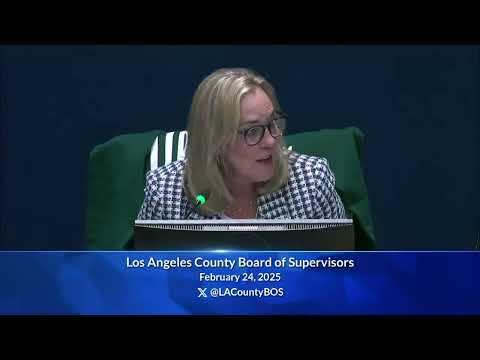
Public Works Director Mark Pastrella presented the department's FY 2025–26 recommended budget of $4,100,000,000 to the Los Angeles County Board of Supervisors on Feb. 24, 2025, and warned supervisors that recent wildfires have produced significant new costs the budget does not fully reflect. "We estimate that response and recovery costs will exceed $480,000,000 with more than $250,000,000 not eligible for reimbursement," Pastrella said as he outlined the department's recovery role, including debris removal, damage assessments and temporary permitting support to help residents rebuild.
Pastrella said the department is leading debris removal and recovery work under the county's Office of Emergency Management, and that staff are asking affected property owners to return right‑of‑entry forms needed for clearing private property portions within public right‑of‑way. He reported a 99% opt‑in rate for the 8,642 right‑of‑entry forms submitted by property owners in the affected areas but said the department anticipates significant unreimbursed expense on projects and permits tied to rebuilding and basin cleanup.
Why it matters: the recommended budget is dominated by restricted funds (147 separate funds), and Public Works said approximately 98.25% of its budget comes from restricted sources; only about 1% is net county cost (NCC). That mix limits the department's flexibility to respond to sudden countywide needs that fall outside the scope of those restricted funds.
Key budget and program points - Recommended budget: $4,100,000,000 (a $299,000,000 decrease from FY24–25 adopted). Pastrella said the decrease reflects prior-year spending patterns and restricted fund flows. - Recovery estimate: $480,000,000 total response and recovery cost estimate; more than $250,000,000 of that amount may not be reimbursable, Pastrella said. - Debris removal and rebuilding: Public Works is operating Calabasas and Altadena one‑stop centers to help property owners with permits and is coordinating with fire, regional planning and public health on permitting and inspections. - Eaton Wash Dam: the department estimated removal of roughly 500,000 cubic yards of sediment and debris from Eaton Wash Dam will continue through May to protect downstream communities. - Fund structure: the department manages 147 funds; water resources recommended fund budgets total $1.7B; transportation business area $850.1M; municipal services $236.7M. - Net county cost request: Public Works requested an additional $30,800,000 in NCC to address unmet needs (street safety, homeless initiatives, transit shade structures, urban canopy, stormwater operations, and a transportation planning division).
Supervisors pressed for detail on how the department will prioritize projects and staffing. Pastrella said staff will consult board offices on proposed project delays and prioritization, and that the department will return with a comprehensive options analysis to help stabilize funding. He also said Public Works will publish a prioritized recovery needs list (for philanthropic and private donors) for the departments most active in recovery work.
Context and next steps: Pastrella said Public Works has begun workshops for home builders and contractors in the fire areas to streamline permitting and that the department has opened one‑stop centers to expedite reconstruction. He also said the department is coordinating with state and local partners ahead of storms to protect people and infrastructure from mud and debris flows. Supervisors asked about Measure W eligibility for watershed work, whether the department will request fee updates for the Flood Control District, and how the department will balance road fund declines with safety investments; Pastrella and staff described a mix of fund reallocation, prioritization and requests for additional NCC.
Ending: Pastrella told the board he would return with a tighter analysis of recovery costs and proposed budget adjustments as permitting and damage assessments are refined.