Get Full Government Meeting Transcripts, Videos, & Alerts Forever!
Get email alerts on the School Construction Msba Medford topic
No spam. Unsubscribe anytime.
Medford committee approves RFS to MSBA, moves to Phase 2 of high school project; three members added to OPM selection panel
Summary
The Medford Comprehensive School Building Committee voted unanimously, 14–0 with one member absent, to approve a request‑for‑services package to the Massachusetts School Building Authority that begins Phase 2 of the Medford High School project.
The Medford Comprehensive School Building Committee voted unanimously, 14–0 with one member absent, to approve a request-for-services (RFS) package to the Massachusetts School Building Authority that starts Phase 2 of the Medford High School project and puts the district in the MSBA review queue.
The RFS will be sent to MSBA “tomorrow” for a two‑week review so Medford can be scheduled for the OPM (owner’s project manager) selection process, Jenny Graham, chair of the Medford Comprehensive School Building Committee, told attendees. "We will review that tonight with a goal to make any amendments that this committee sees fit and get ready to send that to the MSBA tomorrow," Graham said.
Why it matters: Approval moves Medford from the MSBA eligibility work into the procurement and feasibility phase, allowing the district to hire an OPM and then an architect to complete a feasibility study that will evaluate renovation, addition, and new‑construction options. That study will determine a preferred solution and provide construction schedules, cost estimates, and life‑cycle analyses for each option.
What the committee approved and the vote: The RFS as amended uses the MSBA template and includes an evaluation rubric for scoring OPM proposals. The motion to approve the RFS was moved by Emily Lazaro (motion: “Motion to approve”) and seconded by Aaron Olapade. Roll call after discussion showed 14 yes, 0 no, 1 absent (Luke Preisner); the motion passed.
Key numbers and scope from the RFS: Committee materials and discussion cited current MPS high‑school enrollment of about 1,200 students and an MSBA‑agreed high‑school enrollment of 1,395 students. The district’s broader agreed projection for a new Medford High School is 1,695 total: 1,395 grades 9–12; 200 pre‑K; and 100 daycare seats, according to the draft RFS presented to the committee. The OPM selection subcommittee recommended an initial planning cost range of $200 million to $600 million to reflect the wide range of possible solutions from substantial renovation to full new construction.
Timeline and next steps: Graham said MSBA staff will consider a recommendation Wednesday to advance Medford into Phase 2 (also called Module 2). If MSBA clears the RFS, the district will post the procurement, conduct site visits, shortlist firms, hold finalist interviews, and name an OPM. The committee is targeting having an OPM in place before June so the feasibility study and designer selection can proceed on an accelerated timetable.
Process details the committee emphasized: The MSBA process is value‑based; cost proposals are not submitted with initial OPM bids. According to the RFS discussion, price negotiations occur only with the top‑ranked respondent after the selection panel’s ranking. The committee also asked the OPM to prepare alternatives that account for phased construction, site egress improvements, hazardous‑materials surveys, swing‑space needs for vocational (Chapter 74) programs, and a life‑cycle sustainability analysis. The committee discussed including LEED or NE‑CHPS benchmarks and WELL certification as potential sustainability/health targets.
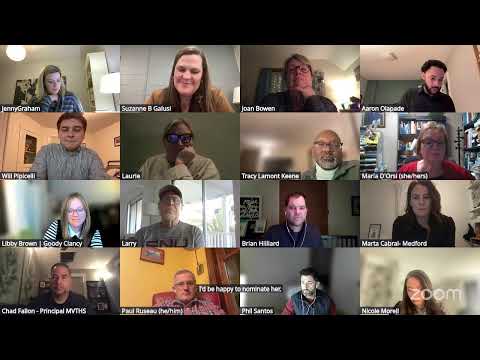
Committee composition and appointments: The committee voted to expand the OPM selection subcommittee from three voting members to five voting members (plus nonvoting participants). The following additions were approved by roll call votes (each 14–0, 1 absent): Libby Brown was added as a voting member (motion by Aaron Olapade, seconded by Marissa Desmond); Paul Russo (nominated by Mayor Lungo Kern, seconded by Dr. Cushing) was added as a voting member; and Dr. Galusi accepted appointment as a voting member to increase capacity for reviews. Nonvoting members identified in the discussion include Fiona Maxwell (chief procurement officer) and John McLaughlin.
Discussion highlights and clarifications: Committee members asked about the enrollment horizon used in MSBA’s analysis; staff said MSBA staff modeled a 10–15 year horizon and the district provided projections that extend further, including anticipated housing developments and possible transformative projects such as air‑rights redevelopment. The group discussed the need to maintain learning continuity for Chapter 74 vocational programs during construction and the potential need for modular swing space. Several members flagged the single‑ingress configuration of the existing campus and asked that OPM candidates address egress improvements.
Quotable: "We have about 1,200 students right now," Graham said, noting the MSBA‑agreed high‑school enrollment and the district’s planning figure. "We are done with the MSBA module 1 work," she added, and reported MSBA staff would make a formal recommendation on Wednesday.
What remains outstanding: The RFS package will include additional MSBA attachments that were not yet in the draft. The committee also agreed to finalize minor edits (point scales, lifecycle language, certification language) before submission. The committee said it will notify the public of the MSBA board outcome and prepare a community release after Wednesday’s MSBA meeting.
The meeting adjourned after the committee completed the votes. The committee said it will reach out to new subcommittee members to schedule availability for interviews and panels in the coming weeks.