Get Full Government Meeting Transcripts, Videos, & Alerts Forever!
Get email alerts on the Teacher Recruitment Retention topic
No spam. Unsubscribe anytime.
Anchorage School District: teacher shortfalls, budget uncertainty could worsen vacancies; district eyes nonreplacement to avoid mass layoffs
Summary
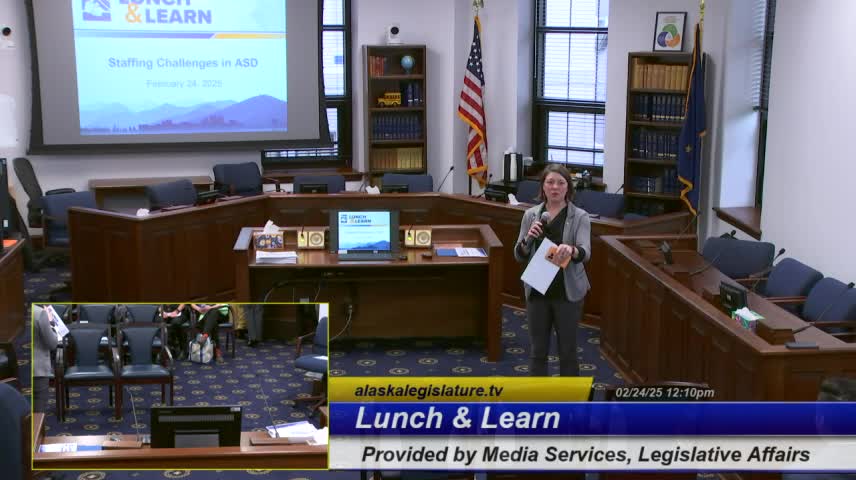
Anchorage School District leaders told a legislative "lunch and learn" that statewide and national teacher shortages, high health-care costs and uncertain state funding mean the district may cut about 375 positions and will limit hiring to avoid widespread pink slips.
Representative Carolyn Hall hosted a March 1, 2025, lunch-and-learn where Anchorage School District leaders warned that continuing teacher shortages, escalating benefit costs and budget uncertainty threaten staffing for the 2025–26 school year.
"If we think about ways to revitalize our education system, it will always begin with incredible teachers in the classroom," ASD Superintendent Jarrett Bryant said, framing the presentation on recruitment and retention as central to student outcomes.
The Anchorage School District (ASD) faces shortages that mirror national trends, district Chief Human Resources Officer Marty Lang told the audience. Using federal and state data as context, Lang said national teacher attrition and a smaller pipeline of teacher-preparation graduates constrain supply: "In 2021–22 there were 3,200,000 full-time teachers in public schools in The United States... About 8 percent... left public education as teachers. We only had just under 162,000 folks graduate from traditional teacher preparation programs," he said.
Lang presented Alaska- and district-level figures. He said the state had "just under 7,500 teachers" in 2021–22 and that 22 percent left positions that year; the University of Alaska system produced 153 licensure candidates that year. For ASD specifically, Lang said the district employed just over 3,000 teachers in 2021–22 and that 416 teachers resigned that year, representing roughly 13 percent of ASD's teacher workforce.
Lang described how timing and budget uncertainty amplify the hiring challenge. District hiring typically draws its strongest candidate pool between March and April, after local boards approve budgets. With state funding unclear, Lang said ASD expects to cut roughly 375 teacher positions and will attempt to avoid mass pink slips by not replacing current vacancies and releasing long-term substitutes instead. "We're really not in a position to hire anybody once our board passes the budget, hopefully, tomorrow night," he said.
Lang described several alternate pipelines the district has used in recent years: 24 hires on emergency teaching certificates, 49 teachers on J-1 visas (primarily from the Philippines), and 29 retire-rehire teachers under the Teachers' Retirement System (TRS) program. Even with those strategies, he said, "we are adding teacher pipelines, and we are still losing ground." He added that in 2017, when ASD laid off about 200 teachers, about 32 percent of that group left the state rather than await recall offers.
The presentation also covered non-teacher staffing and benefit cost pressures. Lang said ASD spent more than $110 million a year—about 16 percent of its general fund—on employee health benefits and noted rising costs and Alaska's high health-care prices. He described past operational impacts: in 2022 bus driver shortages forced rolling reductions in routes until pay increases of about 25 percent stabilized staffing. The district raised paraprofessional starting pay from $16 to $20 per hour and has filled about 130 of those vacancies, Lang said.
Lang thanked recent state initiatives that he said helped recruitment and retention, including the Alaska Teacher Recruitment and Retention Task Force, the emergency certificate process opened by the Department of Education & Early Development (DEED), SB 185 (2018) that opened a TRS retire‑rehire option, and the removal of a service‑credit limit in last year's HB 230. He also cited Ballot Measure 1 (a statutory increase to the state minimum wage) as a factor that will require school districts to raise some hourly wages, such as for transportation staff.
Audience members asked whether retirement tiers and historic turnover patterns affected current retention rates. Lang said the district needs more analysis to compare turn‑over under prior retirement structures and noted that a traditional teacher-preparation pathway can take several years to yield new certified hires. He described district efforts to expand apprenticeships and alternative certification and urged policies that would improve competitiveness—particularly retirement security, forward funding to allow hiring during the March hiring window, loan forgiveness, and certification reciprocity.
No formal board action or vote took place during the session; the presentation was informational and followed by audience questions.
The district leaders emphasized that without timely state funding and policy changes to improve competitiveness, ASD expects continued difficulty filling vacancies and potential program impacts next school year.