Get Full Government Meeting Transcripts, Videos, & Alerts Forever!
Get email alerts on the County Finances topic
No spam. Unsubscribe anytime.
Miami County finance director outlines mill-levy, revenue mix and debt outlook
Summary
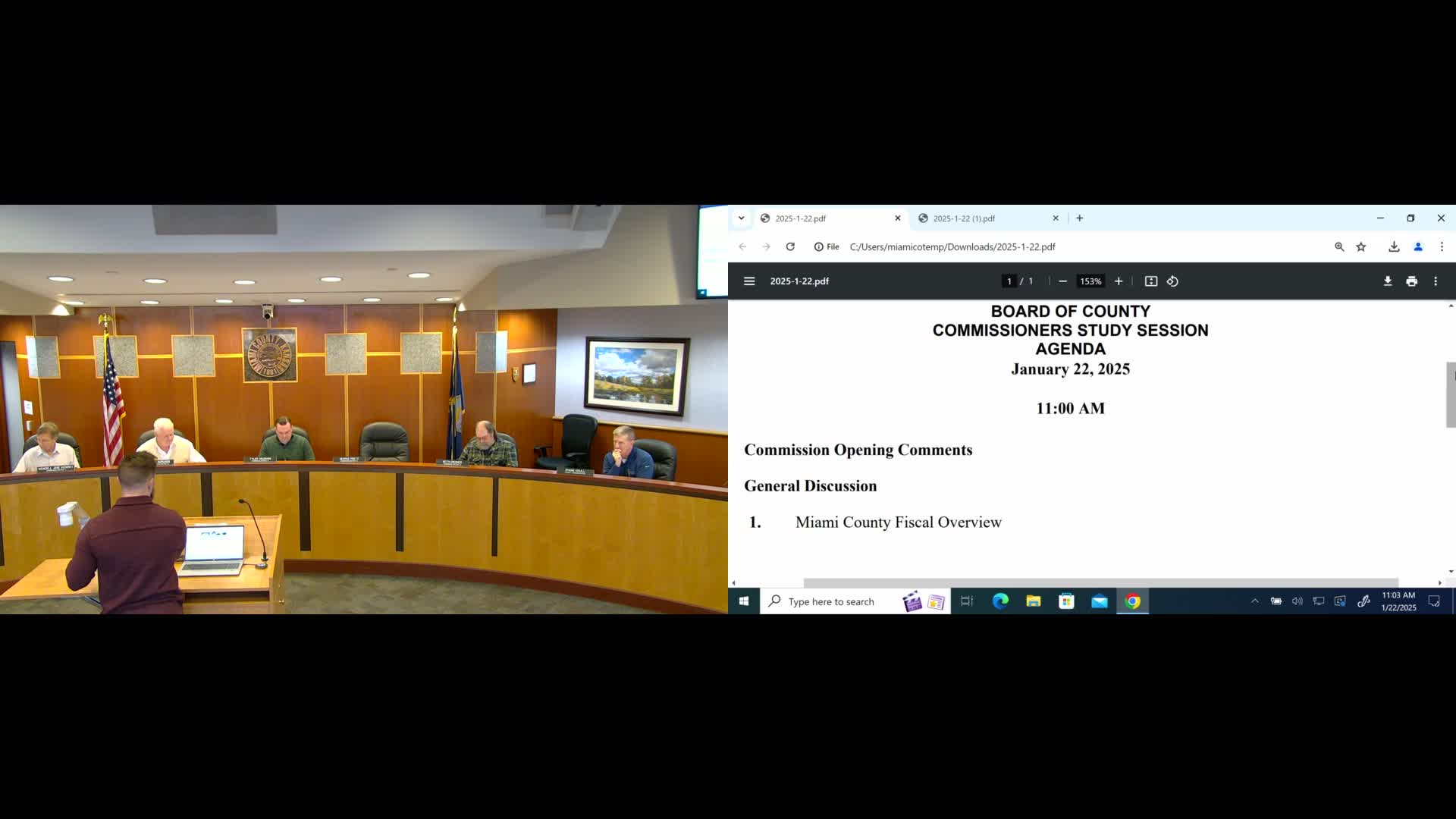
Lucas Mellinger, Miami County finance director, presented a countywide financial overview to the Board of County Commissioners that reviewed property tax breakdowns, the five levied county funds that determine Miami County's revenue-neutral mill levy, recent valuation gains and the county's debt profile.
Lucas Mellinger, Miami County finance director, presented a county financial overview to the Board of County Commissioners, detailing property tax statements, the five levied county funds that determine the county's revenue-neutral mill levy and recent valuation and mill-levy trends.
Mellinger told commissioners the county's five levied funds that comprise the Miami County revenue-neutral rate are the general fund, bond and interest (debt service), reappraisal, road and bridge and special bridge funds. "If we wanted to, we could have put all 34.767 mills into the general fund," he said, referring to the 2025 revenue-neutral figure he cited, "and we still would have been revenue neutral." He also described how the county's ad valorem (property tax) share pays a large portion of core services while many other taxing entities (schools, cities, fire districts, rec commissions and the state) take significant shares of a taxpayer's bill.
Why it matters: Mellinger said the county's total valuation has more than doubled since 2013 and described how that growth affects mill-rate calculations and revenue available for county services. He also explained how sales tax and special fees are routed into particular funds (for example, a countywide 1 sales-tax cent is apportioned between road and bridge and the general fund) and therefore do not move the general fund as much as residents might expect.
Key details and figures - Mellinger used a Spring Hill resident's tax statement as an example to illustrate the breakdown: he said the county portion represented "only 25% of the property tax" on that example bill. He identified constituent levies on the sample taxpayer: about 67 mills for schools, about 34.8 for the county, 22.9 for Spring Hill city, 13.8 for a Johnson County fire levy covering part of Spring Hill, roughly 3 mills for the rec commission and 1.5 mills for the state-related levy. - He listed the five county levied funds and recent mill-levy figures, saying the county was at about 36.5 mills in 2024 and the revenue-neutral rate for 2025 of 34.767 mills. - On debt: Mellinger said the county finished payments on the administration building in 2024 and that outstanding long-term obligations include sales-tax-funded revenue bonds used for the jail/detention center and a GEO bond for the 800-megahertz radio system. He said 56% of the county debt service is for the jail and 41% for the radio system. He said sales-tax receipts have outpaced original projections, allowing early payoff of some callable bonds and an estimated cumulative interest savings of roughly $6 million from prior refinancings. - Budget and fund totals: Mellinger said the county's combined budget across all funds is about $48,000,000 (budgeted figure). He described the reappraisal fund as a small, state-required fund at roughly $700,000 in expenses and the special-bridge fund as roughly $828,000, a long-standing budget level used for culvert and smaller bridge work. - Revenue mix: Mellinger presented a breakdown of combined revenue for the five levied funds (ad valorem ~60%, departmental fees ~12%, sales tax ~11%, motor vehicle ~5%, and other sources), and noted that an "operational transfer" line is backed by sales tax, meaning sales tax effectively funds a larger share (he calculated sales-tax-related funding at an effective 15% when transfers are included). - Valuation and mill-levy trends: He reported Miami County valuation increased from about $346 million in 2013 to about $707.2 million in 2025 (as stated in his slides), and that mill levies have fallen from highs near 49.4 mills in earlier years to the mid-30s recently.
Commissioners and staff asked for follow-up data: commissioners requested five- and ten-year averages for city and school levies and asked for more detail on the county's mill-levy components. Mellinger said he can provide those data and future slides on expense drivers.
Context and outlook Mellinger flagged near-term pressures and long-term drivers: the county will likely face equipment and technology cost increases (he cited radio-system replacement and IT/cybersecurity as material cost drivers). He also said the county has limited flexibility in the general fund from sales tax because most sales-tax proceeds are legally designated or passed through to cities. Commissioners discussed potential state-level proposals (a cap on ad valorem growth or other tax changes) and the unpredictable effect those could have on local revenue distributions.
Ending Mellinger said he will return to the board in a later meeting to present expense-side details and a deeper look at the major cost drivers within the five levied funds. "Next week... the first week in February, I'm gonna come back and we're gonna kinda talk more about expenses," he said.