Get Full Government Meeting Transcripts, Videos, & Alerts Forever!
Get email alerts on the Organized Retail Theft topic
No spam. Unsubscribe anytime.
Deputy attorney general describes governor—s HB106 to create organized retail-theft felony, criminalize medical-record and mail theft
Summary
Deputy Attorney General John Skidmore outlined HB106 at a first hearing, describing a new organized retail-theft offense defined by participation of three or more people in two or more incidents, proposed felony penalties, a new medical-records theft offense, and a class A misdemeanor for mail theft.
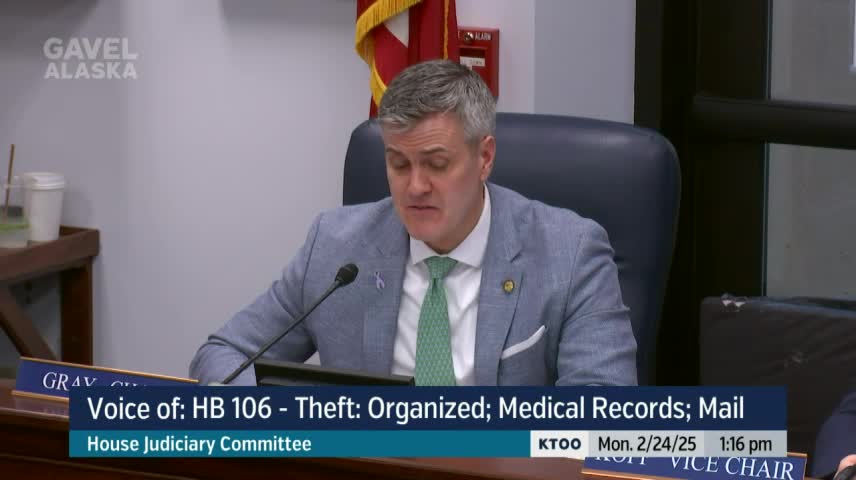
Deputy Attorney General John Skidmore, who supervises state prosecutors, presented HB106 at a first hearing of the House Judiciary Committee and described three core provisions: an organized retail-theft offense, a theft offense directed at medical records, and a mail-theft offense.
Skidmore said the bill defines organized retail theft as conduct by three or more people occurring on two or more occasions; the proposal elevates that conduct to a class A felony with a presumptive sentence range of four to seven years for a first-time offender and a maximum of 20 years. Skidmore said Alaska—s current aggregation statute (identified in testimony as AS 11.46.980(e)) allows prosecutors to add amounts taken across incidents, but that aggregation alone is ``not enough,'' prompting the governor—s proposal.
The bill would also create a theft offense for medical records and related identifying information to address privacy and identity-theft risks; Skidmore told the committee that medical records include electronically stored and physical records and said federal privacy statutes such as HIPAA protect disclosure by providers but do not criminalize theft of records. Skidmore said the bill would treat mail taken from mailboxes as a class A misdemeanor; he contrasted that approach with a separate bill mentioned by members that would add some mail theft to existing theft-in-the-second-degree provisions.
Skidmore offered national and state figures, noting an estimated $121,000,000,000 in retail losses nationally in 2023 and an estimate rising to $145,000,000,000 by 2025. He said, "In Alaska, we see approximately $2.00 $2,000,000 in theft, $222,000,000 in fraudulent returns, which is just over 400,000,000 each and every year that retailers are out here in Alaska." He also told the committee that organized retail theft can be violent and that "76 percent of loss prevention staff were injured just last year" in incidents cited in his presentation.
Committee members pressed Skidmore on several details: Representative Kopp asked how HB106 compares to a bill from Representative Colombe that treats mail theft as a class C felony; Skidmore said the bills take different approaches and that the governor—s bill focuses on mail taken from USPS mailboxes and on conduct by multiple actors. Representative Vance asked whether two people could qualify as an organized group; Skidmore said two people can be jointly liable under principal/accomplice rules but the bill sets the organized-activity element at three people to distinguish it from ordinary accomplice liability. Representative Underwood asked whether the bill would give prosecutors tools beyond current individual-theft charges; Skidmore said prosecutors could pursue the higher-level organized-theft charge where the bill—s elements are met.
No committee vote was taken at the first hearing. Members requested additional legal detail and comparison with other bills; Skidmore said staff would provide further information and that the legislature may amend the proposal as it sees fit.