Get Full Government Meeting Transcripts, Videos, & Alerts Forever!
Get email alerts on the Department Of Agriculture Creation topic
No spam. Unsubscribe anytime.
DNR outlines governor's plan to create Department of Agriculture, transfer staff and programs
Summary
The Department of Natural Resources presented the governor's amended budget items that would stand up a Department of Agriculture under Executive Order 1 36, transferring staff, the North Latitude Plant Material Center and federal grant authority while legislators pressed for detail on timing, staffing and costs.
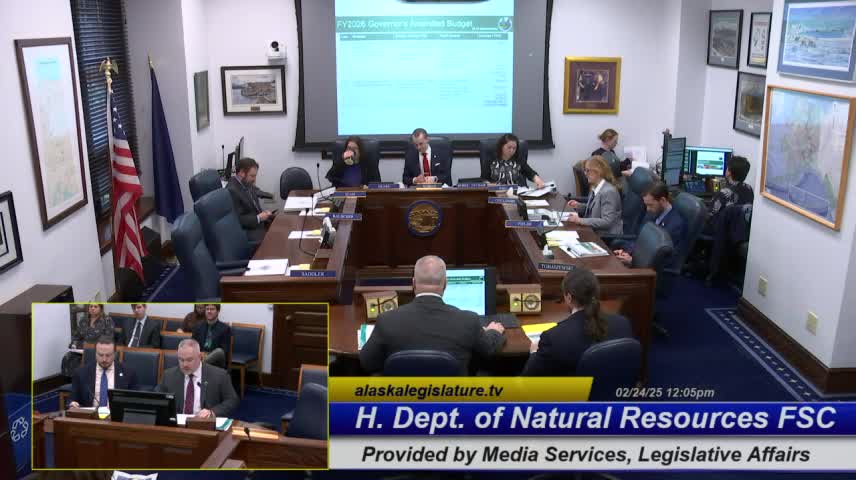
Juneau — The Department of Natural Resources on Feb. 24 presented to the House Finance DNR subcommittee the governor's amended budget items to implement Executive Order 1 36 and establish a standalone Department of Agriculture, including transfers of staff, programs and federal grant authority.
Deputy Commissioner Brent Goodrum, Department of Natural Resources, told the subcommittee that the amended FY2026 governor's budget moves multiple funding sources and positions from DNR to the proposed department and requests federal receipt authority for a microgrant program aimed at food security. "As envisioned in Executive Order 1 36, tomorrow's Department of Agriculture is a measured approach," Goodrum said, adding the leadership structure and a lean support-services team are intended to allow a new commissioner to assess priorities quickly.
Why it matters: The administration says elevating agriculture to a cabinet-level department would centralize policy and funding decisions, provide a single executive-branch contact for agriculture, and help coordinate food-security efforts the governor highlighted after supply-chain disruptions during the COVID-19 pandemic. Legislators on the subcommittee raised repeated concerns about timing, the potential for mission creep, additional costs, and how functions such as IT and land management would be shared or retained.
Details of the proposal. The presentation described three primary amended budget items tied to Executive Order 1 36: - A transfer of authority, positions and funding totaling $3,473,300 from the Department of Natural Resources' agricultural development component to the Department of Agriculture, including 17 permanent full-time positions. - A transfer of the North Latitude Plant Material Center and associated authority totaling $3,792,715 and the movement of specified permanent full-time and permanent part-time positions to the new department. - A request for $2,200,000 in federal receipt authority in FY2026 for a USDA-funded microgrant program to increase locally grown food in areas of the state with high food insecurity. Goodrum said the USDA Agricultural Marketing Service awards the funds, which are then competitively distributed as subawards.
The department also noted a FY2025 supplemental request (discussed for informational purposes) to increase federal receipt authority by roughly $3,200,000 so the division can meet current microgrant obligations for FY2025. Goodrum said the supplemental is informational to the subcommittee because supplemental appropriations are not technically within the committee's purview.
Committee questions and concerns. Representatives pressed DNR leaders on whether the transfers represent new funding or merely move existing authority. Deputy Commissioner John Crowther explained that some allocations (for example, the $45,000 fiscal note tied to Senate Bill 118) were enacted but not rolled into the baseline budget because of timing, and the amended budget item is intended to make the funding present in FY2026.
Several legislators asked about administrative costs and whether existing staff could absorb new federal grants. "These costs would be handled by existing staff both within the division as well as the anticipated staff that would be part of the Department of Agriculture when it stands up in January," Goodrum responded, noting the administration's intent to keep the commissioner's office and support services lean. Representative Sadler and others repeatedly emphasized concern about mission creep and requested clarity on who would perform public information and outreach duties.
Timing and contingency. Goodrum told the committee that the structural transfers are being put in motion on the executive branch side so the department could stand up on the administration's intended effective date in January if the legislature concurs or takes no action. He said that if the legislature were to oppose creation of the department, the structural items would be undone and the division of agriculture would remain within DNR.
Staffing and costs. The presentation listed 13 new permanent full-time positions in the proposed commissioner's office and support services, with an added unrestricted general fund increment of roughly $2.734 million. The administration's FY2026 estimate for a Department of Agriculture totaled about $12.2 million, with roughly one-third of that shown as federal receipt authority. DNR emphasized the new support-services team would be "very lean," while acknowledging officials will revise roles once a commissioner is in place.
Commissioner Christian Boyle, appearing online, framed the initiative as a response to food-security vulnerabilities revealed during the pandemic and said task force recommendations supported creating a department to elevate agriculture within state government and at the governor's cabinet level.
Next steps. The presentation was informational; the subcommittee did not take a formal vote on the amended budget items during the hearing. Several legislators asked the department to provide additional detail on the agriculture revolving loan fund, average loan sizes, and the fund's current balance; DNR staff said they would follow up with more specifics.