Get Full Government Meeting Transcripts, Videos, & Alerts Forever!
Get email alerts on the Payday Lending Regulation topic
No spam. Unsubscribe anytime.
Alaska committee advances bill capping short‑term loan costs after hours of divided testimony
Summary
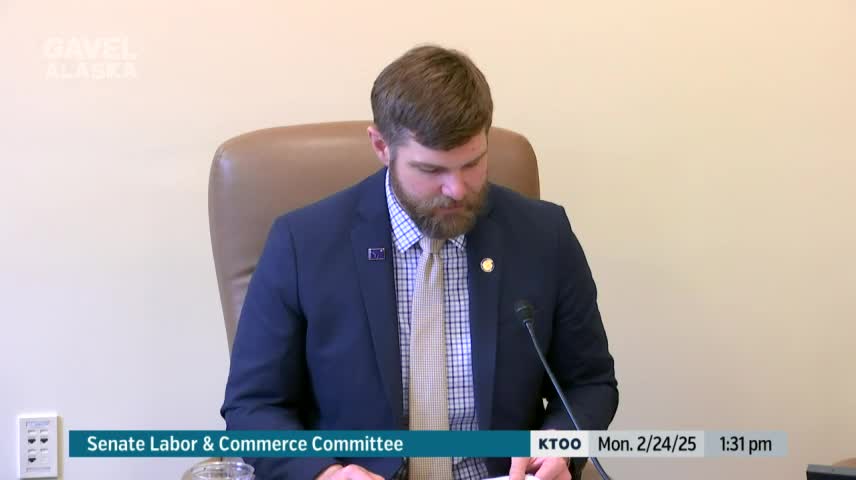
Senate Labor and Commerce Committee members advanced Senate Bill 39 on unanimous consent Monday after a two‑hour hearing that drew lenders, trade groups and consumer advocates to testify about whether a statewide interest‑rate cap would help or harm Alaskans.
Senate Labor and Commerce Committee members advanced Senate Bill 39 on unanimous consent Monday after a two‑hour hearing that drew lenders, trade groups and consumer advocates to testify about whether a statewide interest‑rate cap would help or harm Alaskans.
Senator Forrest Dunbar, sponsor (Senator from District J), said the bill would remove payday lenders from exemptions in state code, expand the definition of a lender to close evasion loopholes, require use of the nationwide multistate licensing registry, change licensing fees and per‑location application rules, and set a uniform cap of 3% per month for loans under $25,000 and for open‑ended loans. Rachel Levy, staff to Senator Dunbar, walked the committee through the bill’s sectional analysis and the proposed technical amendments.
The bill matters because it would reshape how short‑term, small‑dollar credit is offered and regulated in Alaska. Supporters say existing payday products charge predatory rates and disproportionately harm rural and vulnerable borrowers; opponents say a hard cap will eliminate regulated lending and push borrowers to unregulated or offshore lenders.
Supporters of the bill included Erin Baldmunde, economic justice organizer for Alaska Public Interest Research Group, who said the state’s payday market extracts tens of millions of dollars annually and that roughly 70% of payday loans in Alaska are accessed online. Baldmunde told the committee an average APR of “435 percent on a payday loan is absolutely predatory,” and urged the panel to “please carry on with this effort.” Katie Stephens, deputy program manager for the state Tobacco Prevention Control program, was not part of this bill’s testimony; her testimony was for a separate bill heard later in the meeting.
Trade groups and lenders testified strongly against the proposal. Ed D’Alessio, executive director of INFIN (a trade association representing state‑licensed consumer finance companies), said SB 39 “would eliminate the ability of Alaskans to access regulated short‑term small‑dollar loans,” arguing lenders in other states closed after caps were imposed. Andrew Duke, head of the Online Lenders Alliance, and Danielle Arlo, senior vice president of the American Financial Services Association, gave similar testimony that limiting allowable costs would cause licensed lenders to exit the market, reducing safe access to small loans. Cort Walker, vice president of product and risk for an Alaska‑licensed lender, told the committee lenders work to assess ability to repay and that the state’s deferred‑deposit law already has “several effective guardrails.”
Industry witnesses highlighted operational details in the bill: a shift to per‑branch licensing fees ($500 per branch, website, or mobile application and $2,000 for a company license as described in staff testimony), requirements to submit separate applications for each business location, and a proposed effective date of July 1, 2025. Senator Dunbar said the bill includes a non‑evasion clause and provisions intended to help regulators address offshore or online predatory lenders.
Several witnesses framed the experience of other states differently. Patrick Brenner of the Southwest Public Policy Institute and witnesses from lender associations cited New Mexico and Illinois as examples where caps reduced licensed lending and pushed borrowers to higher‑cost or unregulated options. Proponents of a cap pointed to local credit unions offering small‑dollar products at lower APRs and argued that raising access to those alternatives is feasible.
After public testimony, Senator Merrick moved to report the bill from committee “version 34 LS0357alpha as amended … with individual recommendations and attached fiscal note.” There was no objection and the committee announced SB 39 as moved from committee with individual recommendations and an attached fiscal note.
What the committee did not decide: the committee did not take a roll‑call vote on the bill’s substantive provisions, did not mark up final statutory language in session, and did not set a floor date. Several witnesses asked for the committee to consider additional definitional clarifications and to work with stakeholders on language before subsequent referral.
Votes at a glance: the committee’s procedural motion to report SB 39 out of committee was made by Senator Merrick and carried by unanimous consent; no roll‑call tally was recorded in the transcript.
Speakers quoted in this article are drawn from the committee record and were present in the hearing transcript: Forrest Dunbar (Senator, sponsor), Rachel Levy (staff to Senator Dunbar), Patrick Brenner (Southwest Public Policy Institute), Ed D’Alessio (executive director, INFIN), Cort Walker (vice president, lender), Erin Baldmunde (economic justice organizer, Alaska PIRG), Joe Rubin (Opportunity Financial), Danielle Arlo (senior vice president, American Financial Services Association), Andrew Duke (Online Lenders Alliance), Noel Lowe (owner, Alaska Fast Cash), Senator Merrick (committee member who moved the committee action), and Senator Bjorkman (chair).
Ending: The committee’s action sends the bill toward further committee consideration with a fiscal note and recommended changes; sponsors and opponents signaled they expect additional negotiations and technical edits before any final floor action.