Get Full Government Meeting Transcripts, Videos, & Alerts Forever!
Get email alerts on the Mining Sector topic
No spam. Unsubscribe anytime.
Mining industry briefs Senate Resources on operations, workforce and 7(i) revenue exposure
Summary
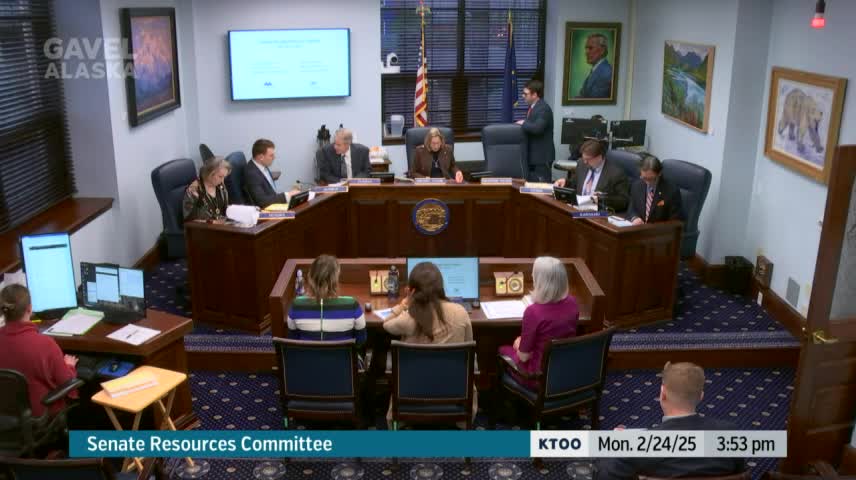
Representatives from Alaska Metal Mines, Teck (Red Dog), Donlin Gold, the Alaska Miners Association and a placer miner briefed the Senate Resources Committee on Feb. 24 about operations, workforce needs, environmental monitoring and revenue implications tied to mining activity, including potential effects on ANCSA 7(i)/7(j) distributions.
Representatives of Alaska Metal Mines, the Alaska Miners Association, Teck (operator at Red Dog), Donlin Gold and a small placer miner briefed the Senate Resources Committee on Feb. 24 about mine operations, workforce challenges, environmental monitoring and the state and local revenues tied to mineral development.
Karen Mathias, executive director of Alaska Metal Mines, said the industry supports thousands of Alaska jobs and high wages: the committee packet cited an industry estimate of about 11,800 total jobs (direct, indirect and induced) and a combined payroll just over $1 billion for 2023, with an average annual wage of about $122,000. Mathias also summarized the statewide map of active operations and advanced projects and said miners live in more than 90 Alaska communities.
Greta Shirk, senior advisor for government and external affairs at Teck (Red Dog operator), reviewed Red Dog operations, describing the mine and port logistics, the subsistence committee that provides local oversight on shipping and wildlife interactions, and Teck’s exploration and permitting work on adjacent state lands. She said the current life of the Red Dog operations on NANA lands is anticipated through 2031 but that exploration on adjacent state lands is underway and a decision on potential extension would require about five more years of exploration and subsequent economic evaluation.
Chris Eckert of Donlin Gold described project logistics including a planned long natural gas pipeline right-of-way and a river-barge supply route; he said federal permitting (EIS completed in 2018) is in an appeals phase and that the company expects approximately two more years to resolve outstanding appeals before a sanction decision. Eckert described environmental baseline and monitoring efforts on aquatic resources, pilot wetlands mitigation and a community-driven fish monitoring pilot to close data gaps on juvenile smelt escapement.
Bronk Jorgensen, a placer miner and trustee for the 40 Mile Mining District, described small-scale placer practices and reclamation experience. He presented photos and described multi-year reclamation work to reestablish stream channels and bank stability, noting that effective, lower-cost approaches often imitate natural beaver-style structures and that reclamation is an ongoing challenge for family operations.
Speakers and committee members discussed workforce composition and nonresident-hire rates, access to capital for small miners, tax and royalty streams, and the centrality of 7(i)/7(j) ANCSA revenue sharing. Mathias reported that Red Dog (NANA) has been the state’s largest contributor to 7(i) revenue: she cited $3.2 billion in total since 1989 and $235 million in 2023 (figures as presented). Committee members and industry representatives noted the prospect of a revenue “gap” or “fiscal cliff” for villages and regional corporations if work on NANA lands declines without replacement revenues.
Mathias and other presenters also summarized state-level receipts from mining (local-government payments and taxes); they highlighted the mining-license tax structure and corporate-income tax as additional state revenue sources and noted that year-to-year calculations can vary with commodity prices, refunds and timing differences between fiscal and calendar years.
Committee members asked detailed operational and timing questions: Teck and Donlin representatives described exploration and permitting time frames (multi-year exploration and appeals before potential sanctioning; construction windows of several years before production), Red Dog’s limited Arctic shipping season and subsistence coordination, and Donlin’s aquatic monitoring pilots intended for community operation once established.
No formal committee action followed this invited testimony; the presentations were informational. The committee adjourned at 5:02 p.m.