Get Full Government Meeting Transcripts, Videos, & Alerts Forever!
Get email alerts on the Waste Recycling topic
No spam. Unsubscribe anytime.
Senate Resources advances electronic-device recycling bill after task-force testimony
Summary
The Senate Resources Committee adopted and reported out a committee substitute for Senate Bill 61, creating an electronic device recycling program with several changes after invited testimony and public comment about existing Alaska logistics and funding gaps.
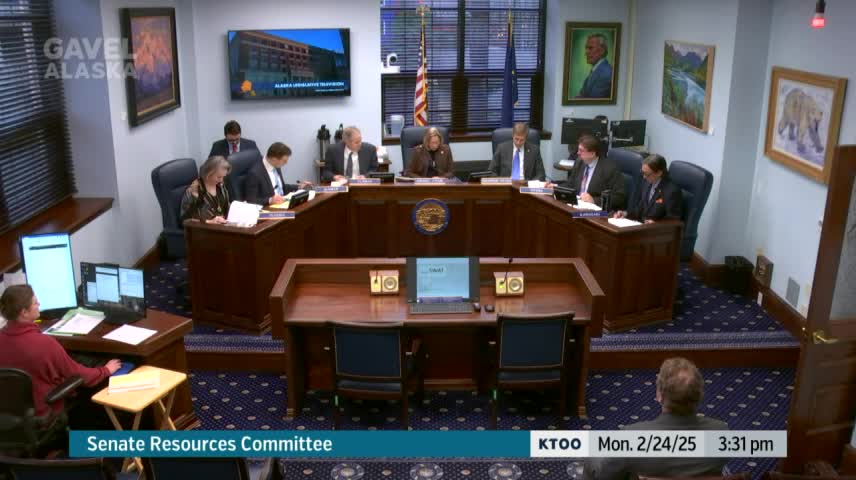
The Senate Resources Committee on Feb. 24 adopted a committee substitute for Senate Bill 61, a proposal to establish an electronic-device recycling program in Alaska, and voted to report the substitute out of committee with individual recommendations and attached fiscal notes.
Committee Chair Senator Jesse Giesel said the substitute would serve as the working document after members removed objections and adopted it by voice vote. Senator Wilkowski moved the final committee action; no member registered an objection on the record.
Louis Flora, staff to Senator L. Tobin, walked the committee through key edits in the working draft. Changes give manufacturers the ability to propose fewer permanent collection sites or fewer collection events if they demonstrate that a community has safe, adequate storage for devices; delete a specific penalty for knowingly mixing electronic devices with landfill waste; permit the program council to meet virtually as well as in person; exclude Food and Drug Administration–regulated medical devices from the covered list; and remove microwave ovens and broadly defined “battery-containing electronic devices” from the bill’s covered-device definition. Flora said some changes came after stakeholder and medical-association concerns and work with committee members.
Riley Kosinski of the Solid Waste Alaska Task Force and Backhaul Alaska told the committee Alaska already has logistics and partners that ship recyclables from remote communities using existing freight routes. Kosinski said Backhaul Alaska started in 2018, has supported roughly 100 operational activities similar to those asked of manufacturers in SB 61 (training, pop-up collections, logistics) and estimated about 70% of Alaska communities already have some access to e-waste recycling or events. He warned that Backhaul Alaska’s federal funding is largely expiring this summer and that programmatic grant uncertainty limits long-term planning; he said a statutory program would create stable, long-term funding and coordination.
Alyssa Murphy, an environmental specialist with the State of Alaska and secretary of a local recycling nonprofit, testified in support, saying local electronics collection events are intensive and costly and that community organizations want legislation to reduce the burden on individual communities.
The committee accepted the committee substitute as its working document and later moved, without recorded objection, to report the substitute out of committee “as amended” with individual recommendations and attached fiscal notes; legislative legal staff were authorized to make technical and conforming changes. The committee did not record a roll-call tally on the floor; the motion passed on a voice vote with no objections recorded in committee.
The substitute remains before the full Legislature; committee staff indicated the bill package includes an attached fiscal note and will be transmitted per standard procedure.