Lifetime Citizen Portal Access — AI Briefings, Alerts & Unlimited Follows
TEDCO outlines investments and warns fiscal 2026 stem‑cell cut will reduce commercialization supports
Loading...
Summary
TEDCO officials described program allocations, new and expanding funds for commercialization and equity, and warned a proposed $5 million reduction for the Maryland Stem Cell Research Fund could slow manufacturing and late‑stage development support.
Maryland Technology Development Corporation (TEDCO) leaders and the Department of Legislative Services analyst presented the corporation’s fiscal 2026 allowance to the Education, Business and Administration Subcommittee on Feb. 14 and described how TEDCO’s grants and investment programs support university commercialization, minority‑led funds and manufacturing for regenerative medicine.
DLS analyst Elizabeth Weibel said TEDCO’s fiscal 2026 allowance is $53 million, a decrease of about $5 million largely attributable to lower planned spending for the Maryland Stem Cell Research Fund. She outlined allocation categories that include the Stem Cell Research Fund ($15.5 million, 29%), social impact investment funds ($13 million, 25%), and university research and commercialization programs such as the Maryland Innovation Initiative (about $7 million, 14%). The analyst also noted a decrease in Cyber Maryland funding to a mandated minimum and that legislation could move Cyber Maryland to the Department of Labor.
TEDCO Chair Ellen Flowers Field highlighted the corporation’s role in stitching together university, industry and workforce development, and CEO Troy Lamail Stovall described TEDCO’s recent initiatives: the Equitec growth fund (infrastructure and workforce investments), a concept fund for very early‑stage ideas, the Maryland Innovation Initiative expansion to more campuses, and an entrepreneur expo in Baltimore that drew more than 1,000 participants. Stovall said the corporation has produced substantial economic impact over its 26‑year history, including private capital attracted into Maryland companies and job creation.
Panel speakers described the stem cell research fund’s evolution from discovery grants to later‑stage and manufacturing assistance grants. DLS asked TEDCO whether the fund should consider loans as well as grants for later‑stage companies; TEDCO staff said grant making remains appropriate because earlier‑stage research is high risk and the stem cell program currently lacks the staffing and underwriting capacity to run a loan program.
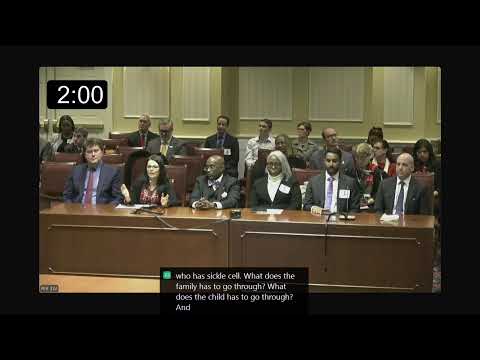
Representatives of TEDCO‑supported companies outlined commercialization outcomes. Seeing Health, a Johns Hopkins spinout that received early support from the Maryland Innovation Initiative and TEDCO seed investment, said its telehealth product is used by public health departments for directly observed therapies, has supported millions of observed doses and contributed sustained jobs. Theradaptive, a regenerative medicine company that began with an MSCRF award and TEDCO support, said it has leveraged state funding to attract more than $60 million in additional private investment, created local jobs and advanced a bone graft product now used in Maryland hospitals.
TEDCO and affiliated program leaders urged continued state support for the stem cell funding portfolio, manufacturing assistance grants, and expanded university commercialization programs, arguing that those investments drive later‑stage company formation, jobs and tax revenue in Maryland.