Get Full Government Meeting Transcripts, Videos, & Alerts Forever!
Get email alerts on the Police Misconduct Policy Review topic
No spam. Unsubscribe anytime.
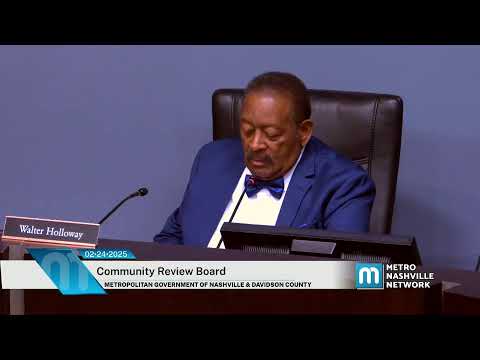
Community Review Board weighs Metro HR review of police misconduct policy advisory report
Summary
The Community Review Board discussed Metro Human Resources’ review of the board’s policy advisory report on police misconduct and harassment, heard recommended edits to align the draft with civil service and public-records rules, and voted to pursue edits and further conversations with MMPD about implementation.
The Community Review Board on Feb. 24 reviewed Metro Human Resources’ written responses to the board’s policy advisory report on police misconduct and harassment and discussed edits to align the draft with Metro civil-service rules and state public-records obligations.
Lead research analyst Ainsley Potter summarized Metro HR’s review and told the board HR highlighted several supported elements of the draft, including victim-assistance best practices, a descriptive list of prohibited behaviors and recommended “early warning signs” for training. Potter said Metro HR recommended structural wording changes, inclusion of Metro Human Resources as an alternate reporting option, and softer confidentiality language consistent with the Tennessee Public Records Act: “due to the Tennessee Public Records Act, changing the language to maintain confidentiality to the degree allowed by law is more accurate while also emphasizing the importance of maintaining confidentiality,” Potter said.
The board’s executive director, Jill Fichard, said many of Metro HR’s comments are edits rather than substantive rejections, but she noted two areas of disagreement that will require follow-up: the board’s proposed use of an implicit-bias assessment in recruitment screening and a recommendation that transfers or reassignments be voluntary with respect to complainants. Potter described Metro HR’s position that using implicit-bias test scores to exclude applicants could create discrimination risks and recommended consulting MMPD and psychologists about whether the test could be a permitted part of psychological screening. On voluntary reassignment, Potter said Metro HR flagged tension with appointing authorities’ management rights; the board discussed alternative wording to protect complainants without restricting management authority.
Board members questioned whether parts of the board’s recommendations had been misinterpreted by HR. Potter clarified that a reference in the advisory report’s introduction to an external “blind review” by organizations such as the YWCA refers to materials cited in the report’s introduction and was not a recommendation to disclose complainants’ identities. Potter also described the report’s proposed memoranda of understanding (MOUs) with advocacy groups as a mechanism to allow victims uncomfortable reporting directly to OPA or MMPD to trigger a complaint and investigative process, not for outside groups to conduct investigations themselves.
Board member Brown asked how the board should respond to the HR review; Fichard said staff will consider making edits recommended by Metro HR and publishing an addendum that documents the tweaks. Several members asked for additional MMPD engagement; Potter said HR recommended further review with MMPD to tailor implementation where the draft crosses from policy advisory into department practice.
The board did not adopt final language at the meeting. Members directed staff to prepare edited language that incorporates Metro HR’s clarifications where appropriate, to re-check sections Metro HR declined to review, and to pursue follow-up conversations with MMPD about implementation and training.
Ending: The board’s discussion closed with a request that staff present draft edits and a proposed path to implementation at a future meeting; Potter said she would revisit the integrity-audit and implementation sections and bring proposals for next steps.