Get Full Government Meeting Transcripts, Videos, & Alerts Forever!
Get email alerts on the Internal Audit topic
No spam. Unsubscribe anytime.
City auditor releases triennial audit plan, flags P‑card, payroll and overtime risks
Summary
City Auditor Shakir Kalanick presented a triennial audit plan covering FY25–FY27 that prioritizes credit‑card (P‑card) controls, payroll/timekeeping integration and overtime spending. The auditor said the office is a single‑person unit and requested additional staffing and continuous‑monitoring tools to expand audit capacity.
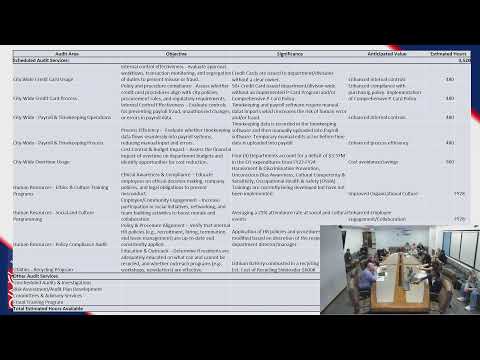
City Auditor Shakir Kalanick presented a draft triennial audit plan to the Finance Committee on Feb. 20 that lays out top‑risk areas for fiscal years 2025–2027 and requests additional resources to expand audit coverage.
Kalanick said the office performed a risk assessment across 13 departments and identified credit‑card controls (P‑card program), payroll/timekeeping integration, overtime budgeting, human resources policy compliance and the relatively new recycling program among the top risks. Kalanick said the office is currently one person and is “capped at 6 audits in 3 years,” a staffing level he described as insufficient to meet the city’s audit needs. He asked council to consider adding at least one auditor to increase capacity.
Why it matters: The audit plan identifies operational risks that can lead to financial loss, fraud or budgetary strain. The auditor emphasized proactive controls, recommended a comprehensive P‑card policy, and proposed investments in case‑management and continuous‑monitoring software to detect anomalies more quickly.
Key details presented: - P‑card/credit‑card usage: Kalanick said more than 50 credit cards are issued across city departments without a single, comprehensive P‑card program and recommended identifying single owners for issued cards and implementing unified procedures and monitoring. He noted this is “low‑hanging audit fruit.” - Payroll/timekeeping: The auditor flagged a manual data‑transfer step between timekeeping and payroll systems that raises the risk of error or misuse and recommended increased automation to reduce that risk. - Overtime: Kalanick said four departments accounted for an overtime deficit of about $3,370,000 from 2022–2024 and identified overtime cost control and budget impact as an audit priority. - Human resources: Kalanick recommended citywide implementation of ethics, harassment prevention, unconscious bias and OSHA training; he said current social and cultural programming attendance averages about 25% of invitees. - Capacity and tools: The auditor requested additional staff, the ability to hire subject‑matter specialists for investigations, implementation of case‑management software and deployment of continuous monitoring/analytics tools tied to the city’s ERP system.
Kalanick also provided an anonymous reporting hotline (partner firm): (866) 912‑5378 and described the office’s plan to present an updated internal audit charter and to schedule an overtime audit in the next month.
Ending: The committee heard the draft plan and invited feedback; Kalanick said he will return a final plan for adoption after incorporating committee input and confirming staffing and software budget requests.