Get Full Government Meeting Transcripts, Videos, & Alerts Forever!
Get email alerts on the Renewable Energy Tax topic
No spam. Unsubscribe anytime.
Bill would replace personal‑property taxes on large wind/solar with an excise tied to nameplate capacity and create local investment grants
Summary
House Bill 19‑60 would exempt personal property at large wind, solar and storage facilities from property tax, replace that revenue with a new renewable‑energy excise tied to nameplate capacity, and use excise receipts for tribal capacity grants and local community investment grants.
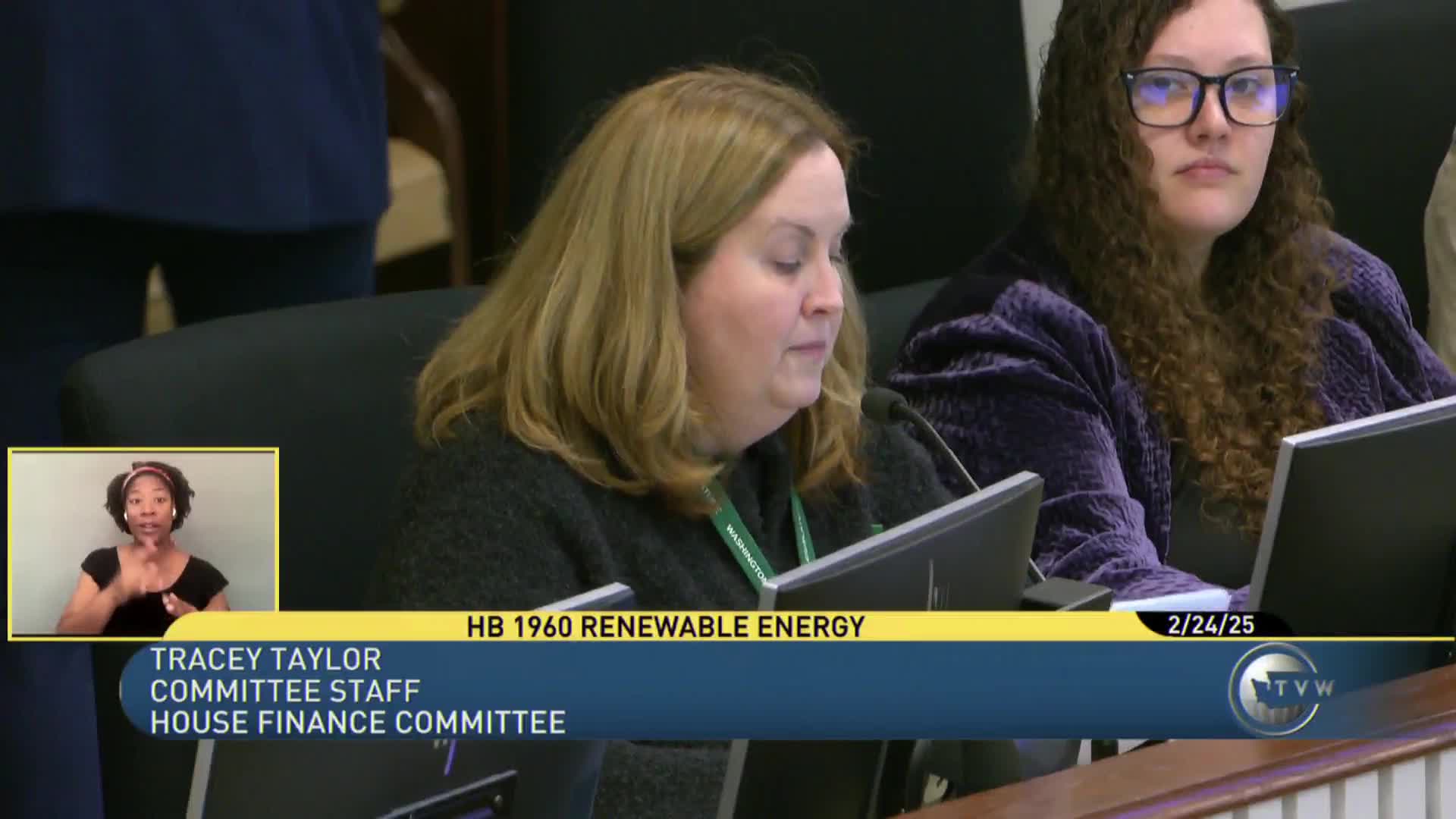
A complex proposal to change how large wind and solar projects are taxed in Washington drew extensive testimony and sharp questions on Feb. 24 as House Finance took up House Bill 19‑60.
Under the bill, personal property used exclusively for generation or storage at qualified renewable energy facilities (defined in the bill as solar or wind facilities with at least 50 MW nameplate capacity) would be exempt from property taxes beginning in 2027. In place of the property tax on that personal property, the bill would impose a renewable energy excise tax on qualified systems beginning Jan. 1, 2027, with rates that vary by technology and age and annual inflation adjustments thereafter.
Committee staff said the excise revenues would be apportioned between the state and counties; state receipts would be deposited in a new renewable energy local benefit account and local receipts in a local community investment account to be distributed to counties and then to taxing districts in proportion to prior-year levy shares. The bill would also repeal the production excise tax enacted in 2023 and its personal‑property exemption.
Part of the bill establishes two new spending programs: (1) a tribal capacity grant program that would provide biannual grants to federally recognized tribes (the bill contemplates continuing a temporary program funded in the operating budget, with an initial intent to use Climate Commitment Act funds in 2025 and thereafter up to 50% of local community investment account revenues to support the tribal grants); and (2) a Department of Commerce‑run local community investment matching grant program for wind, solar and storage projects that meet siting, tribal-notification and local-benefit criteria. Commerce could retain up to 5% of funds for administration.
Supporters said the bill aims to remove a budgeting problem counties face when large clean-energy projects’ personal property is added to local tax rolls and then depreciates, shifting tax burdens to other local property owners over time. Representative Alex Ramel, the sponsor, said the excise is intended to “levelize” the amount paid by projects over their lifespans and preserve predictable revenue for junior taxing districts.
Opponents and cautious stakeholders raised several concerns. Renewable developers and project owners warned that applying a new tax structure retroactively to existing projects would undermine financing and power‑purchase agreements and create market uncertainty. NextEra said its projects have already paid significant property taxes and that changing tax structure mid‑stream would be harmful. Renewable industry groups urged applying the new structure only to new and repowered projects and asked for more time to resolve open issues, including exact rates, the treatment of stand‑alone storage, and thresholds.
County treasurers and assessors urged changes to reduce administrative complexity and cost, including requiring DOR to provide technical assistance to counties, a regular DOR market‑value study to support consistent valuations, and a phased transition option rather than a single‑year shift. Several treasurers asked to receive excise collections locally rather than through the state.
Staff fiscal estimates provided a preliminary DOR draft showing a modest reduction in state property-tax revenues in early years and projecting new excise receipts that begin small in 2027 and grow in future biennia; staff emphasized the numbers are preliminary and depend on assumptions about project counts and capacities.
Ending: Lawmakers and stakeholders described the proposal as addressing a real local budgeting problem but flagged unresolved design, rate-setting and transition issues — especially the proposed treatment of existing projects — and asked for further technical work before advancing the bill.