Get Full Government Meeting Transcripts, Videos, & Alerts Forever!
Get email alerts on the Transportation.infrastructure.bridges topic
No spam. Unsubscribe anytime.
Committee hears bill to authorize up to $1.6 billion in bonds for I‑5 Columbia River bridge replacement
Summary
The House Transportation Committee heard testimony on House Bill 19-58, which would authorize up to $1.6 billion in state bonding — repayable first from toll revenue — to help finance design, right-of-way and construction of the Interstate Bridge Replacement project connecting Vancouver, Wash., and Portland, Ore.
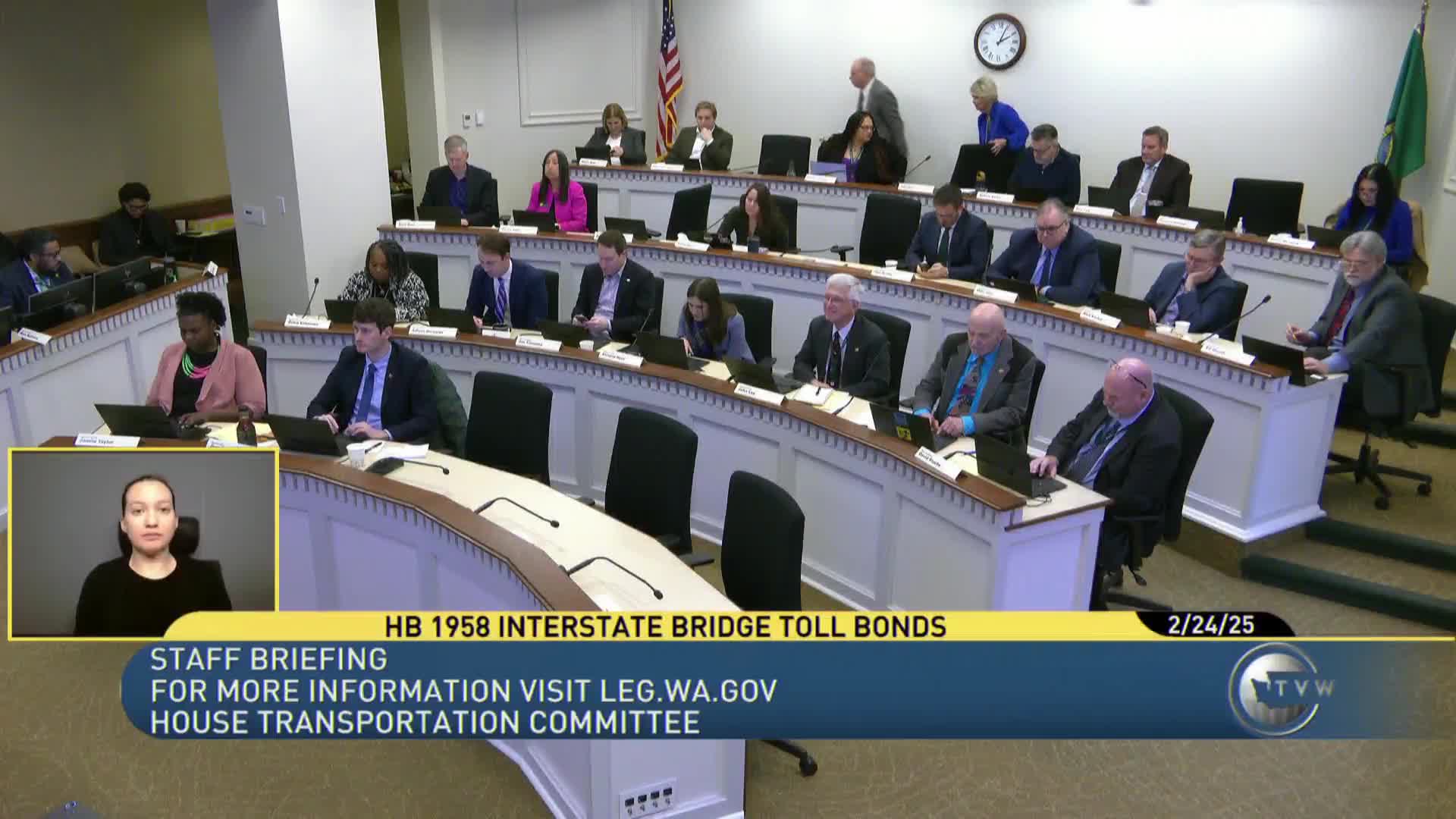
The House Transportation Committee on Feb. 24 heard a briefing and public testimony on House Bill 19-58, an agency-request measure that would authorize up to $1.6 billion in bonds to help fund design, right-of-way and construction of the Interstate Bridge Replacement (IBR) project on I‑5 over the Columbia River.
The bill would allow the state to issue general obligation bonds backing repayment first by toll revenue and then by fuel excise taxes and vehicle fees, or, if determined beneficial, to issue revenue bonds. It also explicitly contemplates Washington acting as a TIFIA applicant for federal credit assistance. "The legislation is a necessary step forward for this important project, authorizing up to $1,600,000,000.0 in bond financing to fund the design, right of way and construction of the interstate bridge replacement project," Doug Vaughn, WSDOT principal financial officer, told the committee.
Why it matters: The I‑5 Columbia River Bridge is nearing the end of its service life and is a critical freight and passenger link for the Pacific Northwest. The project already has federal and state commitments — the committee heard that $2 billion in federal funds and prior state allocations are part of the finance plan — but sponsors say additional local-state financing authority is needed to complete an overall package. Testimony emphasized the project’s regional economic importance and the role of tolling in closing the funding gap.
What the bill would do: Under HB 19-58 the state finance committee could authorize up to $1.6 billion in bonding to deposit into an IBR account for project purposes. The bill allows flexibility in financing form: general obligation bonds that are first payable from tolls (with state full faith and credit) or issuance as revenue/TIFIA loans if found beneficial. The transportation commission remains the tolling authority and the bill keeps existing statutory conditions that tolling may not begin until required federal, state and bi-state conditions are satisfied.
Fiscal and implementation details: WSDOT and the Office of the State Treasurer have discussed financing options; Mark Bennison of the Treasurer’s office explained a notional scenario: if all bonds were issued at once on a 25-year term, annual debt service could be in the $110–140 million per year range. WSDOT’s Doug Vaughn described the $1.6 billion as an authorization ceiling and said actual issuance would be tied to appropriations and projected revenues. He also outlined the department’s intent to share costs equally with Oregon and that the agency is undertaking an investment-grade traffic and revenue analysis for the facility.
Public testimony: Supporters included labor and local-government leaders who framed the bill as necessary to move the long-delayed project forward and create construction jobs. Heather Kurtenbach of the Washington State Building and Construction Trades Council said bonding against toll revenue "provides funding sooner than pay as you go, ensuring we will be replacing this piece of failing infrastructure." Mayor Anne McInerney Ogle of Vancouver, Wash., and representatives of the Port of Vancouver and business groups testified in favor, citing freight mobility and economic impacts.
Opponents and concerns: Opposition testimony focused on project scope, transit elements (including light rail), modeling and tolling impacts. Speakers asked for clarity on the state’s contingent liability if toll revenues fall short and whether Oregon would share bond obligations. In response, WSDOT and Treasurer staff said financing structures and intergovernmental agreements remain to be finalized and that some options would limit state pledge to tolls (e.g., TIFIA), while others would involve the state's full faith and credit for a Washington share of debt.
Committee questions and next steps: Committee members pressed for more detail on timing of when tolls might be implemented, how Oregon will share liabilities, and the outcome of the ongoing traffic and revenue work. WSDOT said program staff would follow up with specific timing and that financing form had not been decided. The bill, which would take effect 90 days after adjournment, was accompanied by testimony across a range of stakeholders and no formal vote was recorded during the hearing.
Ending: The committee recessed the hearing after public testimony and WSDOT staff said they would continue work with the state treasurer and Oregon counterparts to refine financing language before moving forward.