Get Full Government Meeting Transcripts, Videos, & Alerts Forever!
Get email alerts on the Clean Fuels Program topic
No spam. Unsubscribe anytime.
Committee hears proposal to tighten Washington's Clean Fuels Program and change penalties
Summary
Substitute House Bill 14-09 would accelerate carbon intensity reductions under Washington's Clean Fuels Program, change enforcement penalties to a program-specific scheme, and require Ecology to analyze credit markets; supporters said stronger standards would drive investments while opponents warned of higher fuel costs and downstream budgetary
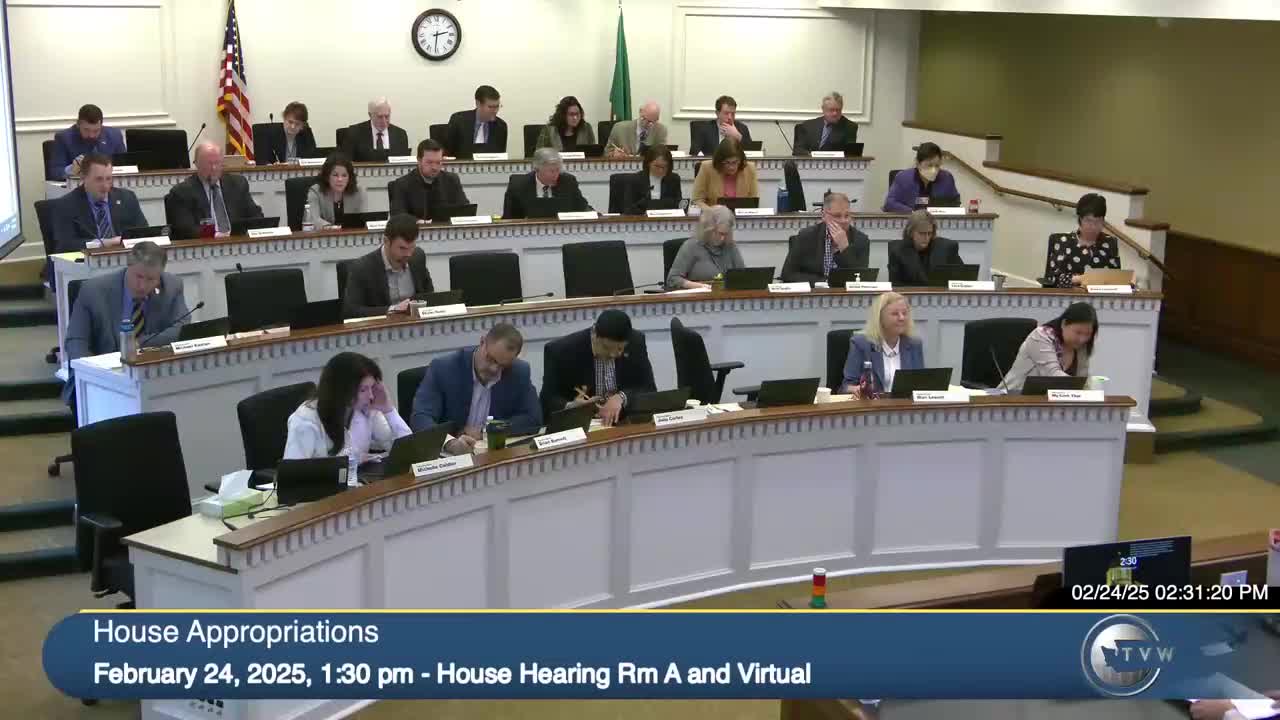
The House Appropriations Committee received a staff briefing and public testimony on substitute House Bill 14-09, which would amend Washington's Clean Fuels Program by changing the carbon-intensity reduction schedule, removing a contingency tied to in-state biofuel facilities and replacing Clean Air Act enforcement penalties with a program-specific penalty structure.
Staff explained the program: Ecology assigns deficits or credits to regulated parties based on fuels' carbon intensity; regulated entities must obtain credits to cover deficits, either by producing low-carbon fuels or buying credits. The substitute would set a more aggressive reduction pathway — staff summarized a target that could reach a 55% reduction below 2017 levels by 2038, with step-downs starting in 2027 — and remove a pause tied to a JLARC review and in-state biofuel facility triggers in current law.
Environmental groups and biofuel industry representatives testified in support. Clean Fuels Alliance America and other backers said a stronger standard would accelerate decarbonization of the transportation sector, improve air quality and create market certainty that encourages investment in renewable diesel, sustainable aviation fuels and renewable natural gas. Supporters said the program is funded by regulated parties rather than state general fund appropriations and could stimulate private investment and EV infrastructure.
Opponents raised concerns about consumer and state budget impacts. The Washington State Petroleum Association and business groups warned that increased stringency would raise fuels' costs at the pump; staff cited earlier analysis estimating potential increases in cents per gallon depending on credit prices. Industry witnesses asked for clarity about the removal of a statutory trigger requiring in-state biofuel production and raised questions about the new penalty framework for enforcement; some urged restoring a trigger or ensuring clarity around credit-market modeling.
Staff said Ecology administrative costs for rulemaking and market-analysis responsibilities under the substitute would be covered by fees paid by regulated entities, although Ecology would need initial appropriation authority because the first fee payment from a producer responsibility organization is not scheduled to arrive immediately. Staff noted the fiscal note on the substitute was not yet complete and that Ecology estimated additional workload for rulemaking and compliance oversight.
The committee heard requests from conservation advocates for collaboration on design details and from utilities and RNG (renewable natural gas) industry representatives who outlined how the program could stimulate investments in RNG projects and other low-carbon fuels.
No committee action was taken; staff will update members when a complete fiscal note for the substitute is available.