Get Full Government Meeting Transcripts, Videos, & Alerts Forever!
Get email alerts on the Firearms Permit To Purchase topic
No spam. Unsubscribe anytime.
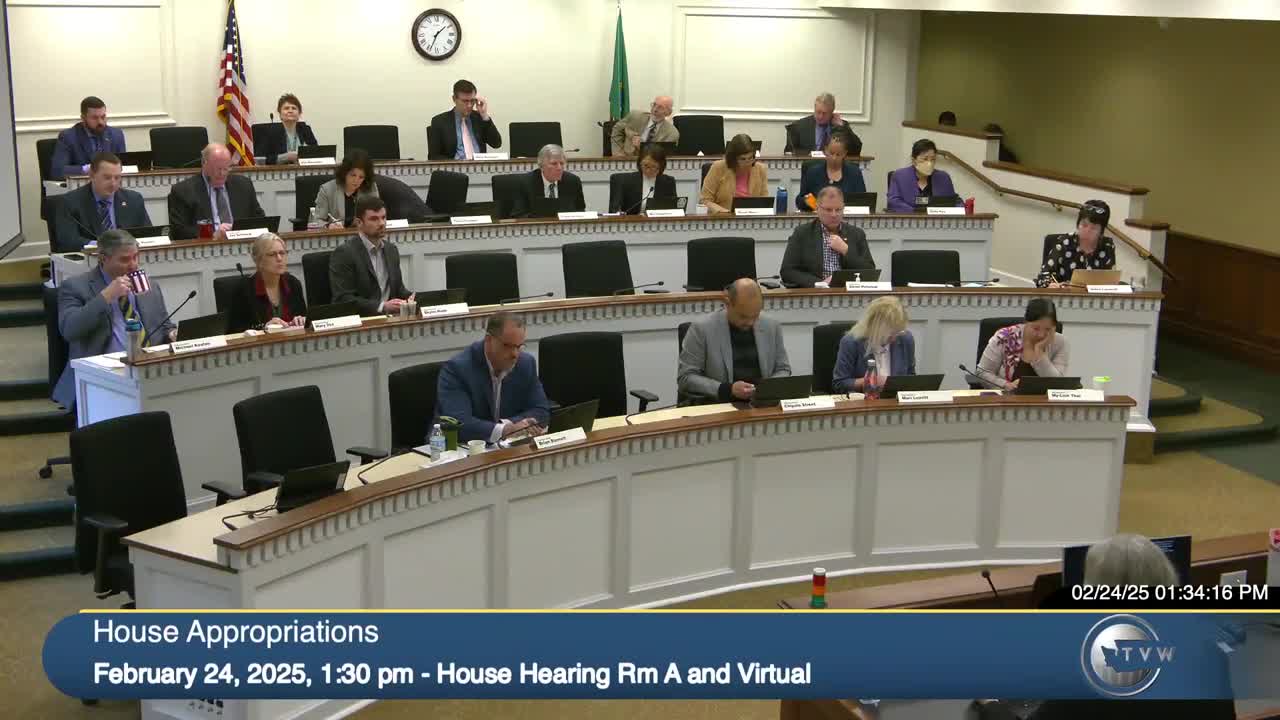
House committee hears staff and public testimony on proposed permit-to-purchase firearms law
Summary
The House Appropriations Committee heard a staff briefing and hours of public testimony Tuesday on substitute House Bill 11-63, a measure that would require a state permit to purchase firearms, mandate fingerprint-based background checks managed by the Washington State Patrol and set new training and recordkeeping requirements.
The House Appropriations Committee on Tuesday heard a staff briefing and more than an hour of public testimony on substitute House Bill 11-63, a proposal to establish a permit-to-purchase program and change rules for concealed pistol licenses.
The bill would require dealers not to transfer firearms unless a purchaser holds a valid permit to purchase firearms and would direct the Washington State Patrol (WSP) to conduct fingerprint-based background checks and issue or deny permits within statutory timelines. A permit would be valid for five years and renewable in five-year periods. The bill would also require the WSP to certify firearm-safety training programs and to annually verify that permit-holders remain eligible to possess firearms, revoking permits if not.
A staff summary by Edie Adams, staff to the House Civil Rights and Judiciary Committee, and fiscal briefing by Sydney Jefferey said a complete fiscal note for the substitute was not yet available. Agency illustrations in committee materials assume 600,000 permit applications across five years and projected primary fiscal impacts at the Washington State Patrol. Staff projected illustrative costs across agencies totaling roughly $14.6 million in the 2025–27 biennium and $21.3 million in 2027–29 under an earlier version; much of the up-front spending would be reimbursed to the general fund from program fees by June 30, 2028 if the substitute remains as drafted.
Public testimony split sharply. Supporters included survivors of gun violence and public-health researchers who said permit-to-purchase laws in other states have been associated with reductions in homicide, suicide and straw purchasing. Robert Schentrup of Brady urged the committee to "vote yes" and said gun violence costs Washington businesses and taxpayers billions of dollars annually. Dr. Cassandra Krafaci of the Johns Hopkins Center for Gun Violence Solutions described the policy as an "effective, life-saving policy." Several students and family members described personal experience or safety concerns and urged passage.
Opponents included the National Rifle Association's state director, A.O.B. Klein, who told the committee that Oregon's similar law has been tied up in litigation and that practical problems—such as fingerprint processing capacity and staffing—caused long delays in that state's implementation. Industry representatives and some small-business owners, including indoor range and gun shop owners, warned about training capacity for the required safety instruction and additional burdens on Washington State Patrol operations. Other public commenters argued the measure would be challenged in federal court on Second Amendment grounds.
Committee members asked staff whether other states use universal permitting systems (staff offered to follow up with comparative data) and about the bill's effective date and rulemaking timeline; staff said the substitute sets an effective date of Nov. 1, 2026, and that rulemaking timelines would depend on the State Patrol.
Because the hearing recorded only testimony and staff briefings, the committee took no final action Tuesday. The staff fiscal analyses and a table summarizing costs for agencies were made available to committee members and the public.
The bill would also require expanded Department of Licensing recordkeeping for firearms transfers, allow superior-court review of denials or revocations of permits and of certain firearms transfer denials, and direct law enforcement agencies to provide annual demographic reporting about permits to purchase and concealed pistol licenses.
If advanced, the State Patrol would be required to establish permit fees in an amount necessary to cover program costs and deposit those fees into the State Firearms Background Check System account. The substitute also requires that any amounts appropriated for initial establishment be reimbursed to the general fund from program fees by mid-2028.
Committee staff said they would follow up with additional comparative-state information and the final fiscal note for the substitute.
The committee moved next to other bills on its agenda following close of public testimony on HB 11-63.