Get Full Government Meeting Transcripts, Videos, & Alerts Forever!
Get email alerts on the School Wellness topic
No spam. Unsubscribe anytime.
County, MCPS and DHHS describe expanded school‑based mental‑health supports; officials point to data needs and budget pressures
Summary
MCPS and the Department of Health and Human Services updated a joint County Council committee on school‑based wellness: social work staffing and wellness centers have expanded, more students are being served, and the district and partners flagged needs for better tier‑1 services, student feedback, evaluation metrics and sustainable funding.
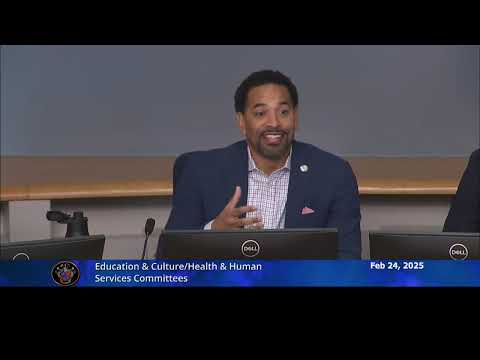
Montgomery County Public Schools and County Department of Health and Human Services officials told the County Council’s joint Education and Culture and Health and Human Services committees they have expanded school‑based mental‑health supports since the pandemic but that staffing, data and funding gaps remain.
The discussion covered the district’s student well‑being teams, a 42‑social‑worker program that serves 51 schools, Bridge to Wellness services in 19 high schools, six high‑school wellness centers and a range of partner contracts. Council members pressed staff on coverage gaps, evaluation methods linking mental‑health services to academic outcomes, cultural competency and how the district will sustain services when temporary federal funds expire.
Damon Motziloni, associate superintendent for the Office of Well‑Being and Student Services, described an “integrated mental health framework” that routes referrals through school‑level student well‑being teams and matches students to tiered supports. He said student well‑being teams — formed early in the pandemic to locate unengaged students — now operate as a hub for school‑level triage and coordination and include pupil personnel workers, school psychologists, social workers, counselors and other school staff.
MCPS and partner data presented to the committees: more than 1,100 direct referrals to date this school year; 549 students served by well‑being social workers and 507 served by Bridge to Wellness programs; 13 students served through private insurance; and 29 students who were referred declined services. MCPS said students identifying as female account for roughly 60% of social‑work clients; 42% of social‑work clients identify as Hispanic/Latino and about 31% as Black. The district reported that 32% of its social workers are bilingual, primarily Spanish.
Officials emphasized progress: MCPS said its social‑work unit has no vacancies and has grown with ESSER and other funding streams; the district also highlighted partnerships with nonprofit providers (Jessa, Thrive Behavioral Health, Shepherd Pratt and others) that extend services into schools described as mental‑health “deserts.” The JED Foundation, a national nonprofit, is working with the district to map services and build an annual accountability framework; MCPS said it will pilot a mental‑health screener this school year in 52 schools (grades 4, 7 and 10) and hopes to expand to all schools next year.
Committee members repeatedly raised implementation gaps. Councilmember Lukey described student reports of dispenser misuse and of students unwilling to seek help through building services; members pushed for student‑friendly feedback channels and greater clarity on which schools have which services. Several councilmembers asked for a clear list — by school — of which sites host wellness centers, Bridge to Wellness teams, linkages to learning, social workers or other services.
Officials also discussed sustainability: many positions were initially funded with federal ESSER dollars; the district said it has worked to move some staff onto the local base budget but that maintaining expanded services remains a budget challenge. Staff noted barriers to service delivery including workforce shortages, cultural and language competency gaps, parental consent processes and logistical constraints such as transportation. The Joint Committee asked for follow‑up on those gaps and for more analysis tying services to academic measures.
Councilmembers and staff identified several next steps rather than taking formal votes: MCPS and DHHS will provide an updated, school‑by‑school inventory of services; follow up with additional data requested by the Committees (including pre‑/post‑measures used by social workers and outcome analysis the Office of Student Accountability produced); clarify plans for the pilot mental‑health screener and for Medicaid billing readiness; and continue coordination with the JED Foundation and community partners.