Get Full Government Meeting Transcripts, Videos, & Alerts Forever!
Get email alerts on the Menstrual Products topic
No spam. Unsubscribe anytime.
Montgomery County schools say menstrual product dispensers installed; questions remain on feedback, reimbursement and gender‑neutral restrooms
Summary
MCPS told a joint County Council committee it has met state installation requirements for menstrual hygiene dispensers in elementary, middle and high schools but has outstanding questions about student feedback systems, reimbursements and coverage for gender‑neutral restrooms.
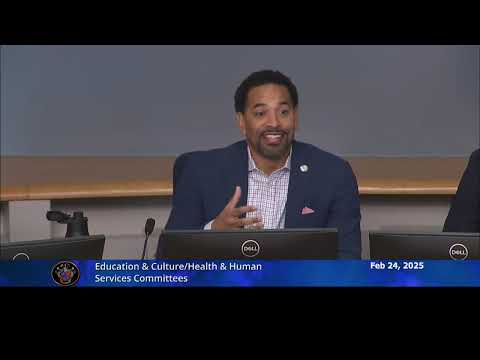
Montgomery County Public Schools officials told a joint meeting of the County Council’s Education and Culture Committee and the Health and Human Services Committee that they have installed menstrual hygiene product dispensers required by Maryland law but will return with follow‑up information on reimbursements, student feedback and dispenser access in gender‑neutral restrooms.
The update matters because Maryland Senate Bill 427, which took effect July 1, 2021, requires local boards of education to provide menstrual products in school restrooms at no charge. Committee members pressed MCPS staff on usage data, vending‑station QR codes and how the district is preventing misuse and ensuring access to all students who need products.
MCPS representative Mr. Mamoon told the committees that the district “has definitely met the April original guideline for 1 menstrual product dispenser in every elementary school as well as 2 in the middle and high schools.” He reported specific installation counts of 275 dispensers in middle‑school restrooms and 267 in high‑school restrooms and said every elementary school has at least one dispenser. He also said the district has received about $93,324 from the State for reimbursement but did not have a full accounting in the meeting for what purchases that covered.
Council staff summarized the state’s deadlines under SB 427: by Oct. 1, 2022 districts were required to install the initial dispensers in the number and locations specified; and by Aug. 1, 2025 dispensers must be installed in all secondary‑school women’s restrooms within a district. The staff memo also noted reimbursements tied to fiscal years (initial reimbursement claimable in FY23, and another reimbursement period ending Sept. 1, 2025, for FY26) and that ongoing product supply will be an operating expense for MCPS.
Committee members asked several operational and equity questions. Councilmember Lukey described repeated reports from students about vandalism and misuse — “Some people take them and just keep them. Others take them and … it’s essentially vandalism and abuse,” she said — and urged MCPS to consider how dispensers fit with education and school culture so students understand the purpose of the program. MCPS staff said restocking is performed weekly and that building services conducts routine inspections, but acknowledged some misuse has occurred and that schools are adjusting restocking frequency based on need.
Several members pressed for a student‑facing feedback channel so users can report an empty dispenser without needing to contact an adult. Mr. Mamoon said the dispensers will be QR coded so building services can identify location and product for restocking; he said about 35 schools in the Upcounty area still need QR labels and that the district is reviewing whether QR codes will route to an administrative form or a student‑accessible reporting page. Councilmembers suggested a simple Google form might be appropriate for students.
Members also asked whether dispensers installed in gender‑neutral restrooms meet the state law’s requirement to place products in “women’s restrooms,” and whether reimbursement requests to the state included work in converted gender‑neutral stalls. MCPS said it will review reimbursement submissions and confirm whether eligible work in gender‑neutral restrooms was included in claims already filed.
No formal action or vote took place during the discussion. MCPS agreed to provide written follow‑up to the Council office with detailed counts, clarification on the $93,324 reimbursement and the district’s plan for QR codes and any student‑facing feedback tool.
The committee scheduled additional follow‑up rather than taking any vote; members emphasized implementation that preserves student privacy and that considers gender‑inclusive restroom users in access planning.