
External auditor finds no material deficiencies; board approves finance and construction items
Get AI-powered insights, summaries, and transcripts
Subscribe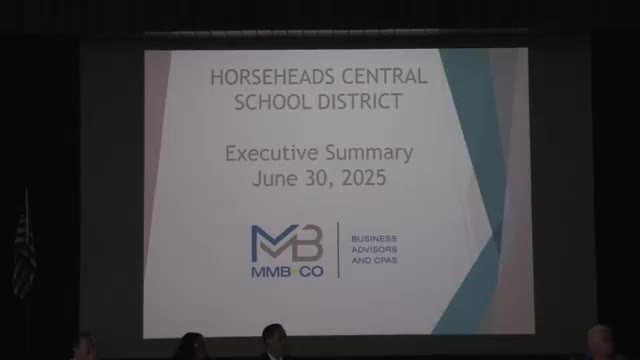
Summary
External auditors told the Horseheads Central School District board its financial statements are fairly stated with no material weaknesses. Trustees approved a package of finance and construction items and discussed reserves, long-term liabilities and a $169 million retiree health obligation shown on the entity-wide statement.
The Horseheads Central School District’s external auditor on Sept. 18 told trustees the district’s financial statements were fairly stated and that auditors found no significant deficiencies in internal controls while highlighting several long-term obligations and reserve considerations.
Mister Zuber, the district’s external auditor, briefed the board on the 2024–25 audit and said the financial statements received the opinion the board should expect. He noted revenue and expense variances, use of fund balance to balance the 2024–25 budget, and an increase in fund balances this fiscal year.
Key figures discussed during the presentation included a $3.7 million appropriation of fund balance to support the 2024–25 adopted budget (the 2025–26 appropriation shown in the discussion is $3.1 million), a reported fund-balance increase of about $2.9 million for the year, and federal COVID-stimulus (ESSER) funds that tapered from roughly $2.7 million in 2024 to about $219,000 in 2025 as the federal program wound down. Zuber and board members also described an actuarial retiree-health obligation (other postemployment benefits) reported at roughly $169 million on the entity-wide statement; because New York State does not allow districts to fund that liability in the same way as other items, it appears on the entity-wide statement as a long-term obligation.
Zuber recommended the district examine reserve levels (including a possible health-insurance reserve) and continue monitoring short-term financing related to capital projects. He noted that deficits reported in the capital fund are common when short-term financing is used for major projects; such deficits are typically addressed when long-term serial bonds or other permanent financing are issued.
Following the audit presentation, the board’s audit and finance chairs summarized committee conversation and recommended board action: trustees voted on a set of finance and construction items. The board approved the series of consent and finance items listed on the agenda (items 7.03 through 7.18). During discussion trustees asked for clearer, routinely updated change-order summaries tied to the net project budget; administrators agreed to provide a quarterly facilities update listing change-order impacts relative to the total authorized project budget.
Trustees also approved personnel items listed on the agenda (8.02–8.04) and a set of business and contract items (9.02–9.11). Several trustees noted abstentions on specific personnel or business items were recorded in the meeting minutes.
Board members raised questions about long-term debt schedules tied to multi-year capital construction borrowing; administrators said cash-flow needs for upcoming construction are forecasted and that the district works with fiscal advisors to limit spikes to the local share as state building aid and borrowing are converted into amortized long-term debt.
Ending: The board accepted the auditor’s report, directed staff to provide clearer change-order-to-budget reconciliations for facilities projects and approved the finance, facilities and personnel items on the meeting agenda.