Get Full Government Meeting Transcripts, Videos, & Alerts Forever!
Get email alerts on the Abandoned Mine Lands Fund topic
No spam. Unsubscribe anytime.
Committee sends bill to floor to steer larger share of mine-license tax to abandoned mine lands fund
Summary
The Resources and Conservation Committee voted to advance House Bill H226, which would increase the share of the mine license tax dedicated to Idaho’s Abandoned Mine Lands Fund, add voluntary contributions, limit administrative spending from the fund and create a public advisory committee.
The Resources and Conservation Committee voted to send House Bill H226 to the floor with a "do pass" recommendation after a brief discussion on stabilizing Idaho’s Abandoned Mine Lands Fund.
Representative Dustin Manwaring, R‑District 29 of Pocatello, introduced the bill and said it "deals with the Idaho Mine License Tax and how it's distributed to the Abandoned Mine Land fund." He said the measure aims to stabilize the fund so "in down cycles we don't see the same pattern of ongoing expenditures depleting the fund."
Committee members and stakeholders focused on four main changes in the bill: redirecting a larger percentage of the state mine license tax to the Abandoned Mine Lands Fund; creating a mechanism for voluntary contributions to the fund; restricting the proportion of money that may be spent on management or personnel costs; and creating a public advisory committee with representatives from counties, state agencies, conservation groups and mining companies.
Benjamin Davenport, executive vice president of the Idaho Mining Association, described the fund's purpose and volatility. "The abandoned mine lands fund was created to assist in clean up of Idaho mine lands that were abandoned by mining generations from the past," Davenport said. He told the committee the mine license tax is a production tax equal to 1% of production and that "one third of that goes into the abandoned mine lands fund. We're asking to put 50% of that rather than one third." Davenport said revenue to the fund is highly variable depending on production and commodity prices.
Davenport and committee members gave examples of recent collections to illustrate variability: he said the fund received more than $700,000 in 2001, and that the five‑year average in recent years has been "somewhere in the neighborhood of... around $70,000 a year," with figures he cited of about $62,000 last year and higher amounts in earlier years. Davenport said that variability makes it difficult to rely on the fund for ongoing administrative costs and that the bill seeks to prioritize spending on reclamation projects.
Committee members pressed for detail on several points. Vice Chairman Shepherd asked how the bill defines a representative of "conservation interests" on the advisory committee; Davenport answered the slot was intended for a non‑governmental organization such as the Idaho Conservation League, Idaho Conservation Voters, sportsmen's groups, or a similar entity. Representative Boyle asked why the Office of Energy and Mineral Resources is listed on the advisory committee rather than the Department of Lands; Davenport said the executive branch seat was intended to give another branch of government input, and that the Department of Lands will manage the committee and funds.
Representative Vanderwouda asked whether advisory committee members would be compensated; Davenport said the board would be voluntary and advisory and that "there is no compensation." Davenport and Representative Manwaring said the bill would also require the Department to maintain a list of eligible abandoned mines, provide annual reporting of funds and expenditures, show progress on projects, and consult with the advisory committee to set priorities and reclamation plans.
Members also questioned recent fund expenditures. Representative Badri asked what the fund had been paying for if not reclamation; Representative Manwaring said analysis from legislative staff showed the fund's main expenditures over the past decade were "gross salary and wages, employee benefits, professional services and in earlier years maintenance and repairs," and that this bill is intended to ensure the money is spent primarily on eligible abandoned mine projects.
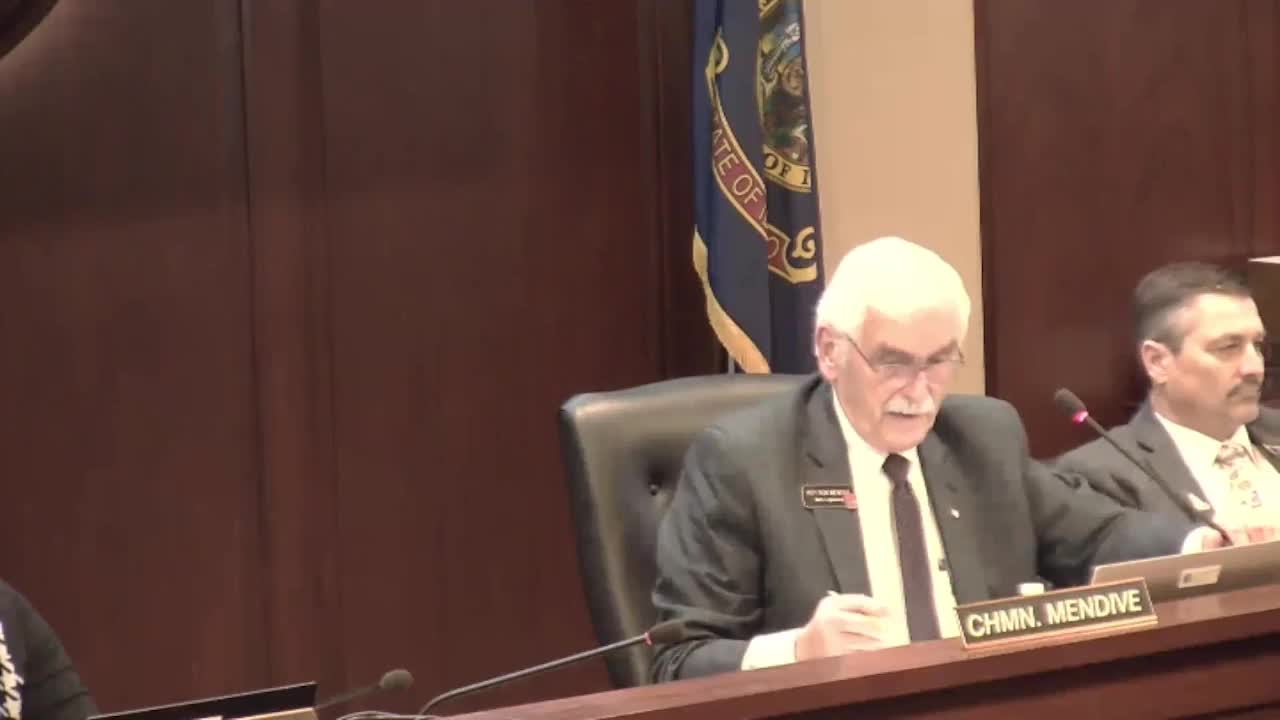
With no public testimony and no recorded roll‑call vote, Representative Mikkelsen moved to send House Bill H226 to the floor with a do‑pass recommendation. The committee approved the motion by voice vote; the chair announced, "Ayes have it." No individual vote tallies were recorded in the transcript.
The bill would change how the mine license tax allocation is calculated and add governance and reporting requirements; it now advances to the full body for additional consideration.
The committee briefed members on an informational flyer from the East Snake (Plain) Aquifer group available on the committee OneDrive, then adjourned.