Get Full Government Meeting Transcripts, Videos, & Alerts Forever!
Get email alerts on the Health Policy topic
No spam. Unsubscribe anytime.
Public Health Committee advances multiple health bills, defeats 988 telecom-fee funding proposal
Summary
The Oklahoma House Public Health Committee approved a series of bills on patient rights, workforce changes and facility rules on mixed votes and defeated a proposal to fund 988 crisis services with a 5¢ per-line telecom fee.
The Oklahoma House Public Health Committee on an extended agenda advanced multiple health-related bills on motions and recorded votes while rejecting a proposed telecom fee intended to sustain the 988 suicide and crisis lifeline.
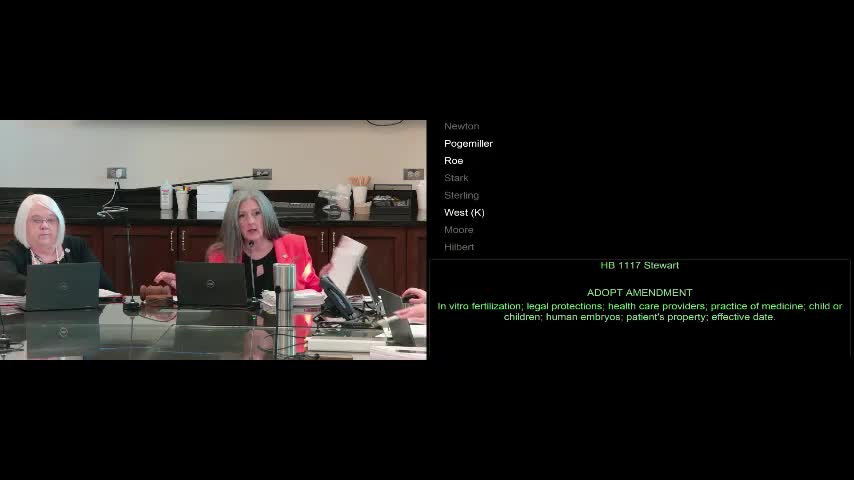
Representative Stewart presented House Bill 1117, a bill to allow in vitro fertilization (IVF) in Oklahoma and to define embryos created during IVF as the patient’s property. "House bill 1117 is simply a, bill that states that IVF ... the embryos created would be considered patient property by law, and that there is no number there is no cap on the number of embryos that can be created or frozen during a single, cycle," Representative Stewart said. The transcript includes no recorded committee vote on HB 1117 during this session.
The committee debated and voted on a range of other measures. Representative Sandoval’s proposal to place 988—the national suicide and crisis lifeline—in state statute and fund it with a 5¢ telecom fee per line per month was the meeting’s most contested item. Sandoval said the fee "would generate roughly $2,800,000 to cover the contract we have with Solari," and outlined that current federal funding (including ARPA and other federal appropriations) may not be guaranteed after 2026. After questions about how the fee would be assessed ("per phone line, not per address"), the committee voted 3 yeas to 5 nays and the bill failed.
Bills that passed include several patient- and workforce-focused measures. Representative Geis presented House Bill 1600, the "Lori Brandt patient bill of rights," which she described as codifying basic patient protections; the committee passed the bill by voice and recorded vote, 5 yeas, 1 nay. Geis acknowledged a constituent in the room: "I would like to honor my constituent Mr. Gerald Brand who's in the room today. He has worked tirelessly on this bill for many years to honor his late wife Lori Brand," she said after the vote.
Other committee actions: HB 2262 (Alzheimer’s disease special care disclosure improvements) passed 5–0; HB 1831 (community health worker recognition) passed 6–1; HB 1832 (expand authorized electronic monitoring to intermediate care facilities) passed 8–0; HB 1688 (streamline birth/death certificate amendments backlog) passed by a recorded vote of 68–0 in the committee record; HB 1812 (APRN supervision clarifications) passed 4–2 after amendment; HB 2298 (nurse practitioner statutory changes) passed 5–1; HB 1224 (medical conscience protections) passed 6–1; HB 1008 (replacement criminal statute relating to abortion) passed 5–1. The committee also approved bills on pharmacy technician training, food-truck licensing reform, managed-care regulatory alignment (removing Insurance Department oversight for certain Medicaid MCO functions), and temporary supervised licensure pathways for physicians who have not yet matched a residency slot.
Why it matters: the committee’s actions affect where and how Oklahomans receive care (patient-rights rules, electronic monitoring in residential facilities), how health workforces are regulated and supervised (APRN, PA, nurse practitioner statutory changes), and whether the state adopts a standalone funding mechanism for 988. The defeated telecom-fee proposal leaves the funding picture for 988 unresolved; committee discussion noted existing federal funds and the risk of service interruption if state-level support is not secured.
Votes at a glance (committee-recorded outcomes and tallies where provided) • HB 1117 (IVF; embryos defined as patient property) — motion recorded; committee vote not specified in transcript. • HB 2262 (Alzheimer’s special-care disclosure improvements) — Passed, 5 yea, 0 nay. • HB 1600 (Lori Brandt patient bill of rights) — Passed, 5 yea, 1 nay. • HB 1831 (Community health worker recognition) — Passed, 6 yea, 1 nay. • HB 1832 (Electronic monitoring authorization for intermediate care facilities) — Passed, 8 yea, 0 nay. • HB 1911 (988 statutory establishment and 5¢ per-line telecom fee) — Failed, 3 yea, 5 nay. • HB 2295 (rural hospital protections/licensure transition) — Passed, 8 yea, 0 nay. • HB 1008 (replacement criminal statute on abortion; penalties described in bill) — Passed, 5 yea, 1 nay. • HB 1688 (birth/death certificate amendment backlog) — Passed, 68 yea, 0 nay. • HB 1812 (APRN supervision clarifications; amendment adopted) — Passed, 4 yea, 2 nay. • HB 2298 (nurse practitioner statutory update) — Passed, 5 yea, 1 nay. • HB 1224 (medical right of conscience) — Passed, 6 yea, 1 nay. • HB 2052 (remove Insurance Dept. oversight for certain Medicaid MCO functions) — Passed, 6 yea, 0 nay.
What committee members asked for or directed: on 988, members sought detail on funding duration, whether the Department of Mental Health and Substance Abuse could assume funding, and the fee’s per-line assessment. On IVF and reproductive-legislation items members probed clinical scenarios and medical practice implications; presenters generally replied that decisions would be left to medical personnel or the patient as specified in the bills.
The committee record shows a daylong agenda with multiple request bills from state agencies, provider associations and members; several items were adopted as working PCS drafts before discussion. The committee chair closed the meeting after the final votes.