Get Full Government Meeting Transcripts, Videos, & Alerts Forever!
Get email alerts on the Education topic
No spam. Unsubscribe anytime.
Committee introduces bill to help districts cover extreme special-education costs
Summary
Representatives introduced RS 32437 to create a state backstop for very high special-education spending on individual students, with proposed caps and coordination with Medicaid; the measure was introduced for a full hearing.
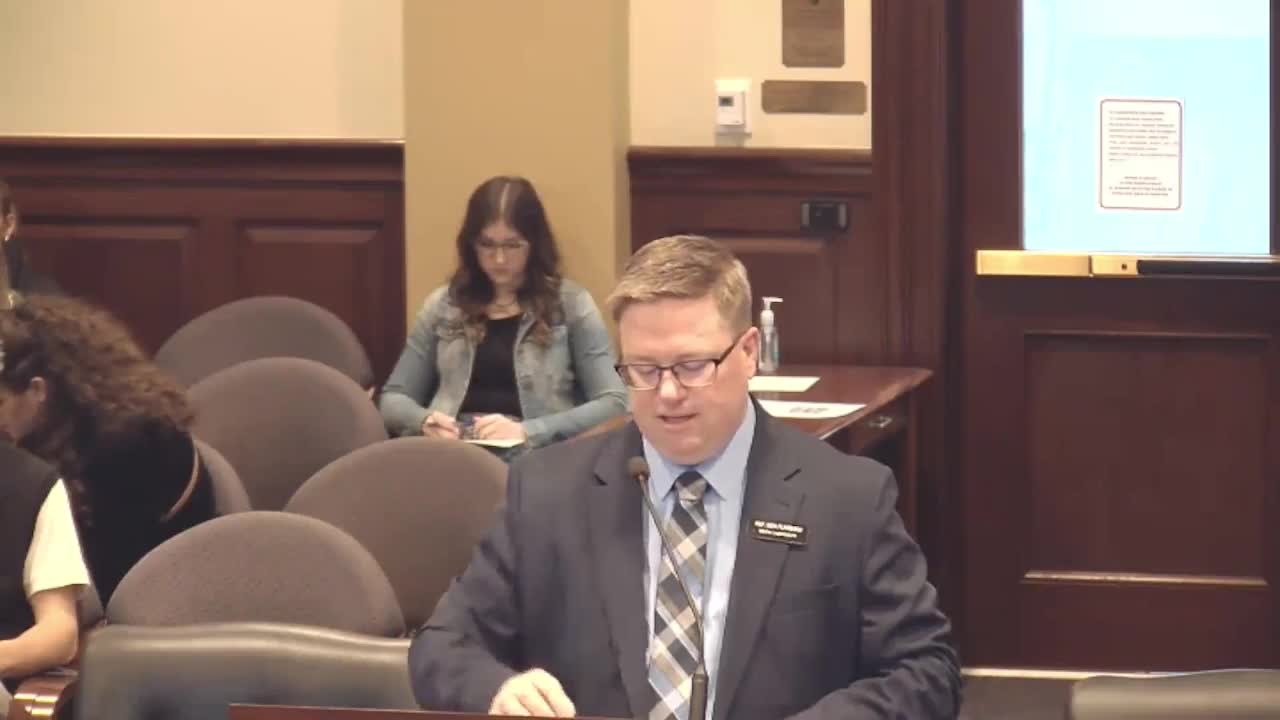
Representative Ben Furman of District 30 asked the House Education Committee to introduce RS 32437, a proposal to help school districts cover very large special-education costs for a small number of high-need students.
The bill targets the most expensive cases, Furman said, noting a statewide funding gap of about $80,000,000 for special education. Under the proposal, districts would absorb the first $15,000 of an individual student’s additional expenses; a state fund would contribute thereafter, and costs above $65,000 for an individual student would be split between the district and the state. Furman said each district would face a cap “roughly $150,000,” and that the bill’s initial statewide appropriation would be $3,000,000 as a starting point for a programmatic pilot.
W. Cutchfield, the state superintendent, told the committee the $3,000,000 figure is an estimate based on statewide data about the number of students who require full-time, one-on-one care. “It is an estimate,” Cutchfield said, adding the appropriation would be a place to start and that the line item would not be automatically distributed; districts would apply for funds after a student is enrolled. China Hirasaki, director of special education for the Idaho Department of Education, said typical special-education services (speech, counseling) are relatively inexpensive but that some students require medical care or full-time aides — for example, tracheostomy care or feeding-tube management — and those cases “can run upwards into the hundred-thousand dollar arena.”
Committee members pressed how RS 32437 would coordinate with other funding sources. Hirasaki explained the bill requires districts to seek other funding first, including Medicaid, which reimburses a portion of eligible school-based medical services but typically leaves a required local match near 30 percent. “If the school district encumbers an expense that is Medicaid reimbursable, it’s like they’re paying $10 up front … and getting reimbursed $7,” she said, describing the practical shortfall districts face. She noted some services — for example, American Sign Language interpreters — are not Medicaid-reimbursable and can cost $60,000–$70,000 for a single student depending on contract and geography.
Representative Tanner and others asked for more detail before a full hearing about how the $3,000,000 number was calculated and how applications would work; Cutchfield and Hirasaki said more data would be available at a hearing. Representative Sauter moved to introduce the RS for a full hearing and explained the measure responds to situations in which districts must assign full-time staff to single students, creating a significant budgetary burden.
The committee approved the motion to introduce RS 32437. Representative Harris was recorded as voting no; the motion otherwise carried and the RS will be scheduled for a full hearing where members requested further fiscal and operational information.
The measure as described would not change Medicaid policy; committee members repeatedly noted the proposal depends on existing Medicaid and local budgeting rules and that the appropriation is intended as a targeted state supplement, applied for after enrollment in district schools.