Get Full Government Meeting Transcripts, Videos, & Alerts Forever!
Get email alerts on the SB125 CAT Exemption For Public Payer Healthcare Receipts topic
No spam. Unsubscribe anytime.
Committee hears healthcare providers and education advocates on SB 125 CAT exemption; supporters cite access risks, opponents urge revenue neutrality
Summary
The Senate Committee on Finance and Revenue heard testimony Feb. 24 on SB 125, which would exclude reimbursements from Medicare, Medicaid and several other public payers from Oregon's corporate activities tax; clinicians and business groups urged passage and education groups urged revenue neutrality.
Chair Meek opened the public hearing on Senate Bill 125 following the Legislative Revenue Office briefing and directed staff to summarize the bill.
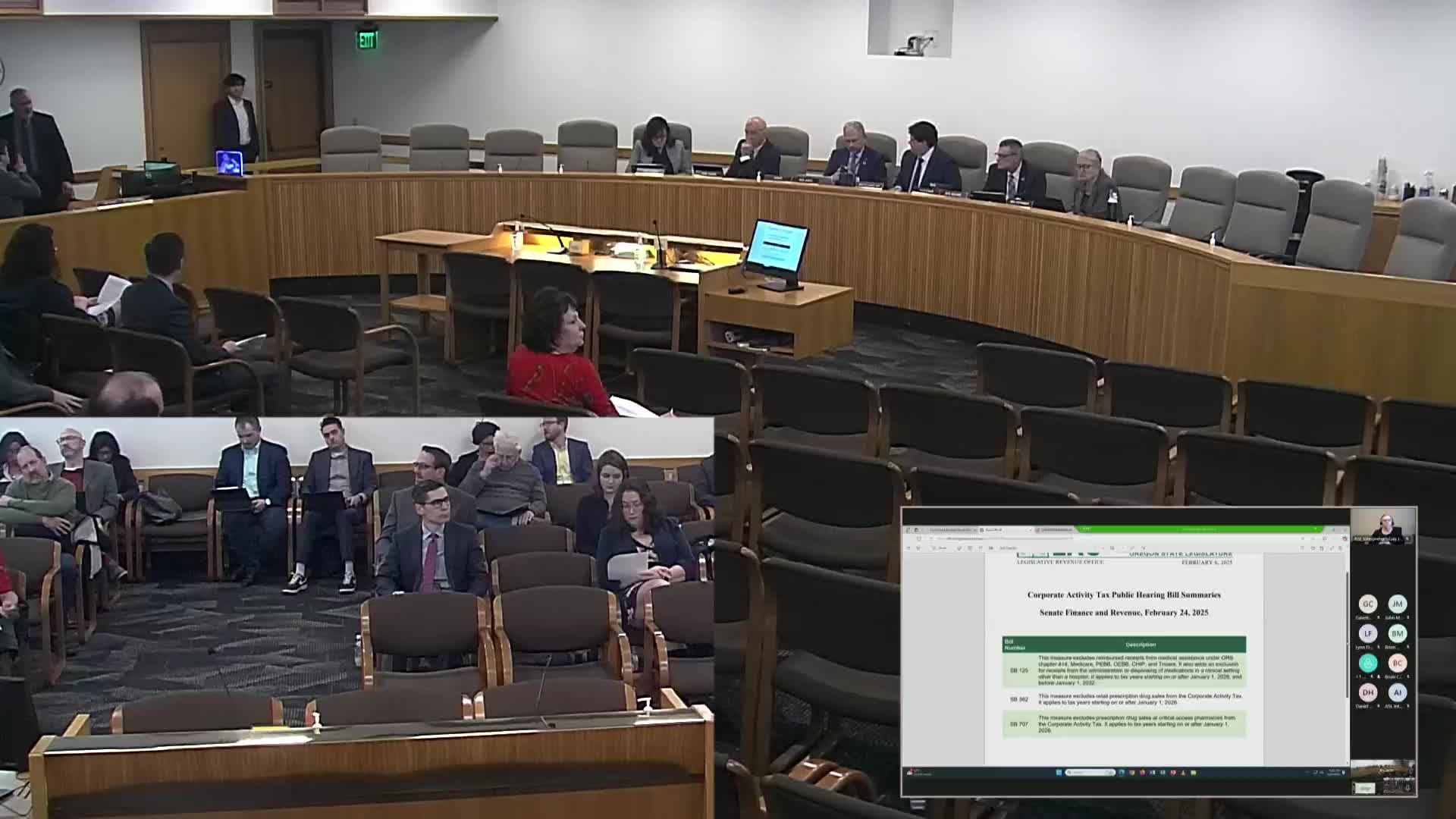
Staff summary: A committee staff summary explained that Senate Bill 125 would exclude from the corporate activities tax (CAT) reimbursement receipts from medical assistance under ORS chapter 414 (medical assistance), Medicare, the Public Employees' Benefit Board (PEBB), the Oregon Educators Benefit Board (OEBB), the Children's Health Insurance Program (CHIP), and TRICARE. The staff summary said the bill also would add an exclusion for receipts from administration or dispensing of medications in a clinical setting other than a hospital. SB 125 would apply to tax years starting on Jan. 1, 2026, and end before Jan. 1, 2032. Staff also placed two related bills on the table for the committee's schedule: SB 382, which would exclude retail prescription drug sales receipts from the CAT for tax years beginning on or after Jan. 1, 2026, and SB 707, which would expand an existing exemption for pharmacies with fewer than nine locations to include critical access pharmacies; SB 707 also would take effect on or after Jan. 1, 2026.
Supporters' testimony: Dozens of witnesses, primarily representing independent medical practices, trade associations and business groups, testified in favor of SB 125. Many said the CAT creates a financial strain because public payers' reimbursements (Medicare, Medicaid and similar programs) are often below the cost of delivering care and the CAT applies to gross receipts generated when clinics purchase expensive medicines or provide treatments. Several witnesses said clinics cannot pass the CAT on to patients when reimbursement rates are fixed by public payers.
- Dr. Alicia Soltz, a family medicine physician with Northwest Primary Care and representing the Oregon Independent Medical Coalition, said her physician-led group cares for roughly 32,000 patients, about 30% of whom are on Medicare or Medicaid. She said smaller independent clinics operate at a deficit treating government-insured patients because reimbursements are below costs and that SB 125 would help maintain continuity of care and preserve clinic employment.
- Dr. John Schuler, a radiation oncologist at Compass Oncology in Portland, described independent oncology practices as less costly venues for chemotherapy and radiation than hospital outpatient departments and said 2024 CAT liability at Compass was $644,000. He warned the CAT could force independent practices to restrict government-insured patients or cut unreimbursed services like navigation and social work.
- Dr. Brian Chankai, a retinal specialist with iHealth Northwest, and other specialists testified that costly specialty drugs inflate gross receipts while profit margins on many government-insured patients are thin or nonexistent; he said retina doctors in his office had a CAT bill of over $500,000 last year for just five retina physicians.
Trade and business voices including the Oregon Medical Association, Oregon Business & Industry, and the Oregon State Chamber of Commerce also urged the committee to support the exemption, saying the CAT has unintended effects on access to care and that independent providers face supply-chain and labor pressures.
Opponents and conditional supporters: Education associations and school boards said removing revenue from the CAT without offsets would reduce funds available for schools. Louis DeSitter of the Oregon Education Association referenced a prior analysis indicating a similar exemption could reduce CAT revenue by roughly $35 million in the prior biennium and said that would translate into cuts in counselors, literacy programs and early childhood education. Adrienne Anderson of the Oregon School Boards Association made similar points and said OSBA opposes SB 125 unless the change is made revenue neutral. John Calhoun of Tax Fairness Oregon and the Oregon Education Association signaled that if the committee wants to advance an exemption, it should do so with offsets; Calhoun suggested reducing the 35% subtraction as a funding source.
Other perspectives: SEIU Local 503 said it was sympathetic to providers but would be neutral on an amendment making the measure revenue neutral. Laurie Kimmel, a retired veteran from rural Oregon, described pharmacy closures and said the CAT had harmed access in some rural communities; she said Kroger no longer takes TRICARE in her area and that local pharmacy choice has narrowed.
Committee process and next steps: Committee members asked questions of witnesses; Chair Meek said the committee would continue discussion and reschedule further hearings on SB 382 and SB 707. After closing the public hearing on SB 125, Vice Chair McLean moved to introduce Legislative Concept (LC) 4,464 as a Senate Finance and Revenue Committee bill for 2025 and later moved to introduce LC 4,283; the committee approved both introductions with no objections recorded.